Punjab Introduces Cap on Private School Fee Hikes, Sparks Debate on Education Affordability
Bengaluru | June 8, 2026
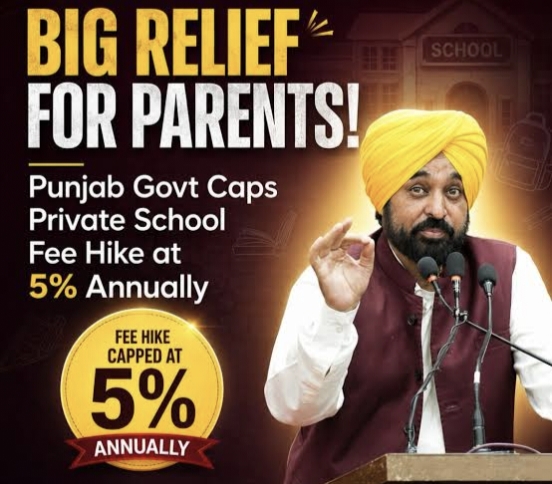
The Punjab government has announced a new policy aimed at regulating fee increases in private schools. Chief Minister Bhagwant Mann stated that annual fee hikes by private schools will be capped at 5 percent across categories including tuition, transport, and development charges.
According to the announcement, schools that collected fees beyond the prescribed limits during the previous three years may be required to issue refunds, subject to the provisions of the new legislation. The government has also proposed penalties for violations, including possible regulatory action against institutions found to be non-compliant.
The decision comes amid growing concerns among parents regarding rising education costs. Public discussion around school fees intensified following reports related to a Class 12 student in Amritsar whose death was allegedly linked to financial pressure associated with educational expenses.
The policy has generated mixed reactions. Parent groups and consumer advocates have welcomed the move, arguing that greater regulation is necessary to ensure affordability and prevent arbitrary fee increases. Supporters believe the measure could provide relief to families facing increasing educational expenditures.
Private school management bodies, however, have expressed concerns regarding the impact of a fixed cap on institutional finances. Representatives from the sector have argued that operational expenses, including staff salaries, infrastructure maintenance, and inflation-related costs, may exceed the permitted increase in some cases.
Education policy experts note that several states have attempted to regulate private school fees through different mechanisms. They suggest that the effectiveness of Punjab’s approach will depend largely on implementation, transparency, and the availability of mechanisms to balance affordability with educational quality.
The development has also prompted discussion on whether similar measures should be considered in other states. While some observers view Punjab’s policy as a possible model for fee regulation, others argue that any future framework should account for regional conditions, operational costs, and institutional diversity.
As the policy moves toward implementation, stakeholders across the education sector are expected to closely monitor its impact on schools, parents, and students.