Renewing Mumbai: The Rising Importance of Redevelopment in a Land-Constrained Metropolis
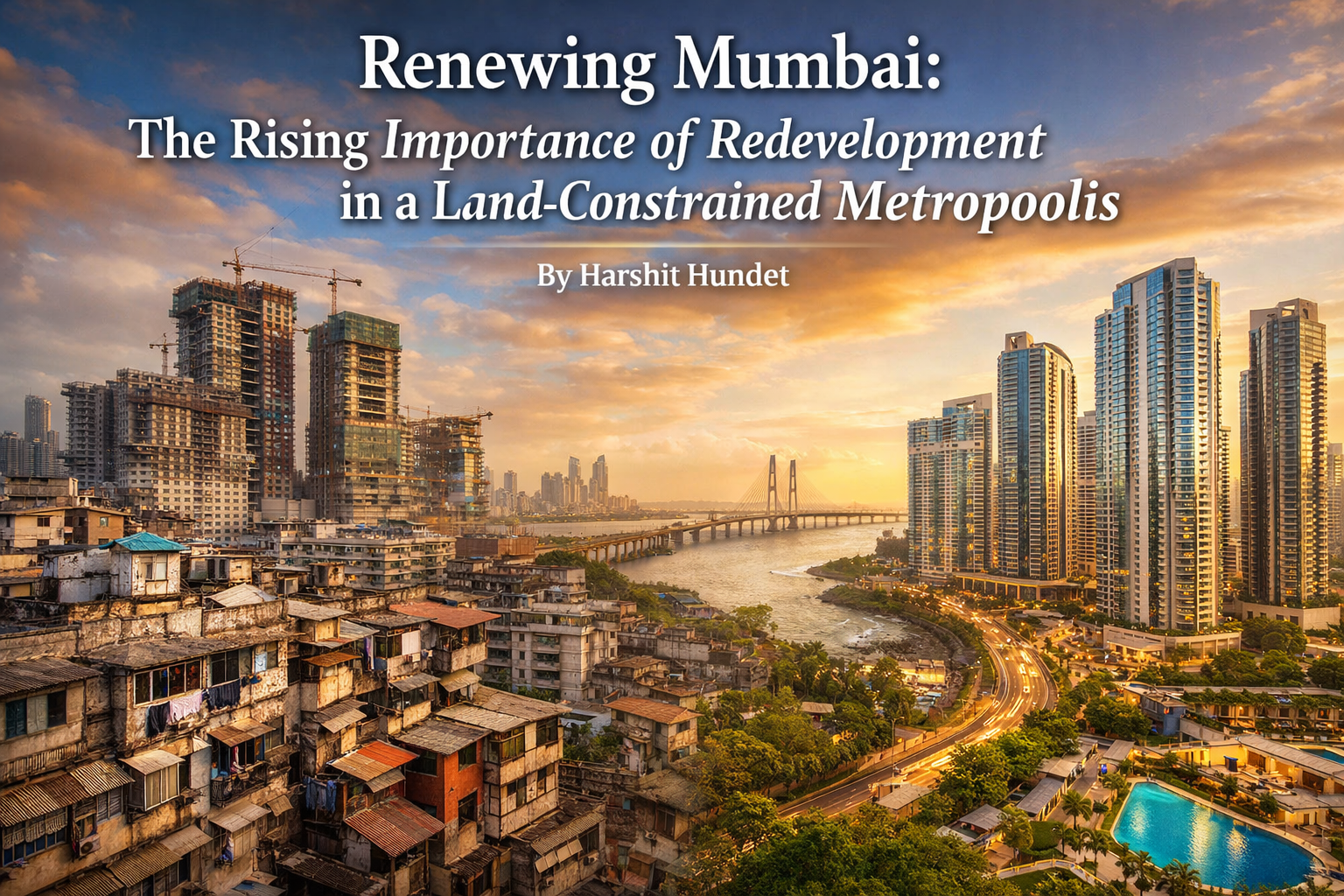
Mumbai has long been recognised as India’s financial nerve centre—a city defined by aspiration, resilience, and relentless urban momentum. Yet the city’s growth has always been accompanied by a critical constraint: limited land availability. With the Arabian Sea on one side and dense urbanisation on the other, Mumbai cannot expand endlessly outward like many other metropolitan centres. Consequently, the future of the city increasingly depends on how intelligently it reinvents the spaces it already occupies.
Within this context, redevelopment has emerged as one of the most practical and forward-looking strategies for shaping Mumbai’s urban landscape.
Across the city, numerous residential buildings constructed several decades ago are gradually ageing beyond their structural and functional relevance. Many of these buildings were designed during a period when population density, infrastructure expectations, and lifestyle standards were vastly different from those of today. As a result, several housing societies now face issues ranging from outdated infrastructure to limited amenities and safety concerns.
Redevelopment offers an opportunity not simply to rebuild, but to reimagine urban living environments.
Modern redevelopment projects replace ageing structures with safer, technologically advanced buildings designed for contemporary lifestyles. These new developments typically introduce improved structural safety, enhanced ventilation, better natural lighting, and modern facilities such as landscaped open spaces, community areas, wellness amenities, and upgraded security systems. For residents, redevelopment often means transitioning from ageing infrastructure into modern living environments without leaving the neighbourhoods they have long called home.
At a broader urban level, redevelopment also enables more efficient land utilisation. By optimising existing plots and upgrading outdated infrastructure, the process helps cities accommodate growing populations without expanding into scarce land reserves. In a high-density city like Mumbai, such optimisation is essential for maintaining both urban functionality and environmental balance.
During our conversation on the evolving redevelopment landscape, we spoke with Mr. Kaling Porwal, Managing Director of Downtown Lifespaces, who highlighted the transformative potential of redevelopment projects in shaping the future of the city.
“Redevelopment is fundamentally about improving how communities live. In cities like Mumbai where land availability is extremely limited, redevelopment provides an opportunity to revitalise older neighbourhoods through modern design, stronger construction standards, and upgraded infrastructure. When executed thoughtfully, redevelopment not only enhances the living experience of residents but also contributes positively to the long-term growth and resilience of the city.”
Urban planning experts also recognise redevelopment as a critical strategy for land-scarce metropolitan regions. Architect Ar. Anubha Ashtikar (B.Arch, M.Arch – Sustainable Architecture) explains that redevelopment allows cities to transform ageing structures while improving sustainability and infrastructure efficiency.
“In densely populated cities where urban land is both limited and highly valuable, redevelopment provides a practical pathway for urban renewal. Instead of expanding the city’s physical footprint, redevelopment focuses on making better use of existing land parcels by replacing ageing or structurally inefficient buildings with safer, more efficient and environmentally responsible developments. For cities such as Mumbai, redevelopment enables the unlocking of additional Floor Space Index (FSI), which can improve infrastructure capacity and increase housing availability without requiring new land. Importantly, modern redevelopment projects also present opportunities to integrate sustainability—through improved daylighting, enhanced ventilation, water-efficient systems and renewable energy solutions. Another positive dimension is the potential for circular construction practices. Materials recovered from older structures—such as steel, concrete components or fixtures—can often be recycled or reused, thereby reducing overall construction waste. While redevelopment may involve temporary disruption during the construction phase, the long-term benefits—safer buildings, higher property value, efficient land utilisation and stronger urban resilience—make it a highly practical strategy for future-ready cities.”
Indeed, redevelopment is increasingly being viewed not merely as a real estate activity but as a broader instrument of urban renewal. By modernising infrastructure, improving building safety, and integrating sustainable architectural practices, redevelopment contributes to a more resilient and efficient urban environment.
For residents, the advantages often include safer homes, upgraded amenities, and enhanced property value. For the city itself, redevelopment supports smarter land utilisation while preserving the social character of long-standing neighbourhoods.
As Mumbai continues to evolve as one of the world’s most vibrant financial capitals, redevelopment will remain a key element in shaping its future skyline. With responsible developers, collaborative housing societies, and thoughtful urban planning, redevelopment has the potential to transform ageing neighbourhoods into modern, sustainable communities.
In a city where space is limited but aspirations remain boundless, redevelopment stands as one of the most powerful pathways toward a stronger, more liveable, and future-ready Mumbai.