




Silent Service, Silent Suffering: The Plight of Indian Veterans in Qatar’s Defence Sector
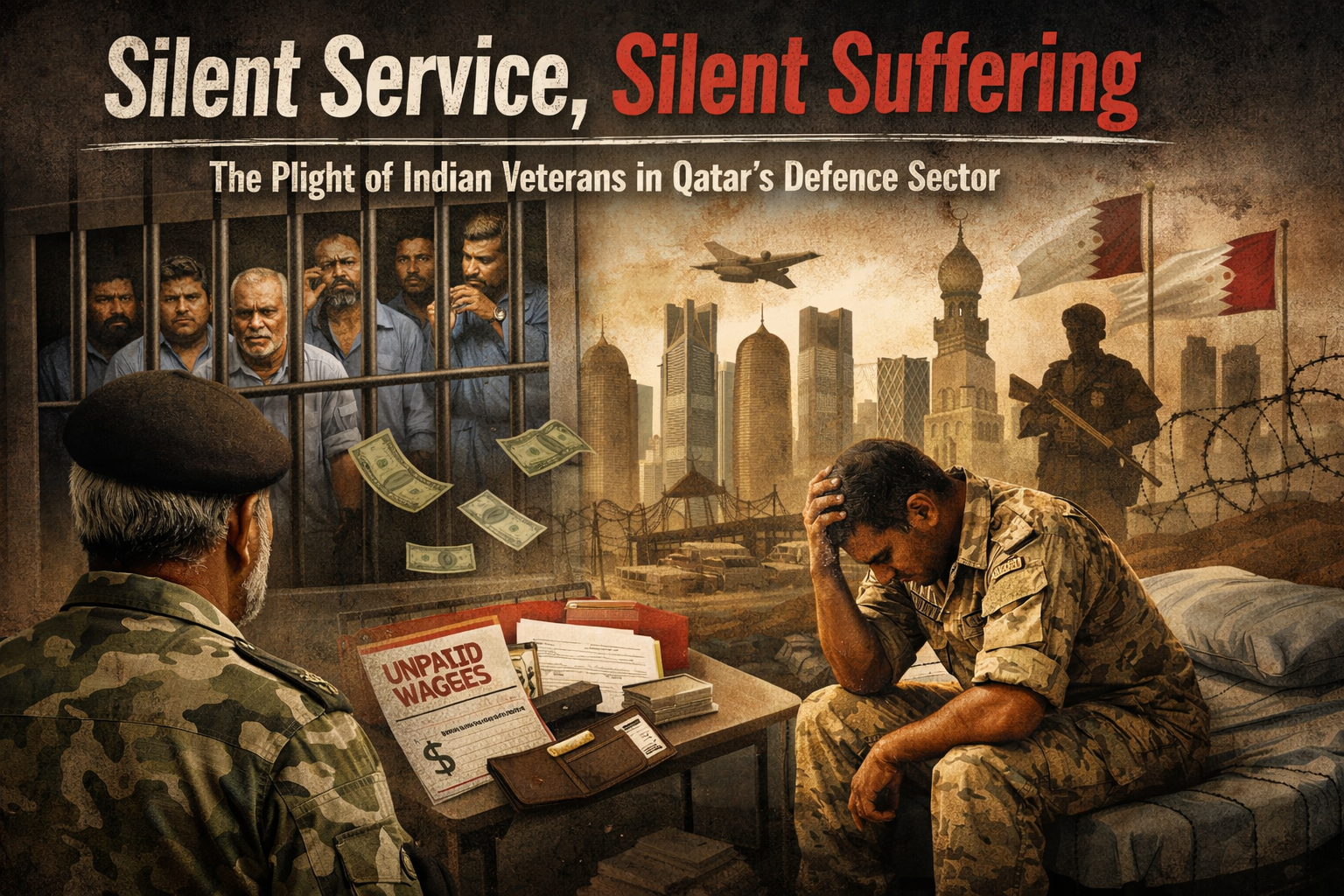
*When Veterans Become Vulnerable Abroad*
India must regulate overseas defence employment to protect ex-servicemen and national security
The transition from military service to civilian life is rarely seamless. For many retired personnel of the Indian armed forces, financial obligations and limited domestic opportunities compel them to seek employment abroad. Among the most attractive destinations is Qatar, where defence-related roles offer significantly higher remuneration. Yet, recent developments reveal that these opportunities often come at a steep and unforeseen cost.
The predicament of Indian veterans employed in foreign defence establishments has exposed a troubling intersection of legal vulnerability, financial exploitation, and national security risk—issues that demand urgent policy attention.
*The promise and the peril*
Private recruitment agencies have emerged as key facilitators of overseas placements for ex-servicemen. These agencies connect retired personnel with foreign firms engaged in military training, logistics, and technical consultancy. While the financial incentives appear attractive, the absence of regulatory oversight often leaves recruits inadequately informed about the nature and risks of their assignments.
The lack of a structured government clearance mechanism allows individuals with sensitive operational knowledge to enter foreign defence ecosystems without sufficient safeguards. This regulatory vacuum has far-reaching consequences—not only for the individuals concerned but also for India’s strategic interests.
*Legal uncertainty in foreign jurisdictions*
The detention of former Indian Navy personnel in Qatar in 2022 brought these risks into sharp focus. Accused under opaque circumstances and subjected to prolonged incarceration, the individuals faced severe legal consequences, including death sentences that were later commuted. The episode highlighted systemic concerns: limited transparency in judicial proceedings, restricted access to legal counsel, and delayed consular intervention.
Such incidents underscore the precarious position of Indian nationals operating in sensitive sectors abroad, where legal frameworks differ significantly and due process may not align with expectations shaped by India’s democratic institutions.
*The quieter crisis: Financial exploitation*
Beyond high-profile legal cases lies a less visible but equally serious concern—financial exploitation.
Many veterans report discrepancies between promised and actual employment terms. Contracts are often vaguely worded, allowing employers to alter salary structures, delay payments, or impose arbitrary deductions. In some cases, wages are withheld for extended periods, leaving employees financially stranded in a foreign country.
The problem is compounded by the absence of institutional safeguards. Unlike their service years in India, these individuals lack access to structured benefits such as insurance, pension continuity, or legal protection. Families back home, dependent on remittances, are left vulnerable when income streams become uncertain.
A particularly concerning trend is the emergence of debt traps. Prospective employees frequently incur significant expenses—including recruitment fees and travel costs—often financed through loans. When employment conditions deteriorate or contracts are terminated prematurely, repayment becomes a burden, pushing families into financial distress.
*Unregulated intermediaries*
The role of recruitment agencies warrants closer scrutiny. Operating in a loosely regulated environment, many agencies prioritise placement volumes over due diligence. Information asymmetry is common: recruits are not fully apprised of job responsibilities, legal risks, or geopolitical sensitivities.
Crucially, these agencies bear little accountability once the candidate is deployed. In the absence of enforceable standards, the burden of risk falls disproportionately on the individual.
*Implications for national security*
The issue extends beyond labour rights into the domain of national security. Retired military personnel possess valuable expertise in strategy, technology, and operations. Their unregulated employment in foreign defence sectors raises the possibility of unintended knowledge transfer.
Moreover, in a geopolitically sensitive region such as the Gulf, individuals may become vulnerable to coercion or wrongful implication in security-related cases. Such situations not only endanger the individuals involved but can also strain diplomatic relations and create leverage points in international negotiations.
*A case for policy intervention*
India must adopt a comprehensive framework to address these challenges.
First, overseas defence-related employment for ex-servicemen should be subject to mandatory government clearance, ensuring that both individual and national risks are assessed. Second, recruitment agencies must be brought under a strict regulatory regime, with licensing requirements, transparency norms, and legal accountability.
Third, bilateral agreements with host countries should be strengthened to guarantee due process, consular access, and labour protections for Indian nationals. Financial safeguards—such as standardised contracts, escrow-based salary systems, and mandatory insurance—must also be instituted.
Finally, expanding domestic employment opportunities for veterans would reduce dependence on overseas placements. Structured rehabilitation programmes and public-private partnerships can play a critical role in this regard.
*Beyond service, beyond borders*
The challenges faced by Indian veterans abroad reflect a broader policy gap. While their skills remain globally respected, their protection does not extend with equal certainty beyond national borders.
Ensuring their safety and dignity is not merely a matter of welfare—it is an obligation rooted in national responsibility. In an increasingly complex geopolitical landscape, safeguarding those who once safeguarded the nation must remain a priority.



3 Comments
shwecasino
April 13, 2026Shwecasino caught my eye. Different vibe, worth exploring if you’re looking for something new. Good luck playing at shwecasino
111kab
April 13, 2026Okay, folks, so I checked out 111kab and, honestly, it’s pretty decent. Nothing too flashy, but it gets the job done. I’d say give it a look if you’re interested in what they’re offering. Check it out here: 111kab
33wincom
April 13, 2026Yo, heard about 33wincom? Feels like a solid place to chill and try your luck. Good vibes so far. Check ’em out 33wincom.