Supreme Court Has Clarified That Scheduled Caste Status Is Forfeited Upon Conversion To Christianity
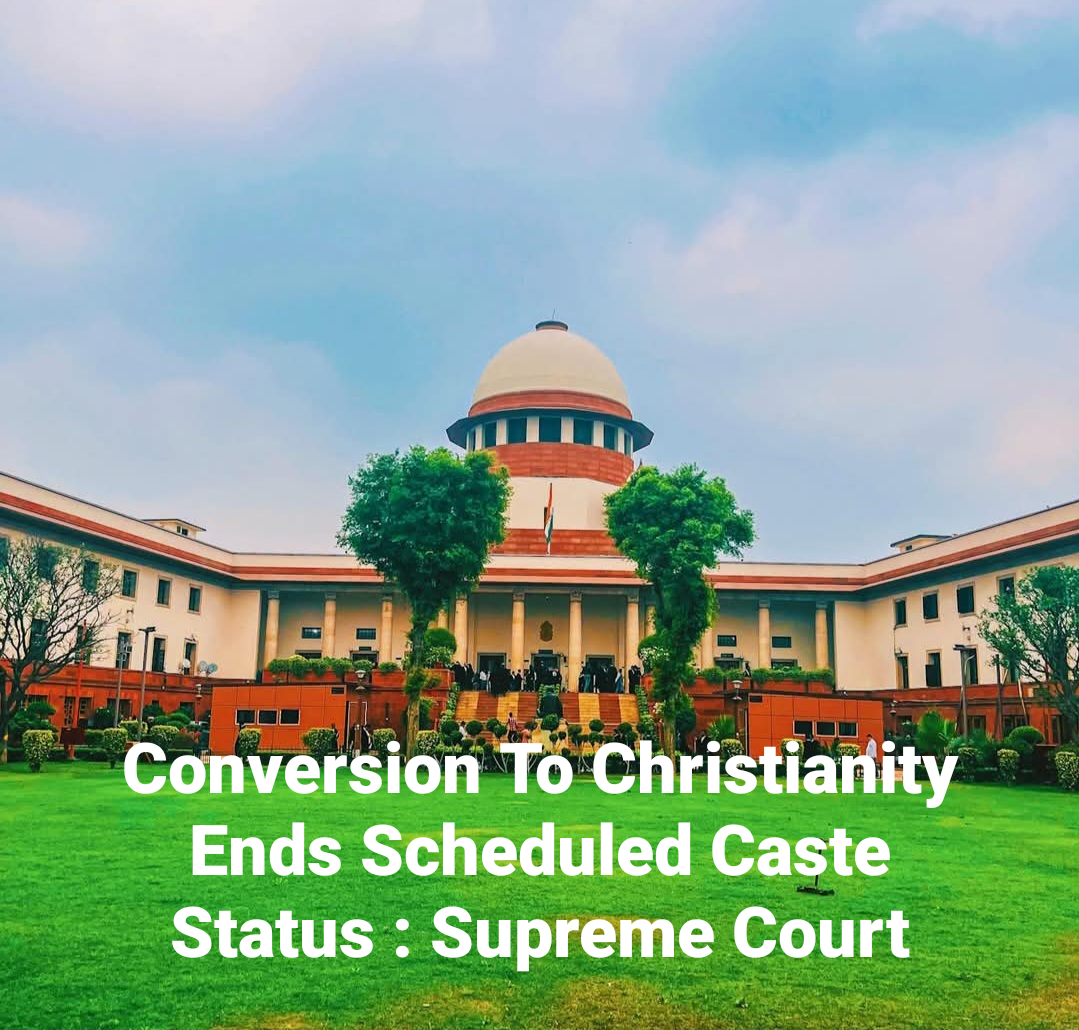
New Delhi, March 24, IPU Media Update News: Only Hindus, Buddhists, and Sikhs are eligible for Scheduled Caste (SC) status. The Supreme Court has clarified that even if individuals convert to another religion, they will not retain their SC status. The Supreme Court made these observations today while hearing a case originating from Andhra Pradesh. A Supreme Court bench declared that Dalits who convert to Christianity cannot avail themselves of benefits under the SC/ST Act.
Today, the Supreme Court delivered a significant verdict regarding the issue of caste status. The apex court explicitly stated that only Dalits belonging to the Hindu, Sikh, or Buddhist faiths are eligible to receive Scheduled Caste status. The Court noted that if individuals convert to a religion other than these three, they forfeit their status as Scheduled Castes. The Court made it clear that those who embrace Christianity are not entitled to Scheduled Caste status. Consequently, the Supreme Court observed that if a Dalit individual converts to Christianity, such an act would constitute a violation of the SC/ST Act. A bench comprising Justice P.K. Mishra and Justice Manmohan issued these directives while adjudicating a specific case. The Court ruled that if individuals convert to a religion other than Hinduism, Sikhism, or Buddhism, they forfeit their Scheduled Caste (SC) status.
The Supreme Court issued these directives while hearing a petition filed by Pastor Chindada Anand, a resident of Andhra Pradesh. The Andhra Pradesh High Court had delivered its verdict in this case in May 2025. In his petition, Pastor Chindada Anand alleged that he had faced caste-based discrimination at the hands of an individual named Akkala Ramireddy. The Pastor subsequently registered a complaint under the SC/ST Act. Acting on his complaint, the police registered a First Information Report (FIR). However, Ramireddy approached the High Court seeking to quash the case filed by Pastor Chindada Anand. In his verdict, Justice N. Harinath observed that Pastor Chindada Anand had lost his SC status by embracing Christianity, and consequently, ordered the quashing of the FIR. The Court held that a Dalit individual who propagates Christianity cannot seek legal redress under the provisions of the SC/ST Act.
The Court further stated that, as a result of his conversion to Christianity, the SC certificate held by Anand had become invalid. Challenging this verdict of the High Court, Anand subsequently moved the Supreme Court. However, the Supreme Court today delivered a verdict upholding the High Court’s judgment.
** Religious Conversion and SC Reservation: What Does the Law Say – ? **
A common doubt shared by many is: Does one retain reservation benefits if they convert from a Scheduled Caste (SC) to Christianity? Here are the constitutional facts regarding this matter:
** Current Legal Status **
* 1. Constitutional Order (1950):
According to the Constitution (Scheduled Castes) Order, 1950, of India, only individuals belonging to the Hindu, Sikh, and Buddhist religions are recognized as ‘Scheduled Castes’ (SC).
* 2. Religious Conversion and Reservation :
If an individual is born into a Scheduled Caste (SC) but subsequently converts to Christianity or Islam, they legally forfeit their ‘SC’ status. This is because, technically, it is deemed that caste-based discrimination does not exist within these two religions.
* 3. BC Status:
In the Telugu-speaking states (Telangana and Andhra Pradesh), individuals who convert from a Scheduled Caste to Christianity are generally recognized under the BC-C category. While SC reservation does not apply to them, they are entitled to the reservations allocated to the BC-C category, as well as other benefits designated for Backward Classes.
* Important Note :
Petitions seeking the extension of SC status to Dalit Christians are currently pending before the Supreme Court. To conduct a study on this matter, the Central Government has appointed the Justice K.G. Balakrishnan Commission. The existing law will remain in force until the Commission’s report is submitted and the court delivers its verdict.
— M Venkata T Reddy, News Editor and Investigative Journalist