Registration, Restriction, and the Illusion of Control
There was a time when the hills did not wait. They breathed, they opened, they received — not everyone, but those who arrived with a certain quietness. You did not enter the mountains; you were allowed into them. There were no gates, no checkpoints, no digital permissions — only a winding road and a slowing of the mind. Arrival was not processed; it was felt.
But something subtle has shifted. Today, before you reach the hills, you register. Before you experience them, you are counted. Before you arrive, you are already in a queue.
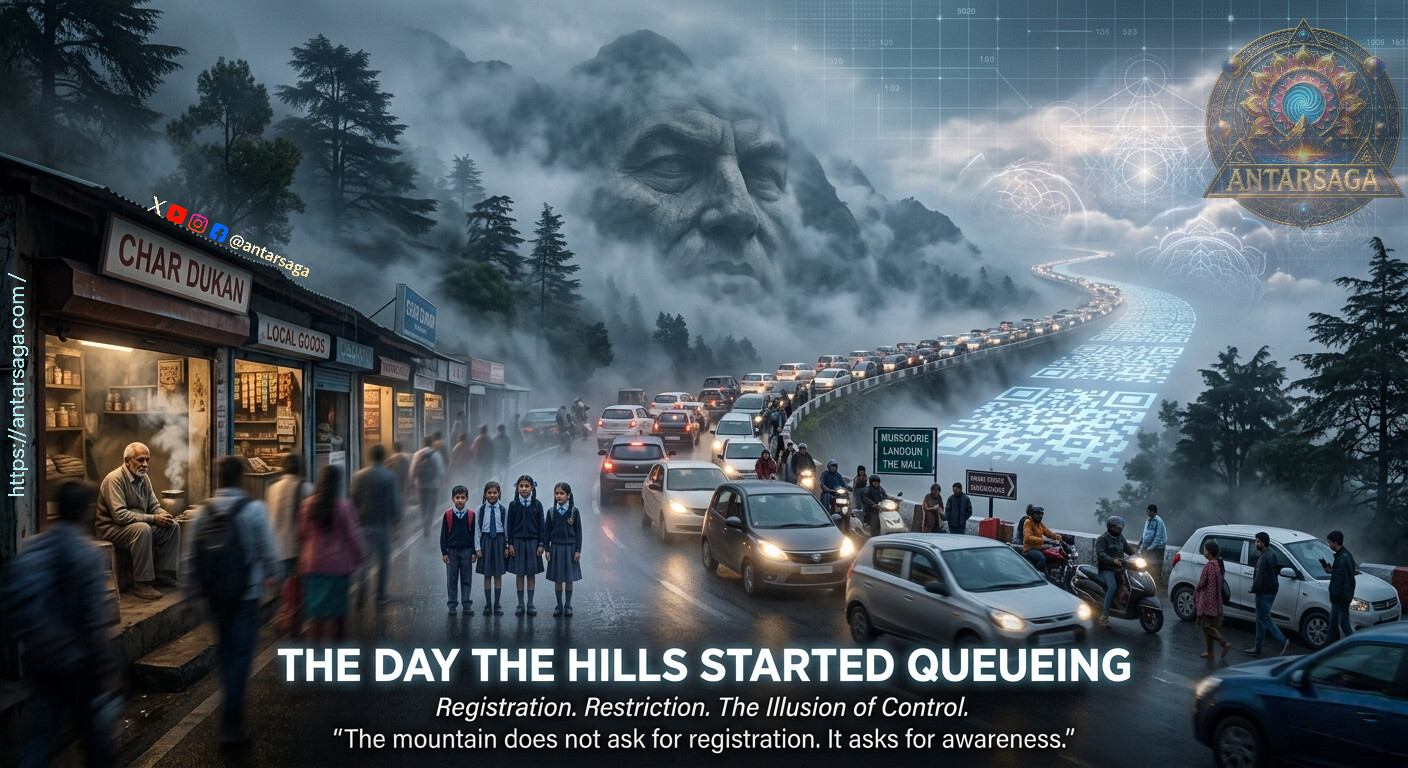
This change did not arrive abruptly; it unfolded with a logic we now call necessity. The roads began to choke, weekends stretched into endless congestion, and silence slowly gave way to the persistence of horns. In response, systems emerged. Mussoorie introduced mandatory tourist registration, attempting to measure and manage what had already exceeded its natural limits. Before that, the Char Dham Yatra had already transformed into a monitored movement — pilgrims registering, routes tracked, numbers controlled. Faith, like tourism, had to be organised.
And now, the control has begun to descend into the details. Spaces like Char Dukan and Lal Tibba — once quiet corners of Landour where time lingered — are beginning to feel the presence of regulation. What was once discovered through a walk is now accessed through a system. The mountain is no longer simply experienced; it is being administered.
On paper, this appears responsible. Perhaps even necessary. But beneath this necessity lies a quieter reality — one that the locals live every single day, long before it becomes policy language.
Because for the resident, the hills are not a destination. They are a life.
The same roads that carry tourists carry children to school, often forcing them to wait in rain and uncertainty while vehicles crawl endlessly. The same water that fills hotel tanks runs uncertain in local homes. And the same narrow lanes that once allowed people to walk, pause, and recognise each other have now been reduced to strained passages of movement.
For the local shopkeeper, the illusion of opportunity has replaced the reality of livelihood. Shops remain open longer, but not necessarily fuller. The crowd does not translate into customers — it becomes a passing current that rarely pauses. People arrive, but they do not stay. They photograph, but they do not participate.
In many stretches, even walking has become difficult. Congestion reduces visibility, accessibility, and time — the three silent foundations of any thriving local economy. What once encouraged strolling now demands navigation. And there is the exhaust — constant, low, unremarked — settling quietly into the lungs of those who cannot leave.
No business truly thrives in a place that cannot breathe.
And so the irony deepens. The economy appears active, but the ecosystem weakens. Presence is replaced by persistence.
We find ourselves trying to solve a problem that was not born out of absence of control, but absence of understanding. The hills were never meant to handle volume; they were meant to hold presence. But we brought speed into stillness, scale into fragility, and now we attempt to correct it with systems.
From an Advaitic lens, the mountain has not altered its nature; our way of seeing it has. We no longer approach it as a living presence, but as an experience to be consumed. And the moment something becomes consumable, it demands regulation.
The queue, then, is not just on the road. It is within the mind.
We queue because we are many, but also because we are restless. We arrive not to listen, but to take. And when taking becomes collective, it becomes pressure. When pressure builds, it becomes policy. And when policy expands, it begins to shape the experience itself.
But control has limits. Registration can count people, but it cannot expand a mountain. It can organise entry, but it cannot restore balance. It can create the appearance of order, while the deeper imbalance continues quietly beneath.
If this trajectory continues, the future is not difficult to imagine. Hill towns may soon operate on timed entry, controlled access zones, and monitored movement. Viewpoints may require slots. Roads may function less like journeys and more like corridors. The mountains may remain physically present, but experientially distant — efficient, regulated, and strangely detached.
And yet, even then, something essential will remain unresolved.
Because the question was never only about how many people came. It was about how they came.
The mountains do not resist presence; they resist excess without awareness.
In older ways of seeing, there was no separation between observer and landscape — no rigid division between tourist and local — only different expressions within the same field of existence. When this unity is forgotten, relationship becomes usage. And usage, when multiplied, becomes exploitation.
Perhaps this is why the locals feel it first. They live closest to the fracture.
They inhabit the space where the mountain is still real — not an idea, not an escape, but a living condition. And so they experience the tension most directly: between what the hills are, and what they are becoming.
The question, then, is not whether registration is right or wrong. It may be necessary. But it is not sufficient.
Because no system can replace sensitivity. No regulation can substitute respect. And no amount of control can restore a relationship that has already been reduced to transaction.
The day the hills started queueing was not the day a rule was introduced. It was the day we began to approach them without stillness.
The mountain does not ask for registration.
It asks for awareness.