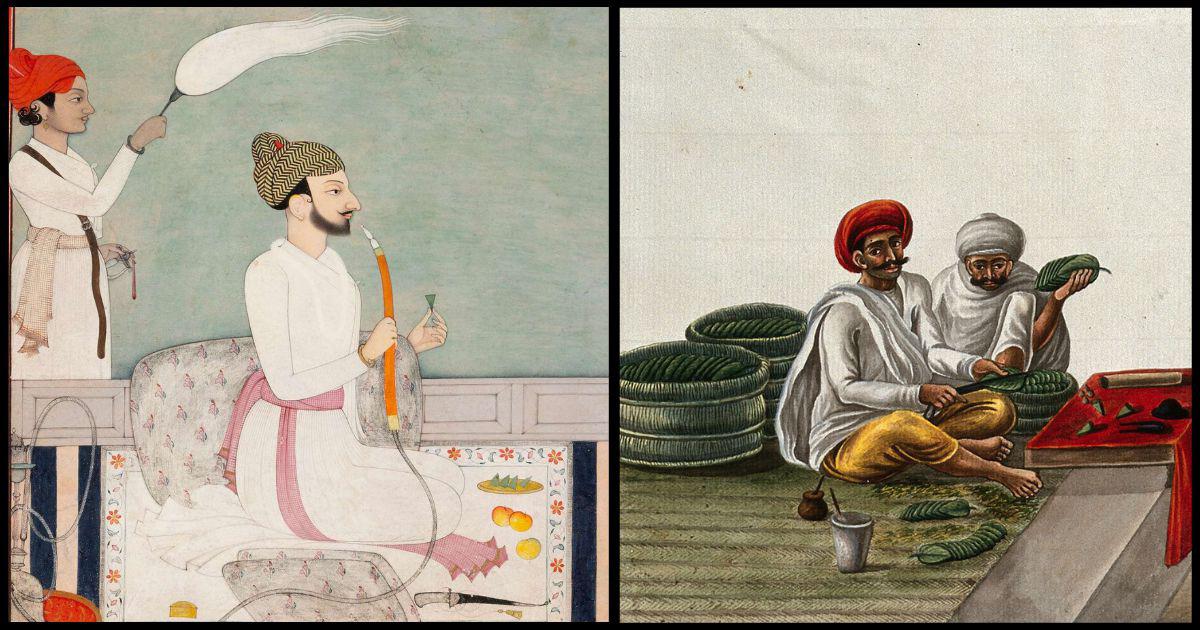
The history of paan in India is as rich and complex as the country’s cultural tapestry. Once a symbol of aristocracy, this traditional chewable leaf has seen a significant transformation in its perception over the centuries. A striking example of this evolution can be observed in an 18th-century portrait of an East India Company officer, believed to be William Fullerton, painted by the artist Dip Chand. This artwork not only captures the essence of colonial opulence but also highlights the intimate relationship between paan and the elite social fabric of the time.
In the painting, Fullerton is depicted lounging on a lavishly adorned platform, accompanied by Indian attendants, some of whom fan him gently. However, what might catch the discerning eye is the presence of a beautifully arranged pāndān, or betel box, along with a spittoon and various vessels filled with lime, areca nut, and aromatic ingredients, forming an essential part of the tableau. This careful arrangement signifies the role of paan in courtly manners and social interactions among the elite. The spittoon, placed conveniently within reach, acknowledges the natural bodily functions associated with paan, all while maintaining a facade of decorum that was characteristic of high society.
Historically, during the late 18th and early 19th centuries, paan was not merely a chewing habit but an integral aspect of refined social conduct among elites in India. Artworks and written records from this period reveal that the consumption of paan was intimately woven into the fabric of aristocratic gatherings. European travelers, who increasingly began to arrive in India as colonial interests expanded, often expressed intrigue towards this social custom. Their observations often documented the elaborate rituals surrounding paan consumption, celebrating its status as a marker of refinement and sophistication.
However, as colonial influence deepened, the perception of paan began to shift. What was once a luxurious indulgence became stigmatized as a ‘native’ habit associated with unsanitary practices. This change was influenced by the colonial narrative that sought to depict indigenous customs as inferior or uncultured, leading to a long-lasting divide in how paan was viewed by different strata of society. The very elements that once signified nobility and social grace were now relegated to the margins of polite society, overshadowed by colonial attitudes toward hygiene and propriety.
Today, paan faces a complex identity crisis. While it remains a beloved treat for many, particularly in rural and semi-urban areas, its association with health risks, such as oral cancer and other illnesses, has led to increased scrutiny. Moreover, urbanization and changing lifestyles have further complicated its role within Indian culture. The challenge now lies in reconciling the historical significance of paan as a cultural artifact with contemporary health concerns and societal attitudes.
As India strides towards modernization, the narrative around paan continues to evolve. Efforts to celebrate its heritage, while addressing the health impacts, are underway. Paan has the potential to reclaim its status not just as a cultural emblem but also as a symbol of resilience amidst changing perceptions. It is a reminder of India’s rich history and the intricate pathways of cultural evolution that shape our identities today.