The Metacognitive Renaissance: Why AI May Be the Most Human Moment in Education Yet
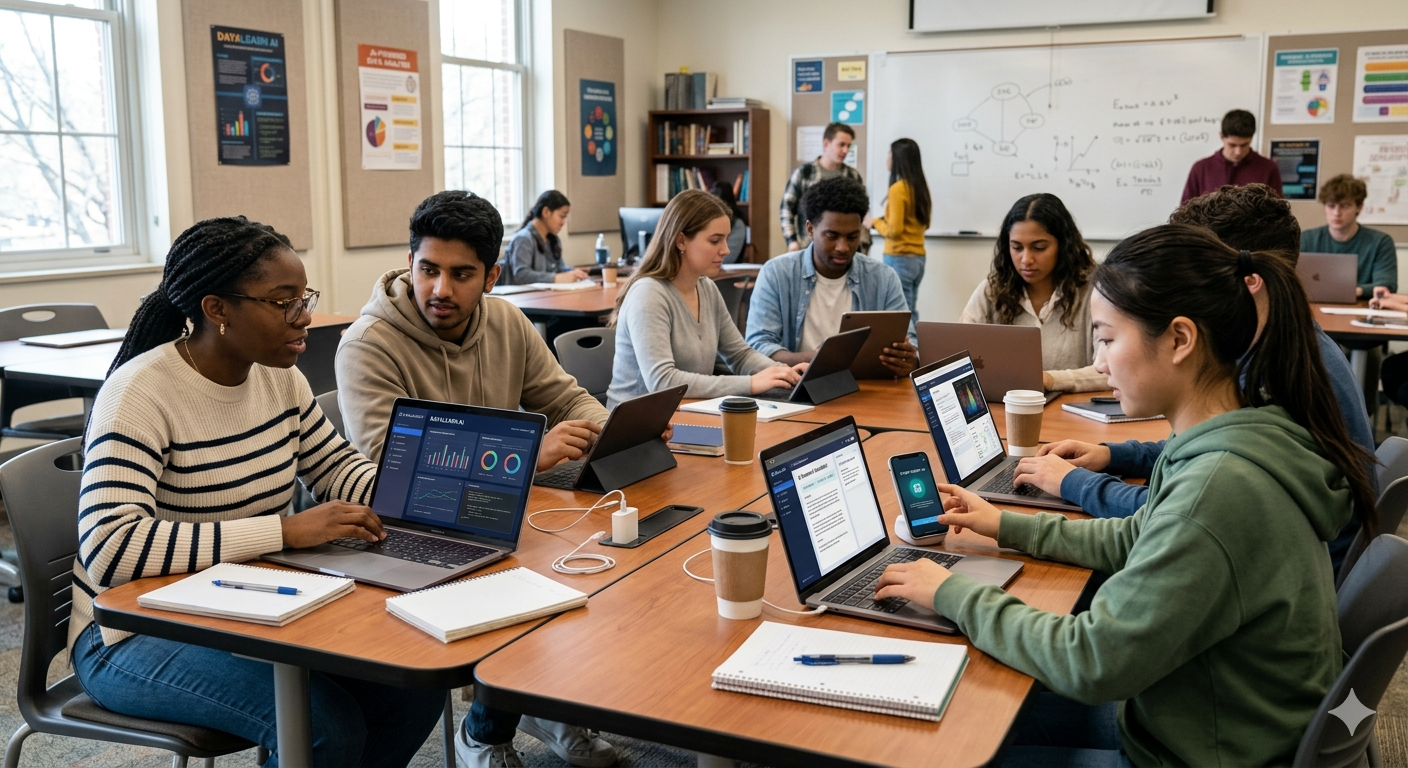
For generations, schools have been built on a remarkably stable design. Rows of desks. A standard syllabus. A single teacher delivering the same lesson to dozens of students, all moving at the same pace. This architecture shaped mass education for the industrial age, but according to educationist Dr George Panicker, it is no longer fit for the world our children are entering.
“We are standing at a moment as consequential as the invention of the printing press,” says Dr Panicker, Founder and CEO of International STEAM Research (ISR). Yet, he argues, the true significance of artificial intelligence in education is not technological at all. It is philosophical.
For the first time, technology allows education to become deeply personal, without sacrificing scale. And in that shift, Dr Panicker believes, we are witnessing the beginning of what he calls a “Metacognitive Renaissance” in learning .
From Industrial Efficiency to Individual Minds
Modern schooling, Dr Panicker explains, was designed around efficiency rather than individuality. One teacher, one curriculum, one assessment system, all optimised to produce uniform outcomes.
“The factory model made sense in another era,” he notes. “But children are not identical units rolling off an assembly line”.
In every classroom, this mismatch plays out predictably. Advanced learners disengage. Struggling students fall behind. Teachers, despite their best efforts, are forced to teach to an imagined “average” learner who rarely exists.
Artificial intelligence changes this equation in a fundamental way. By analysing how each learner engages with content in real time, AI systems can adapt pace, presentation and difficulty to individual needs, something human teachers have never been able to do at scale .
What a Metacognitive Classroom Looks Like
In Dr Panicker’s vision, AI does not dominate the classroom. It blends into it.
“Imagine every child having a quiet, invisible assistant,” he says, an AI tutor that understands a student’s reading level, interests and even the moment their attention begins to fade.
Lessons can slow down or accelerate instantly. Examples can shift from abstract to familiar. Confusion is identified the moment it appears, rather than weeks later in an exam. Learning becomes responsive rather than reactive.
When AI takes over grading, routine explanations and data tracking, something unexpected happens. “The classroom stops being mechanical,” Dr Panicker observes. “It becomes humane again”.
Why Teachers Matter More Than Ever
Perhaps the greatest anxiety surrounding AI in education is the fear that it will replace teachers. Dr Panicker is unequivocal in his response.
“AI will not replace teachers,” he says. “It will liberate them”.
Teaching, he argues, has become burdened by administrative tasks and repetitive instruction that dilute its core purpose. When machines handle those functions, teachers are free to focus on what no algorithm can replicate.
He identifies three irreplaceable human dimensions of education: emotional intelligence, ethical guidance, and critical synthesis. Teachers understand students’ unspoken fears and motivations. They model values and responsibility. They help learners connect ideas into meaning rather than isolated answers.
In this future, teachers are not information deliverers. They are mentors, designers of learning experiences and guides through complexity.
Rethinking Screens, Skills and Learning Itself
Parents’ concerns about screen time are legitimate, Dr Panicker acknowledges. But he believes the debate is framed incorrectly.
“The question isn’t screen time versus no screen time,” he explains. “It’s skill time versus passive time”.
AI‑augmented education shifts learning away from memorisation toward metacognition, thinking about thinking. In a world where information is instantly accessible, the value of education lies not in recall, but in reasoning, judgment and creativity.
Dr Panicker offers a powerful metaphor: “AI is a cognitive bicycle. A bicycle doesn’t replace walking; it extends human capability”.
AI as the Great Equaliser—Or the Great Divider
One of AI’s most radical promises is its potential to democratise elite learning experiences. For decades, personalised tutoring has been the privilege of the wealthy. AI changes that equation.
“A high‑quality AI tutor can now sit in the pocket of any child, anywhere,” Dr Panicker says.
But he is equally clear about the risk. If access to AI tools is uneven, the digital divide becomes something far more dangerous, a metacognitive chasm.
This, he insists, is not a technological problem but a moral and policy decision. Access to AI and high‑speed connectivity must be treated as educational infrastructure, not luxury.
When Exams No Longer Measure What Matters
Assessment systems, Dr Panicker believes, are among the first structures that must change.
“If an AI can pass an exam,” he says bluntly, “then the exam is obsolete”.
In its place, he advocates for heutagogy in experiential learning, real‑world projects, collaboration and iterative problem‑solving forms of assessment that measure understanding, creativity and applied knowledge rather than recall.
A Shared Responsibility
As the conversation concludes, Dr Panicker emphasises that this transformation cannot be outsourced. School leaders must create spaces for experimentation. Teachers must model lifelong learning. Parents must move from monitoring technology to exploring it alongside their children .
“The Metacognitive Renaissance of Learning is not about machines,” he says. “It is about opportunity.”
The bell for this new age of education, he believes, has already rung. The question is no longer whether change is coming, but whether we are ready to learn differently.