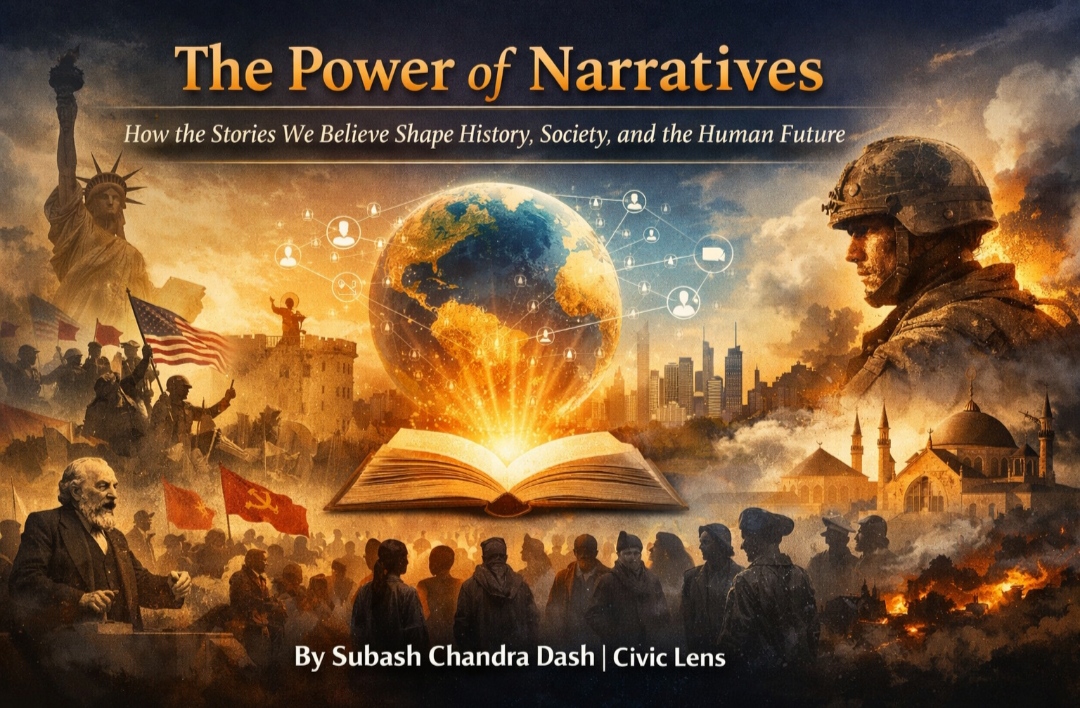
The Power of Narratives: How the Stories We Believe Shape History, Society, and the Human Future
Sub-headline:
From revolutions to modern digital conflicts, narratives shape how societies think, unite, and sometimes divide.
By Subash Chandra Dash
Civic Lens
The Power of Narratives
Human history is not shaped only by events. It is shaped by the stories societies choose to believe.
Nations rise, revolutions ignite, and movements gather momentum not merely because of facts or circumstances, but because of the narratives people embrace. These narratives provide meaning, identity, and direction. They tell societies who they are, what they stand for, and what future they should pursue.
In many ways, the story a society believes becomes the path that society follows.
We are all human beings, yet we often stand within different narratives. Sometimes these narratives bring people together around shared ideals. At other times, they divide communities and nations into opposing camps.
Understanding the power of narratives is therefore essential to understanding the course of human history.
Narratives as Engines of Change
Many of the most transformative moments in history were driven by powerful narratives that reshaped collective thinking.
The American Revolution was not only a political uprising; it was fueled by a compelling narrative of liberty and self-determination.
The French Revolution carried the inspiring ideals of liberty, equality, and fraternity—ideas that resonated far beyond France and influenced political thought across the world.
Similarly, the Russian Revolution emerged from a narrative promising justice and dignity for the working class.
Ideological movements such as socialism and communism also gained strength because they presented a story about a fairer and more equal society.
Narratives possess a unique strength: they translate complex political and social realities into simple ideas that ordinary people can understand and emotionally connect with. Once a narrative captures the imagination of the masses, it becomes a powerful force capable of reshaping societies.
The Double-Edged Nature of Narratives
Yet narratives carry a dual nature.
When they remain open to questioning and dialogue, narratives can encourage intellectual growth and social progress. They stimulate debate, inspire reform, and allow societies to evolve.
But when narratives harden into unquestioned beliefs, they can become dangerous. When a story becomes absolute truth in the public mind, dissent is often viewed as betrayal.
History offers many examples of this transformation. During the period known as the Reign of Terror in the aftermath of the French Revolution, revolutionary ideals that once promised freedom turned into instruments of political repression and violence.
The same narrative that once united people can, under certain circumstances, justify intolerance and brutality.
When the Innocent Pay the Price
Social change rarely unfolds peacefully.
In times of intense ideological struggle, narratives often simplify reality into stark opposites—heroes and enemies, patriots and traitors.
But real life is rarely so simple.
Human societies are complex, filled with diverse perspectives and lived experiences. Yet when narratives become rigid and emotionally charged, nuance disappears.
In such moments, it is often ordinary people—those far removed from political power—who bear the greatest cost. Innocent lives are disrupted, communities fracture, and the human toll of ideological conflict becomes painfully visible.
The Age of Global Narratives
In today’s digital era, narratives travel faster and influence more people than ever before.
A message, image, or interpretation of an event can spread across the world within minutes through digital platforms and social media. As a result, narratives now shape global perceptions almost instantly.
The world today is influenced not only by geography and political borders but also by competing narratives built around religion, economics, identity, language, and culture.
These narratives shape public opinion, influence political decisions, and sometimes deepen divisions within societies.
In the digital age, the battle of narratives has become one of the defining features of global discourse.
The Civic Lens Perspective
At Civic Lens, we attempt to look beyond competing narratives and examine global issues through the enduring values of humanity, justice, and wisdom.
Narratives can inspire change, and change can shape the course of history. But whether that change ultimately benefits humanity depends on the presence of wisdom, ethical reflection, and a willingness to question the stories we believe.
Before every great transformation in history, a narrative is written.
The true measure of human progress lies in whether societies have the courage to examine those narratives critically—guided not by blind belief, but by reason, compassion, and moral clarity.
Only then can narratives become instruments of progress rather than forces of division.
Civic Lens ✍️
Seeing the world through humanity, justice, and wisdom.