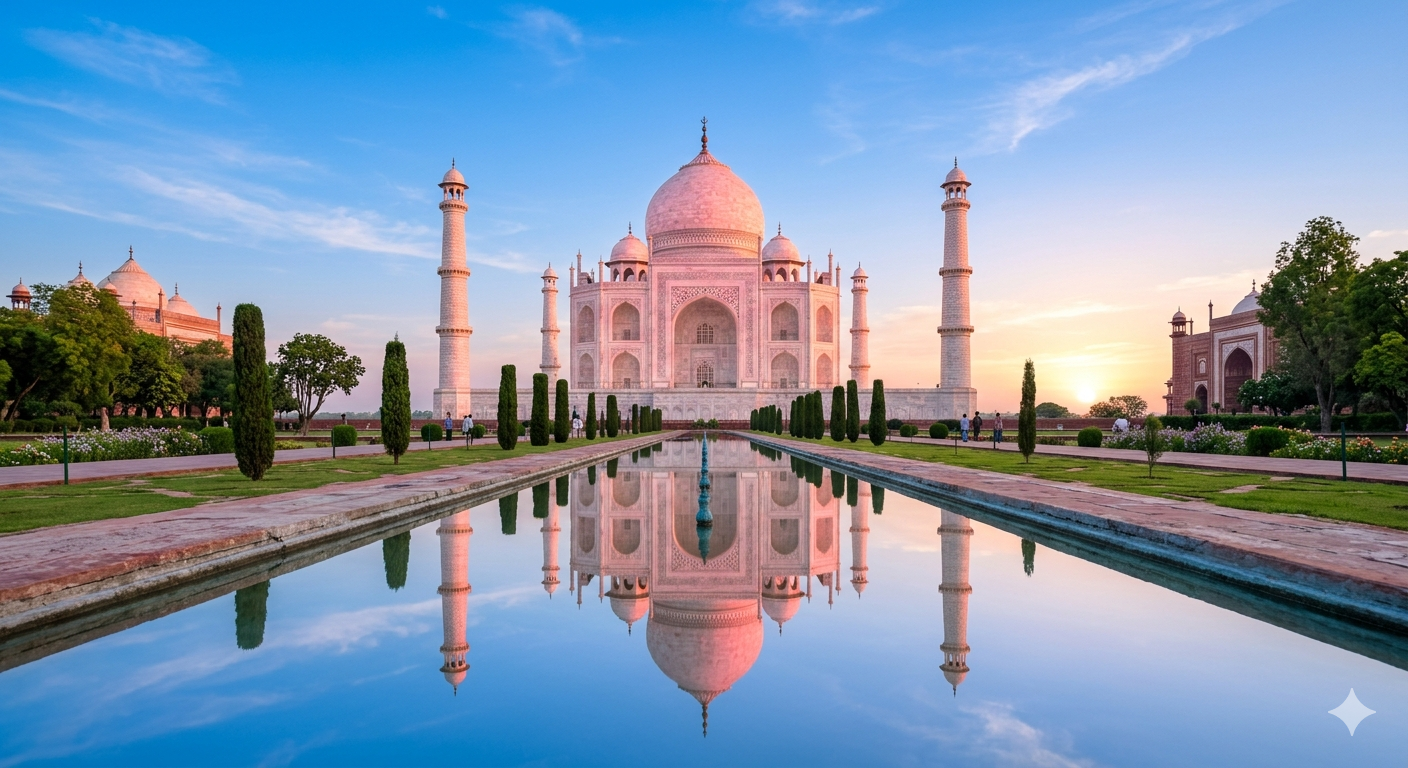
An Analytical Compendium of the Taj Mahal: Historical Provenance, Rajput Land Tenure, and the Intersection of Indo-Islamic and Hindu Architectural Traditions
The Taj Mahal stands as the preeminent symbol of Mughal architectural achievement, a structure that has simultaneously served as a primary subject for historiographical consensus and a focal point for modern revisionist discourse. While traditionally understood through the lens of seventeenth-century imperial patronage, the monument’s history is inextricably linked to the socio-political landscape of medieval India, involving complex negotiations with Rajput royalty, the synthesis of divergent artistic traditions, and the emergence of alternative historical narratives in the twentieth century. This report provides an exhaustive examination of the original history of the Taj Mahal, its foundational facts, and the multi-layered relationship it shares with Hindu architectural motifs and land tenure.
The Imperial Genesis: Chronology and Historical Context
The construction of the Taj Mahal was precipitated by the death of Arjumand Banu Begum, known by her title Mumtaz Mahal, in June 1631.1 As the favorite wife of the fifth Mughal Emperor, Shah Jahan, her passing during the birth of their fourteenth child in Burhanpur led to an unprecedented architectural undertaking intended to represent an earthly manifestation of the celestial garden of Paradise.1 The emperor’s grief, documented extensively by court chroniclers, translated into a state-sponsored project that mobilized the empire’s vast resources.1
Chronological Development and Construction Phases
The timeline of the Taj Mahal’s construction is preserved in various contemporary Mughal records, such as the Badshahnama and the Amal-i-Salih.1 The process was a multi-staged endeavor that spanned over two decades, involving distinct phases for the mausoleum, the peripheral buildings, and the expansive garden complex.
Phase of Construction
Commenced
Completed
Primary Features
Foundation and Plinth
1632
1633
Riverfront excavation, well-foundation system 1
Main Mausoleum
1632
1648
White marble veneer, central dome, cenotaph chamber 1
Mosque and Guest House
1643
1650
Red sandstone structures flanking the main tomb 1
Charbagh and Main Gate
1648
1653
Formal gardens, water channels, Darwaza-i-rauza 1
The first formal ceremony at the site occurred on February 6, 1643, marking the twelfth anniversary of Mumtaz Mahal’s death, by which time the main tomb structure was substantially advanced.1 The total cost of the complex was estimated at approximately 32 million rupees in the mid-seventeenth century, a figure that represents the zenith of Mughal fiscal and artistic investment.1
The Board of Architects and Cosmopolitan Craftsmanship
Contrary to the nineteenth-century myth of a single Italian architect (Geronimo Veroneo), modern scholarship and primary sources confirm that the Taj Mahal was the product of a sophisticated board of architects and master specialists.1 This team reflected the cosmopolitan nature of the Mughal court, drawing expertise from the Ottoman Empire, Persia, and the Indian subcontinent.
Specialist Name
Role
Regional Expertise
Ustad Ahmad Lahori
Chief Architect
Persian-Indian; also designed the Red Fort 1
Ismail Afandi
Dome Architect
Ottoman Empire; trained in the Sinan tradition 1
Amanat Khan Shirazi
Chief Calligrapher
Persian; designed the monumental Quranic script 1
Qazim Khan
Finial Specialist
Lahore; cast the gold-plated copper finial 1
Chiranji Lal
Chief Mosaicist
Delhi; indigenous specialist in parchin kari 10
Mir Abdul Karim
Supervisor
Shiraz; imperial administrative oversight 2
This collaborative effort ensured the integration of Timurid geometry, Ottoman engineering, and Indian decorative sensibilities, resulting in a structure that was both innovative and grounded in regional traditions.1
Land Tenure and the Rajput-Mughal Exchange
A critical aspect of the Taj Mahal’s original history involves the land on which it stands. Historical evidence indicates that the site was not unoccupied land but was the location of a significant Rajput residence owned by the Kachhwaha family of Amber.6
The 1633 Farman and Raja Jai Singh
When Shah Jahan selected the riverfront site for the mausoleum, it was owned by Mirza Raja Jai Singh, the grandson of Raja Man Singh (a prominent general under Emperor Akbar).13 The Badshahnama of Abdul Hamid Lahori explicitly states that the site selected for the burial of the Queen was the mansion (manzil) of Raja Jai Singh.6
While Jai Singh was reportedly willing to donate the property as a gesture of loyalty, the emperor followed legal and bureaucratic protocols to ensure the site was formally acquired.6 This exchange is documented in a royal farman (decree) dated December 28, 1633, which is preserved in the Kapad Dwara collection at the Jaipur City Palace.6
Property Relinquished by Jai Singh
Properties Granted in Exchange (Havelis in Agra)
The ancestral mansion of Raja Man Singh
Haveli of Raja Bhagwandas 14
Haveli of Madho Singh 14
Haveli of Rupsi Bairagi 14
Haveli of Chand Singh 14
This exchange underscores the bureaucratic rigor of the Mughal state and clarifies that the pre-existing structure on the site was a domestic mansion (haveli) rather than a religious temple.6 Revisionist claims often interpret the mention of this “splendid domed house” as evidence that the Taj Mahal itself was a pre-existing building.15 However, the geological and architectural evidence points to the demolition or modification of the haveli to accommodate the massive, well-based foundations required for the marble mausoleum.1
Architectural Syncretism: The Integration of Hindu Elements
The Taj Mahal is frequently analyzed as the supreme example of the Indo-Islamic style, a synthesis that matured as the Mughals increasingly viewed themselves as indigenous Indian rulers.1 This syncretism is visible in the deliberate use of Hindu architectural motifs and philosophical concepts within the Islamic framework of the tomb.
The Lotus Motif and Floral Naturalism
One of the most striking Indian features is the inverted lotus that crowns the main dome. The lotus is a central symbol in Hindu, Buddhist, and Jain iconography, representing purity and divine birth.17 In the Taj Mahal, the dome is “capped” by this lotus, effectively anchoring the Persian-style bulbous dome in the Indian soil.17 Furthermore, the decorative program emphasizes a level of floral naturalism that reflects both the Mughal interest in botany and the ancient Indian tradition of the “vase of plenty” (purna-ghata).4
The Purna-Kalasa and the Gilded Finial
The finial that surmounts the main dome is a masterpiece of metallurgical and symbolic synthesis. While it terminates in an Islamic crescent moon, the base of the finial incorporates the kalasa or pitcher motif, a staple of Hindu temple architecture.4 In Hindu traditions, the purna-kalasa symbolizes abundance and the life force, and its presence on the Taj Mahal illustrates the cross-cultural vocabulary used by Mughal master craftsmen.4
Material Hierarchies and Color Coding
The Mughals adopted a color-coding system for their buildings that mirrored ancient Indian social and religious treatises, such as the Vishnudharmottara Purana.4 This text recommended white stone for buildings belonging to the Brahmin (priestly) class and red stone for the Kshatriya (warrior) class.4
Material Used
Source Location
Traditional Indian Significance
White Marble
Makrana, Rajasthan
Purity, divinity, Brahminical association 1
Red Sandstone
Fatehpur Sikri / Dholpur
Imperial power, Kshatriya association 1
By cladding the central mausoleum in white marble and the subsidiary buildings (mosque, guest house, and gate) in red sandstone, Shah Jahan’s architects utilized a visual language that was deeply familiar to the Indian populace, reinforcing the emperor’s role as a traditional Indian sovereign.4
The Revisionist Discourse: P.N. Oak and the “Tejo Mahalaya” Theory
In the latter half of the twentieth century, a highly contentious revisionist narrative emerged, primarily through the work of writer P.N. Oak.21 Oak’s theory posits that the Taj Mahal was not built by Shah Jahan but was an ancient Hindu temple dedicated to Lord Shiva, known as “Tejo Mahalaya,” which was commandeered and modified by the Mughals.23
Linguistic and Etymological Arguments
Oak’s primary evidence often rests on linguistic reinterpretations of the monument’s name and historical terms. He argued that the word “Mahal” is not an Islamic term for a tomb and that the name “Taj Mahal” does not appear in contemporary Mughal chronicles like the Badshahnama.23 Instead, he claimed the name is a corruption of “Tejo Mahalaya,” or the “Abode of the Resplendent One”.22
Theory
Proposed Origin
Argument Summary
Mainstream
Persian / Urdu
“Taj” (Crown) “Mahal” (Palace/Place); derived from Mumtaz Mahal 1
Revisionist
Sanskrit
“Tejo Mahalaya”; ancient Shiva temple (Agreshwar Mahadev) 25
However, linguists point out that the Persian word Taj (crown) and the Arabic/Urdu Mahall (residence/palace) were standard parts of the courtly lexicon.26 Mainstream historians note that the formal name in records was Rauza-i munawwara (the Illumined Tomb) and that “Taj Mahal” likely became the popular name used by locals and European travelers.1
Structural Anomalies and the 22 Sealed Rooms
Proponents of the Tejo Mahalaya theory frequently cite structural elements as evidence of a Hindu origin. These include the presence of trident-like shapes on the finial, the orientation of certain chambers, and the existence of “sealed rooms” in the basement.8 The theory suggests that these rooms, located in the tahkhana (underground chambers), contain Hindu idols that were hidden by Shah Jahan during the building’s conversion.8
Scientific Investigation and Archaeological Rebuttal
The Archaeological Survey of India (ASI) and various judicial bodies have addressed these revisionist claims through scientific data and physical inspections.1
Analysis of the Sealed Basement Chambers
In 2022, following renewed public interest and a high-profile court petition, the ASI released photographs of several of the 22 basement rooms.33 These images showed plain arched galleries and structural maintenance work, contradicting the theory that the rooms housed religious artifacts.33
ASI Finding
Explanation
Context
Room Contents
Plain brick/mortar walls, lime plaster 31
No evidence of idols or temple remnants 8
Reason for Sealing
Structural stability and security 8
High footfall could compromise the riverfront foundation 33
Ventilation
Arched windows facing the Yamuna 33
Designed as a cool retreat (tahkhana) for the emperor 33
ASI officials, including former Regional Director K.K. Muhammad, have noted that the architectural style of these basement galleries is consistent with other Mughal tombs in Delhi and Agra, such as Humayun’s Tomb, and serves the practical purpose of raising the height of the main structure while providing a cool subterranean space.1
The Marvin Mills Carbon Dating Controversy
A significant point in the revisionist argument is a carbon-dating study reportedly conducted in 1974 by American architect Marvin Mills.36 Mills claimed to have tested a sample of wood from a riverside doorway, which supposedly yielded a date of 1359 AD, roughly 270 years before the Mughal construction date.37
However, this study has been widely dismissed by the scientific community for several reasons:
Sample Integrity: There is no verified documentation of the sample’s collection or chain of custody.39
Material Reuse: It was a common practice in medieval India to reuse old timbers for structural reinforcement or for less prominent doorways.40
Methodological Skepticism: The results were never published in a peer-reviewed scientific journal and are largely circulated through revisionist literature.39 The ASI maintains that no authorized carbon dating has been performed on the monument, as the epigraphic evidence—the intricately designed Quranic inscriptions by Amanat Khan—provides a clear and indisputable chronology.1
Judicial Precedents and Legal Status
The controversy regarding the Taj Mahal’s origin has been brought before the Indian courts multiple times since the 1960s, resulting in a series of definitive rulings.21
Year
Judicial Body
Case Summary
Ruling / Observation
2000
Supreme Court of India
P.N. Oak vs. Union of India 21
Petition to declare Taj a Hindu temple dismissed; “bee in his bonnet” remark 21
2022
Allahabad High Court
Rajneesh Singh vs. Union of India 8
Petition to open 22 rooms for inspection; dismissed as “misconceived” 31
2022
Supreme Court of India
Surjit Yadav vs. Union of India 41
Petition to unearth “real age” and history; dismissed; “Do not drag courts into everything” 41
The courts have consistently argued that historical matters of this nature are outside the jurisdiction of the judiciary and should be left to the expertise of archaeologists and historians.34 The 2022 Supreme Court ruling emphasized that the history of a 400-year-old world heritage site should be allowed to continue as it has been known and that reopening such questions without scientific basis can be detrimental to societal harmony.41
Historiographical Analysis: The Synthesis of Narrative and Reality
The enduring debate over the Taj Mahal’s history reflects a deeper tension in the interpretation of Indian heritage. The monument is not merely a static object of beauty but a dynamic intersection of competing identities.
The Role of European Travelers
Accounts from seventeenth-century European travelers have been used to support both the imperial and revisionist narratives.
Peter Mundy (1632): An English traveler who recorded the “Taj-e-Mahal’s tomb, gardens and bazaars” within a year of Mumtaz’s death.30 Revisionists argue this indicates the building already existed; historians argue it shows the project was an immediate and highly publicized priority of the state.30
Jean-Baptiste Tavernier: A French jeweler who visited Agra during the construction. He noted that Shah Jahan “purposely buried Mumtaz near the Taz-i-Makan… where foreigners used to come”.30 His mention of the “Taj building” suggests it was a well-known site even during its construction phase.30
François Bernier: A contemporary French visitor who noted that non-Muslims were restricted from certain areas, a detail revisionists claim was to hide Hindu artifacts, while historians see it as a standard measure for protecting the sanctity of a burial site.30
The P.N. Oak Legacy and Modern Cultural Politics
The theories of P.N. Oak have found a second life in the digital age, fueled by a broader shift in Indian cultural politics.22 This movement seeks to re-evaluate the Mughal era as one of primarily “foreign” imposition, often ignoring the degree to which the Mughals became integrated into the Indian fabric.4 The portrayal of Islamic architecture as “captured” Hindu structures creates a simplified narrative of native versus invader, which mainstream scholars argue marginalizes the complex, shared history of the subcontinent.11
The UNESCO designation of the Taj Mahal in 1983 as “the jewel of Muslim art in India” recognizes its Islamic heritage while acknowledging its place as a “universally admired masterpiece” that belongs to the collective history of India.1
Technical and Conservationist Perspectives
Beyond the historical and religious debates, the Taj Mahal is a significant subject of structural and environmental engineering. The Archaeological Survey of India (ASI) manages the site under the Ancient Monuments and Archaeological Sites and Remains Act, 1958, focusing on preservation against modern threats.1
Structural Integrity and Environmental Factors
The site’s proximity to the Yamuna River presents unique challenges. The foundational well-system was designed to withstand the river’s ebb and flow, but modern issues like silting and industrial pollution have necessitated strict conservation protocols.1
Moisture and Silting: The 22 sealed rooms in the basement are particularly vulnerable to moisture. The ASI has explained that excessive footfall in these poorly ventilated areas would increase humidity, potentially damaging the delicate lime plaster and original brickwork.33
Pollution and Discoloration: The white marble is sensitive to sulfur dioxide and other pollutants, which can react with the stone to create yellowing. This has led to the implementation of the “mud pack” treatment (using fuller’s earth) to restore the marble’s original luster.8
Scientific Imaging and Non-Invasive Methods
To address public curiosity while maintaining structural safety, some experts have proposed the use of non-invasive technologies like ground-penetrating radar (GPR) and 3D laser scanning.35 These methods could provide detailed images of the monument’s subterranean levels without the need for physical excavation, potentially putting an end to rumors of hidden chambers and idols.35
Synthesis: A Monument of Multiple Realities
The original history of the Taj Mahal is a narrative of imperial ambition, romantic tragedy, and profound cultural integration. While the structural and bureaucratic evidence definitively points to its creation as a seventeenth-century Mughal mausoleum, the monument’s “Hindu” elements—from its land tenure under the Rajputs to its lotus-capped dome—are equally essential to its identity.
The Taj Mahal is not a monolith; it is a synthesis. It is a structure where Persian mathematics (Hindsa and Hisab) met Indian craftsmanship (parchin kari), and where Islamic theology was expressed through a visual language steeped in the soil of the subcontinent.4 The revisionist “Tejo Mahalaya” theory, while largely rejected by the global academic and judicial community, highlights the monument’s role as a potent symbol of Indian heritage that continues to be contested and reclaimed in the modern era.
As a masterpiece of Mughal architecture and a UNESCO World Heritage site, the Taj Mahal remains a testament to the fact that the history of India is not a series of isolated events but a continuous process of exchange and evolution.1 Whether viewed as a house for the Queen in Paradise or as a symbol of India’s multicultural maturity, the structure continues to serve as a profound subject for historical inquiry and universal admiration.
Works cited
Taj Mahal – Wikipedia, accessed March 21, 2026, https://en.wikipedia.org/wiki/Taj_Mahal
Taj Mahal Complex – CONA Full Record, accessed March 21, 2026, https://www.getty.edu/cona/conafullsubject.aspx?subid=700000214
Taj Mahal – UNESCO World Heritage Centre, accessed March 21, 2026, https://whc.unesco.org/en/list/252/
Architecture – Taj Mahal, accessed March 21, 2026, https://www.tajmahal.gov.in/architecture.aspx
The Man Who Built The Taj – Smithsonian Magazine, accessed March 21, 2026, https://www.smithsonianmag.com/history/the-man-who-built-the-taj-140535404/
The real story of how Taj Mahal was built – Rana Safvi, accessed March 21, 2026, https://ranasafvi.com/the-real-story-of-how-taj-mahal-was-built/
Images of the Taj Mahal complex, Agra India by Ustad Ahmad Lahauri and Ustad Isa. – Bluffton University, accessed March 21, 2026, https://homepages.bluffton.edu/~sullivanm/india/agra/taj.html
What is inside 22 sealed doors of the Taj Mahal? – The Times of India, accessed March 21, 2026, https://timesofindia.indiatimes.com/etimes/trending/what-is-inside-22-sealed-doors-of-the-taj-mahal/articleshow/117772078.cms
Journal of Architectural Engineering Technology – Taj Mahal: A Mesmerizing Marvel of Architectural Splendour – OMICS International, accessed March 21, 2026, https://www.omicsonline.org/open-access/taj-mahal-a-mesmerizing-marvel-of-architectural-splendour-125418.html
Taj Mahal | PDF – Scribd, accessed March 21, 2026, https://www.scribd.com/document/468653277/TAJ-MAHAL
The Luminous Tomb: A Comprehensive Historiographical and Architectural Analysis of the Taj Mahal as the Zenith of Indo-Islamic Synthesis – The Glorious Quran and Science, accessed March 21, 2026, https://thequran.love/2025/12/25/the-luminous-tomb-a-comprehensive-historiographical-and-architectural-analysis-of-the-taj-mahal-as-the-zenith-of-indo-islamic-synthesis/
A Comparative Study of the Taj Mahal from the Mughal Period and the Forbidden City from the Ming and Qing Dynasties, accessed March 21, 2026, https://ojs.pssr.org.pk/journal/article/download/778/603/1295
The Taj Mahal was built on the land owned by this person – The Times of India, accessed March 21, 2026, https://timesofindia.indiatimes.com/etimes/trending/the-taj-mahal-was-built-on-the-land-owned-by-this-person/articleshow/120341829.cms
Taj Mahal’s Ownership – A Brief History of The Land Acquisition | PDF – Scribd, accessed March 21, 2026, https://www.scribd.com/document/774339812/Taj-Mahal-s-ownership-A-brief-history-of-the-land-acquisition
Exclusive Details: Did the Taj Mahal land belong to Raja Man Singh? – Ground Report, accessed March 21, 2026, https://www.groundreport.in/latest/taj-mahal-is-built-on-plot-belonged-to-raja-man-singh/
EXCLUSIVE: Shahjahan returned properties of King Jai Singh for donating haveli for Taj Mahal | SabrangIndia, accessed March 21, 2026, https://sabrangindia.in/exclusive-shahjahan-returned-properties-king-jai-singh-donating-haveli-taj-mahal/
Architecture | Four Californian Lectures – Al-Islam.org, accessed March 21, 2026, https://al-islam.org/four-californian-lectures-sayyid-saeed-akhtar-rizvi/architecture
The Taj Mahal – Within The Walls – interior design, decor, art and architecture, accessed March 21, 2026, https://withinthewalls.home.blog/2019/05/29/the-taj-mahal/
(PDF) The Conceptual, Cultural and Artistic Significance of Purna …, accessed March 21, 2026, https://www.researchgate.net/publication/364722436_The_Conceptual_Cultural_and_Artistic_Significance_of_Purna-Kalasa_and_its_Use_in_Hindu_and_Muslim_Architecture_of_the_Subcontinent
The Influence of the Mughal Empire on Art, Architecture, and Culture in India. – IOSR Journal, accessed March 21, 2026, https://www.iosrjournals.org/iosr-jhss/papers/vol1-issue1/Ser-1/H01014447.pdf
P. N. Oak – Wikipedia, accessed March 21, 2026, https://en.wikipedia.org/wiki/P._N._Oak
”There is a Bee in the Bonnet” – Frontier articles on Society & Politics, accessed March 21, 2026, https://www.frontierweekly.com/articles/vol-50/50-19/50-19-There%20is%20a%20Bee%20in%20the%20Bonnet.html
The True Story of the Taj Mahal – Stephen Knapp, accessed March 21, 2026, https://www.stephen-knapp.com/true_story_of_the_taj_mahal.htm
Taj Mahal? No! it is Tejo-Maha-Alay – Exotic India Art, accessed March 21, 2026, https://www.exoticindiaart.com/book/details/taj-mahal-no-it-is-tejo-maha-alay-hbl137/
THE TAJ MAHAL IS TEJO-MAHALAYA: A SHIVA TEMPLE, accessed March 21, 2026, https://www.harekrsna.de/taj-mahal/tejo-mahalaya.html
Taj Mahal – Etymology, Origin & Meaning of the Name, accessed March 21, 2026, https://www.etymonline.com/word/Taj%20Mahal
Why Taj Mahal is Called Taj Mahal ? Its name is believed to have been drawn from Persian: ‘taj’ meaning crown and ‘mahal’ meaning palace, thus making this the ‘palace of the crown’. Interestingly, the queen in whose memory it was built, originally – Mayank Universe Space, accessed March 21, 2026, https://mrmayanksspace.quora.com/Why-Taj-Mahal-is-Called-Taj-Mahal-Its-name-is-believed-to-have-been-drawn-from-Persian-taj-meaning-crown-and-ma
Tejo Mahalaya Controversy: Mysteries Surrounding the Taj Mahal — ARCLANTIC, accessed March 21, 2026, https://www.arclantic.com/the-tejo-mahalaya-controversy-unraveling-the-mysteries-surrounding-the-taj-mahal
Tejo Mahalaya vs Taj Mahal: What’s feeding a conspiracy theory – The Federal, accessed March 21, 2026, https://thefederal.com/explainers-2/tejo-mahalaya-vs-taj-mahal-whats-feeding-a-conspiracy-theory
What European Visitors’ Accounts Say About Taj Mahal as Hindu Structure – myIndiamyGlory, accessed March 21, 2026, https://www.myindiamyglory.com/2017/11/11/european-visitors-accounts-about-taj-mahal/
Rooms in Taj Mahal not permanently closed nor do they have idols: ASI – The Federal, accessed March 21, 2026, https://thefederal.com/news/rooms-in-taj-mahal-not-permanently-closed-nor-do-they-have-idols-asi
Taj Mahal Identity and Historical Claims | PDF – Scribd, accessed March 21, 2026, https://www.scribd.com/doc/6765198/Complete-Taj-Mahal-Petition
Why Are 22 Chambers Locked in the Taj Mahal? | Reasons, Facts …, accessed March 21, 2026, https://www.britannica.com/topic/Why-Are-22-Chambers-Locked-in-the-Taj-Mahal
ASI Releases Pictures Of Taj Mahal’s Closed Rooms Amid Controversy – Read More, accessed March 21, 2026, https://pragnews.com/en/asi-releases-pictures-of-taj-mahals-closed-rooms-amid-controversy-read-more
What’s Hidden In 22 Locked Rooms Of The Taj Mahal? Secrets, Myths, And Truths That Will Shock You, accessed March 21, 2026, https://zeenews.india.com/photos/india/what-s-hidden-in-22-locked-rooms-of-the-taj-mahal-secrets-myths-and-truths-that-will-shock-you-2916274
Taj Photo # 46 – Stephen Knapp, accessed March 21, 2026, https://www.stephen-knapp.com/taj_photo_fortysix.htm
What’s behind the claim about the Taj Mahal being a Hindu Temple? – NewsGram, accessed March 21, 2026, https://www.newsgram.com/india/2022/05/13/whats-behind-the-claim-about-the-taj-mahal-being-a-hindu-temple
Was The Taj Mahal A Vedic Temple | PDF | Dome – Scribd, accessed March 21, 2026, https://www.scribd.com/document/7053585/Was-the-Taj-Mahal-a-Vedic-Temple
The Taj Story – Wikipedia, accessed March 21, 2026, https://en.wikipedia.org/wiki/The_Taj_Story
The controversy of Taj or tej Mahal never seems to die – Talk Tennis, accessed March 21, 2026, http://tt.tennis-warehouse.com/index.php?threads/the-controversy-of-taj-or-tej-mahal-never-seems-to-die.611188/
Let the history of Taj Mahal continue as it is: Supreme Court – The …, accessed March 21, 2026, https://www.thehindu.com/news/national/let-the-history-of-taj-mahal-continue-as-it-is-sc/article66225517.ece
Supreme Court dismisses plea seeking ‘real history’ of Taj Mahal – Scroll.in, accessed March 21, 2026, https://scroll.in/latest/1039082/supreme-court-dismisses-plea-seeking-real-history-of-taj-mahal
‘Publicity Interest Litigation’: Supreme Court Rejects Plea To Ascertain ‘Real History’ Of Taj Mahal – YouTube, accessed March 21, 2026, https://www.youtube.com/watch?v=b7-xFB1oudw
Disgusting that SC allowed the ‘disputed’ and ‘false’ history of Taj Mahal to continue as it is., accessed March 21, 2026, https://hinduexistence.org/2022/12/07/taj-mahal-has-been-there-for-400-years-let-it-be-do-not-drag-courts-into-everything-make-a-representation-to-the-asi-and-let-them-decide/
Tajmahal – Is An Ancient Siva Temple – Not Built by Shah Jahan – Scribd, accessed March 21, 2026, https://www.scribd.com/doc/4007629/Tajmahal-Is-an-Ancient-Siva-Temple-Not-Built-by-Shah-Jahan
Disclaimer: This is a brand post. The views, opinions, and claims expressed in this article belong to the respective brand. No one independently verifies or guarantees the accuracy, completeness, or reliability of the information mentioned in this article.