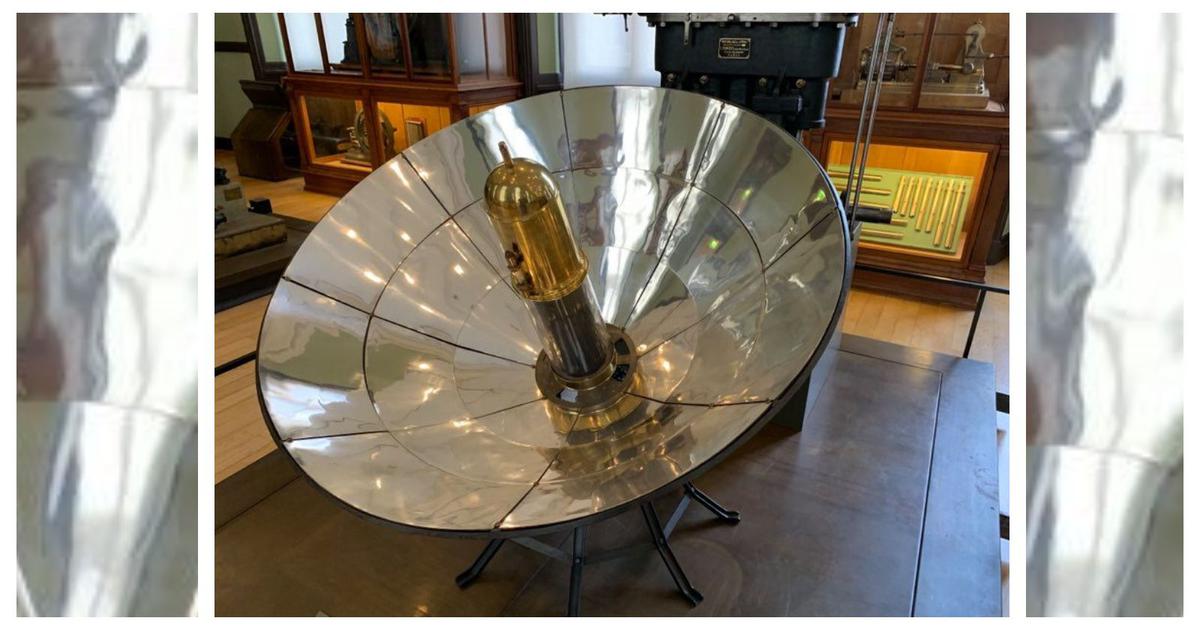
In the 1870s, when Bombay was bustling with the vibrant energy of a cotton boom, a British official named William Adams was on the brink of an extraordinary innovation. His fascination with energy began in his youth, nurtured by his work as a clerk at a London patent office during the 1860s. This position afforded him glimpses into the nascent field of solar energy, where he encountered the pioneering designs that aimed to harness sunlight through mirrors and water.
Adams’ passion transformed into ambition when he learned of the remarkable invention by French mathematician Augustin Mouchot, who created the first machine capable of operating on solar energy. Mouchot’s groundbreaking device, which linked a solar boiler to a specialized steam engine, garnered significant attention and acclaim when it was presented to Napoleon III in 1866. Inspired by this innovation, Adams set out to develop his own solar boiler, but he quickly realized that he needed a more suitable environment for his experiments—one that offered ample sunlight.
His opportunity arrived when Sir Philip Edmond Wodehouse, the governor of Bombay, offered him the position of deputy registrar. Seizing the chance, Adams made his way to India and soon made history as the first British individual to design, construct, and successfully test a solar steam engine suitable for industrial use. His groundbreaking work was no small feat, as it represented a significant step forward in the quest to utilize renewable energy sources.
However, Adams faced considerable resistance from the conservative mindset of the colonial administration. While he envisioned a future powered by the sun, the bureaucrats of the time were not ready to embrace this innovation. They failed to recognize Adams as the energy visionary he truly was, viewing his work with skepticism rather than the excitement it deserved. Despite the challenges, Adams continued to push the boundaries of what was considered possible in the realm of energy.
Upon his arrival in Bombay in 1873, Adams found himself in a city that was rapidly evolving, with cotton mills emerging at an unprecedented rate, and the industrial revolution taking its toll. The contradiction of a flourishing textile industry and the potential benefits of solar energy was stark. While the mills required vast amounts of energy, they were primarily reliant on traditional sources such as coal and steam, neglecting the abundant solar resources that surrounded them.
Adams’s journey exemplifies the struggle between innovation and tradition, a theme that resonates even today in the context of India’s ongoing energy transformation. His work laid the foundation for future explorations into renewable energy in India, encouraging subsequent generations to explore the potential of solar power. Though he may not have received the validation he sought during his time, William Adams remains a trailblazer, whose vision for a sustainable energy future was ahead of its era.