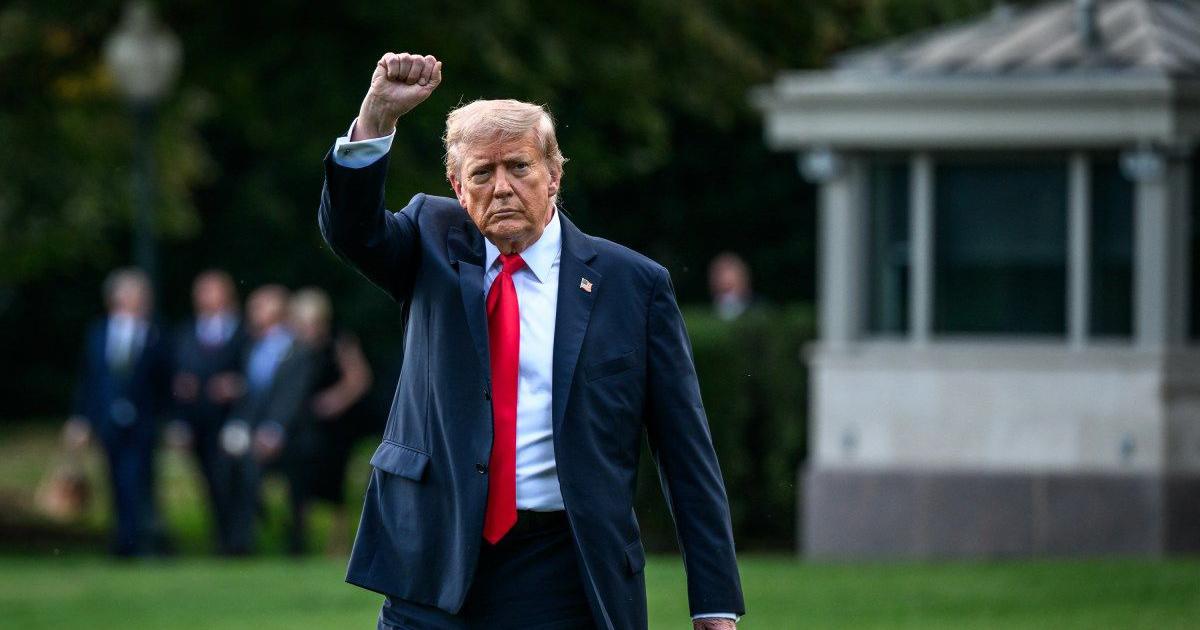
In a surprising announcement on Tuesday, U.S. President Donald Trump declared that the ongoing conflict with Iran could wrap up within two to three weeks. Speaking to reporters at the White House, Trump expressed confidence, stating, “We’ll be leaving very soon,” underscoring that a formal agreement is not a prerequisite for ending hostilities in the tumultuous West Asian region.
This statement comes amidst a backdrop of escalating tensions, with Iranian Foreign Minister Abbas Araghchi asserting that no direct negotiations are occurring between Tehran and Washington. In an interview with Al Jazeera, Araghchi indicated that while messages have been exchanged between the two nations, they have primarily consisted of threats and viewpoints conveyed through intermediaries rather than official dialogue.
Further complicating the situation, Iran’s Islamic Revolutionary Guard Corps (IRGC) issued a stern warning that it would target U.S. corporations in the region if any more Iranian leadership figures were harmed. The IRGC’s threat includes a list of 18 American firms, notably tech giants like Microsoft, Google, and Apple, as well as defense contractors such as Boeing, highlighting the potential for broader economic repercussions from the conflict.
The ramifications of Trump’s comments were felt immediately on the financial markets. Major Asian stock indices experienced a notable surge, with the Indian benchmark Sensex soaring over 1,800 points, marking a significant 2.6% increase. Similarly, the Nifty index rose by over 500 points, or nearly 2.9%. Other markets in Asia also reported gains, with Hong Kong’s Hang Seng index rising by 1.9%, South Korea’s Kospi up by 7%, Japan’s Nikkei increasing by 4.4%, and China’s Shanghai Composite climbing by 1.3%. These positive shifts reflect investor optimism that a de-escalation in the Middle East might stabilize global markets.
U.S. Secretary of State Marco Rubio echoed Trump’s sentiments, reinforcing the notion that the administration is committed to reducing military engagement in the region. As discussions of troop withdrawal intensify, the geopolitical landscape remains fluid, with analysts speculating on the potential implications for U.S.-Iran relations and regional stability.
As the situation evolves, it remains crucial for observers in India and around the world to monitor the developments closely. The economic interconnections between the U.S. and Asian markets mean that any significant shifts in policy regarding Iran could have lasting effects, not just in the Middle East but also on global trade and investment patterns.