There was a time when war arrived like a storm—loud, unmistakable, and distant for most of us. Today, it feels different. War no longer shocks. It lingers. It scrolls past us on screens between a business update and a family photograph.
What we are witnessing now is not just a single conflict, but a pattern. From Eastern Europe to the Middle East, and through several regions that rarely make headlines, tensions have hardened into prolonged confrontation. The language of diplomacy exists, but its impact feels increasingly limited.
The most troubling shift is not the presence of war, but the way it has settled into our daily awareness without truly unsettling us.
A Conflict That Refuses to Conclude
Modern warfare is no longer defined by clear beginnings or decisive endings. It stretches. It adapts. It becomes a test of endurance rather than a battle for resolution.
Nations involved in ongoing conflicts are not just fighting on the battlefield. They are fighting economically, digitally, and psychologically. Sanctions, cyber operations, and information campaigns now run parallel to missiles and ground offensives.
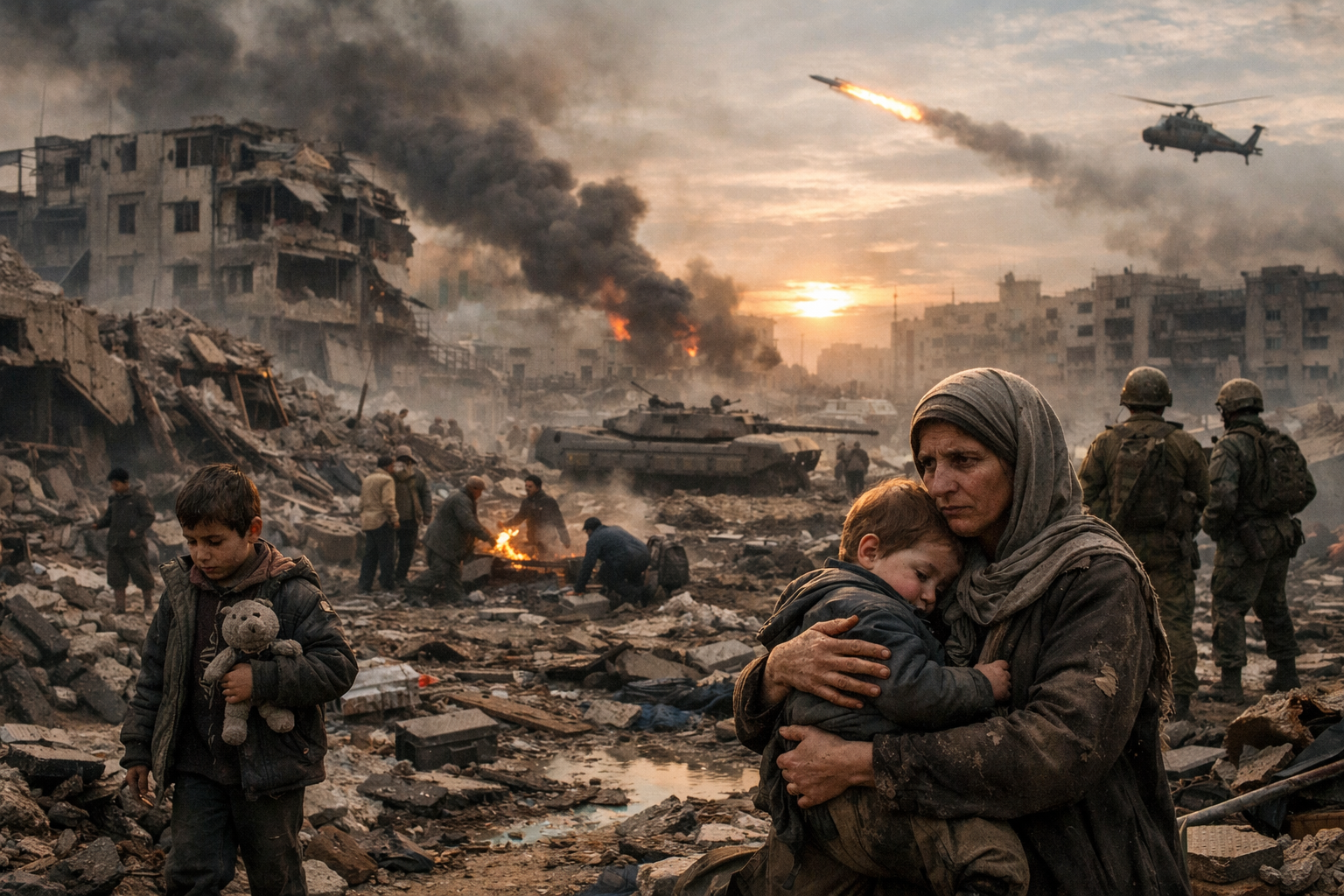
For civilians, this means a prolonged state of uncertainty. Displacement is no longer temporary. Infrastructure damage is not quickly repaired. Entire generations are growing up in conditions where instability is the norm, not the exception.
The Civilian Cost: Always the Highest
In every war, statistics are often used to summarise loss. But numbers have a way of distancing reality.
Behind every count is a life interrupted—families split across borders, children pulled out of schools, livelihoods erased overnight. Hospitals operate under pressure, not just from injuries, but from shortages. Food supply chains break down. What was once routine becomes a daily struggle.
And yet, these stories rarely sustain attention. The world moves on faster than the recovery of those affected.
The Politics of Power and Perception
Wars today are as much about narrative as they are about territory.
Governments shape perception carefully—both domestically and internationally. Information is curated, amplified, or suppressed depending on strategic interests. The result is a fragmented understanding of truth, where audiences often see only one side of a deeply complex situation.
This has created a dangerous environment where public opinion is influenced less by verified facts and more by persuasive storytelling. In such a climate, clarity becomes a casualty.
A Global Ripple Effect
No war remains contained anymore.
Energy prices fluctuate. Trade routes shift. Economic uncertainty spreads far beyond the region of conflict. Countries that are not directly involved still feel the pressure—through inflation, disrupted supply chains, or geopolitical realignments.
For nations like India, which maintain strategic relationships across different blocs, this creates a delicate balancing act. Neutrality is no longer passive; it requires active and careful diplomacy.
The Silent Fatigue of the World
Perhaps the most overlooked consequence of ongoing war is fatigue.
Audiences grow tired. News cycles move quickly. What once felt urgent slowly becomes background noise. This fatigue does not mean the conflict has reduced in intensity—it simply means attention has shifted.
And when attention fades, accountability often follows.
Where Do We Stand?
It is easy to feel distant from war when it is not at our doorstep. But in an interconnected world, distance is an illusion.
The responsibility of journalism, now more than ever, is not just to report events, but to preserve perspective. To remind readers that behind strategy and politics, there are human lives that cannot be reduced to headlines.
War may continue. History suggests that it often does. But what must not continue is our gradual acceptance of it as routine.
Because the moment war feels normal is the moment we stop questioning it.