The Supreme Court’s swift and decisive intervention in the NCERT Class 8 Social Science textbook controversy has once again placed the boundary between institutional dignity and educational transparency under intense scrutiny.
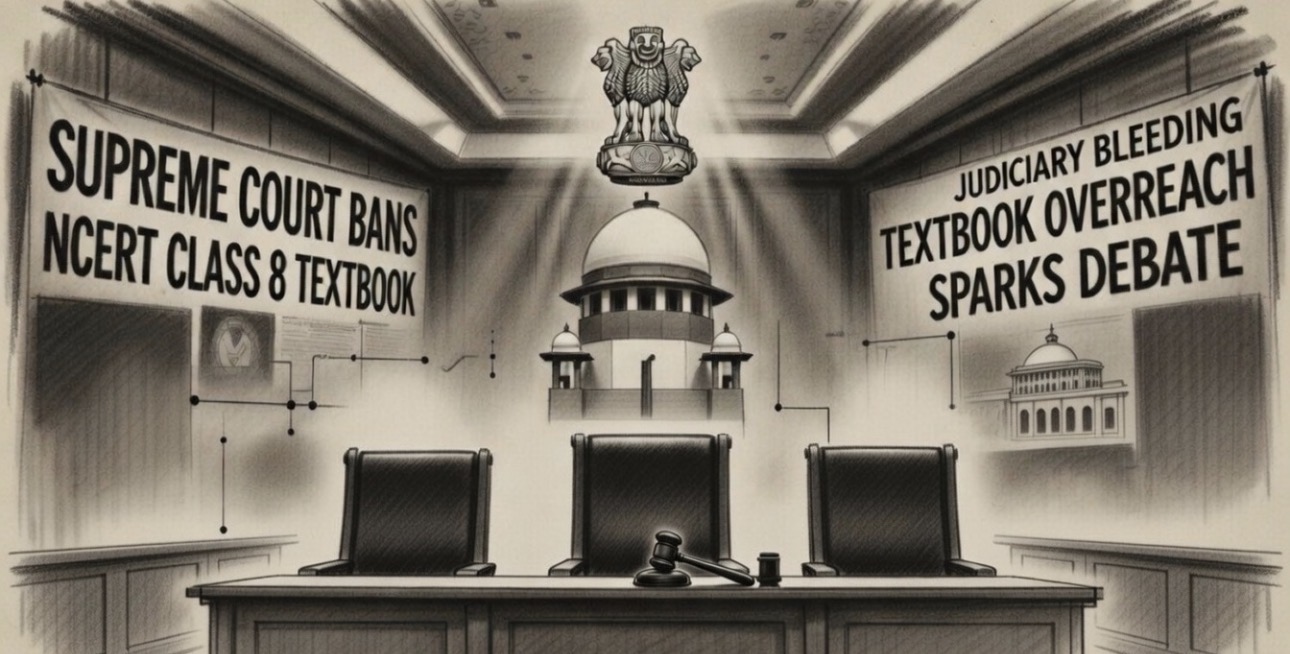
At the heart of the matter is a revised chapter in Exploring Society: India and Beyond, Vol II that went beyond describing the structure of courts to mention documented realities: corruption allegations within the judiciary, a backlog exceeding 50 million cases, and persistent shortages of judges. Within days of its release, senior advocates raised concerns, the Chief Justice took suo motu cognisance, and a three-judge bench—led by CJI Surya Kant—ordered a complete nationwide ban on the book’s production, distribution, and digital availability. Physical copies are to be seized, and the court has warned of possible contempt action against responsible officials.
The Centre tendered an apology in open court and promised accountability. NCERT, for its part, withdrew the chapter, described the inclusion as an “error of judgement,” halted all further distribution, and undertook to rewrite the section in consultation with appropriate authorities.
The episode has triggered sharply divided reactions. Supporters of the court’s action argue that school textbooks must not present unverified or inflammatory claims about any constitutional institution, especially in language that could shape impressionable young minds. Critics, however, maintain that acknowledging widely reported systemic challenges—backed by official statistics—is a legitimate part of civic education and that the judiciary’s response appeared disproportionately severe.
Both perspectives carry weight. Protecting the reputation of a vital democratic pillar is essential; so too is ensuring that future citizens understand the functioning—and the imperfections—of the institutions that govern them.
Conclusion
The controversy ultimately underscores a delicate balance that must be struck between safeguarding institutional integrity and fostering informed, critical thinking among students. Neither complete insulation from criticism nor unchecked licence to publish potentially damaging content serves the long-term health of democracy. A measured middle path—through dialogue, careful editorial review, and mutual respect between educational bodies and constitutional institutions—remains the most constructive way forward.
Timeline of Events
• Early February 2026 — NCERT releases updated Class 8 textbook featuring expanded judiciary chapter that references corruption, case pendency, and judge shortages.
• February 23–24, 2026 — Media coverage highlights contentious passages; senior lawyers express concern.
• February 25, 2026 — CJI Surya Kant registers suo motu case; NCERT issues initial apology and withdraws the chapter.
• February 26, 2026 — Three-judge bench hears arguments. CJI describes content as a “calculated move” that left the judiciary “bleeding.” Court directs immediate nationwide ban, seizure of copies, digital removal, and show-cause notices.
• February 26–27, 2026 — NCERT suspends distribution entirely; Centre assures action against those responsible. Public debate continues on the scope of school curricula and institutional responses to criticism.