Boeing is opening its fourth 737 MAX production line at its Everett, Washington, facility this summer, marking the first time the company will assemble a narrowbody aircraft outside its longtime Renton home.
The North Line will expand single-aisle production capacity, allowing Boeing to better meet growing market demand.
Boeing announced its plans for a fourth MAX production line in 2023, using space freed up at the Everett (PAE) factory after it ended 747 production and moved all 787 assembly to its North Charleston, South Carolina, facility.
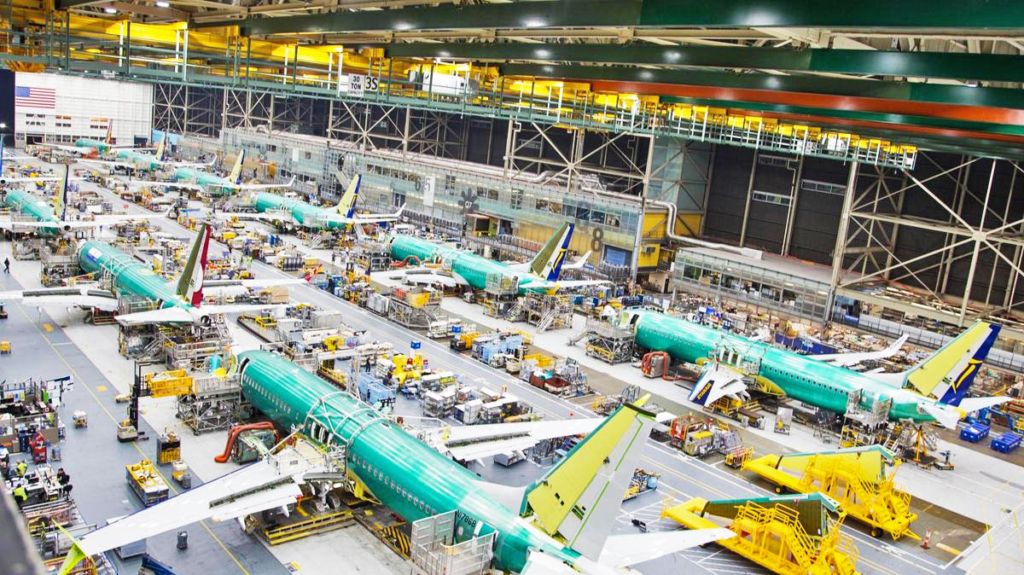
Currently, all 737 MAX jets are produced at the company’s Renton facility, with three active production lines.
The North Line will be capable of building all 737 MAX models, and will initially focus on producing the 737-8, 737-9, and 737-10.
Boeing CEO Kelly Ortberg confirmed that the 737 MAX 10, the largest and most complex variant of its narrowbody family, will be produced predominantly at the Everett factory.
Ortberg noted that isolating the MAX 10 to the North Line will allow the three Renton lines to maintain faster and more efficient flow rates.
Boeing Chief Financial Officer Jay Malave described the new production line as an “exact replica” of the three lines already operating in Renton. Anything above a rate of 47 aircraft per month will be built in Everett.
Boeing hopes to eventually reach a MAX production rate of 63 planes per month, though Boeing’s 737 program manager Katie Ringgold noted this would take a number of years.
Production in Everett will replicate the 737 build process used in the Renton factory, with one key addition: the 737 Wing Transport Tool, which will ferry partially completed wings for final assembly in Everett.
The North Line team will include a combination of newly hired employees and existing teammates drawn from Renton, Everett, and Moses Lake. This staffing approach ensures safety and quality standards remain consistent across all 737 MAX production and gives new hires direct access to experienced mechanics.
One veteran mechanic, John V., brings nearly 40 years of Boeing experience spanning the 747, 767, and 777 programs to his new role as FAA and customer coordinator for the North Line. “This will be my first time working on the 737 program,” he said. “But we are doing the training right. Even folks like me who have been around for a long time are in Renton now getting familiar with the program and the product before the North Line starts.”
In late 2025, Jaden Myers and Alondra Ponce were among the first employees hired specifically for the 737 North Line. Both completed 12 weeks of Foundational Training followed by structured on-the-job training (SOJT) conducted at the Renton facility.
SOJT pairs new mechanics with experienced teammates to reinforce skills and build confidence before the line begins operation.
“Training was so positive and refreshing,” said Alondra Ponce, an electrician for Flow Day 1. “My managers and the workplace coaches were always there to make sure I got my questions answered and felt confident in my work.”
Once the North Line begins operation, Boeing will enter a phase known as Low Rate Initial Production (LRIP). During LRIP, the build process is intentionally slowed to allow for additional checks and adjustments before full production flow times are established.
Jennifer Boland-Masterson, production leader for the Everett line, described the approach: “It’s like running. We know how to do it, and we’ve done it before, but we need to warm up our muscles. You don’t start with a marathon. You start with shorter distances and build up from there.”
Boeing will use the first set of airplanes built during LRIP to demonstrate conformity to the Federal Aviation Administration (FAA), allowing the North Line to operate under Boeing’s production certificate, PC700.
Following LRIP and conformity airplanes, the North Line will be integrated into the overall 737 MAX flow, adding capacity for production rates above 47 airplanes per month.
Boeing was on a path to produce 63 MAX planes per month in 2018 and early 2019, before two fatal 737 MAX crashes grounded its most popular aircraft.
The COVID-19 pandemic further hampered production, and in January 2024, a midair fuselage blowout again slowed Boeing’s factory.
The FAA capped Boeing’s MAX production rate following the door-plug blowout on an Alaska Airlines (AS) 737-9 MAX departing Portland International Airport (PDX). That production limit was later raised to 42 per month in October.
Boeing’s Washington workforce shrank 4% in 2025, from 67,000 workers in 2024 to 65,000, reflecting companywide cuts, offset by renewed hiring efforts in the second half of 2025 to increase MAX output.
Ringgold credited three main factors in Boeing’s production turnaround: a culture reset, quality improvement demands on major 737 suppliers, and pushing production decisions to the factory floor level, where workers, rather than executives, determine whether a plane should advance on the assembly line.