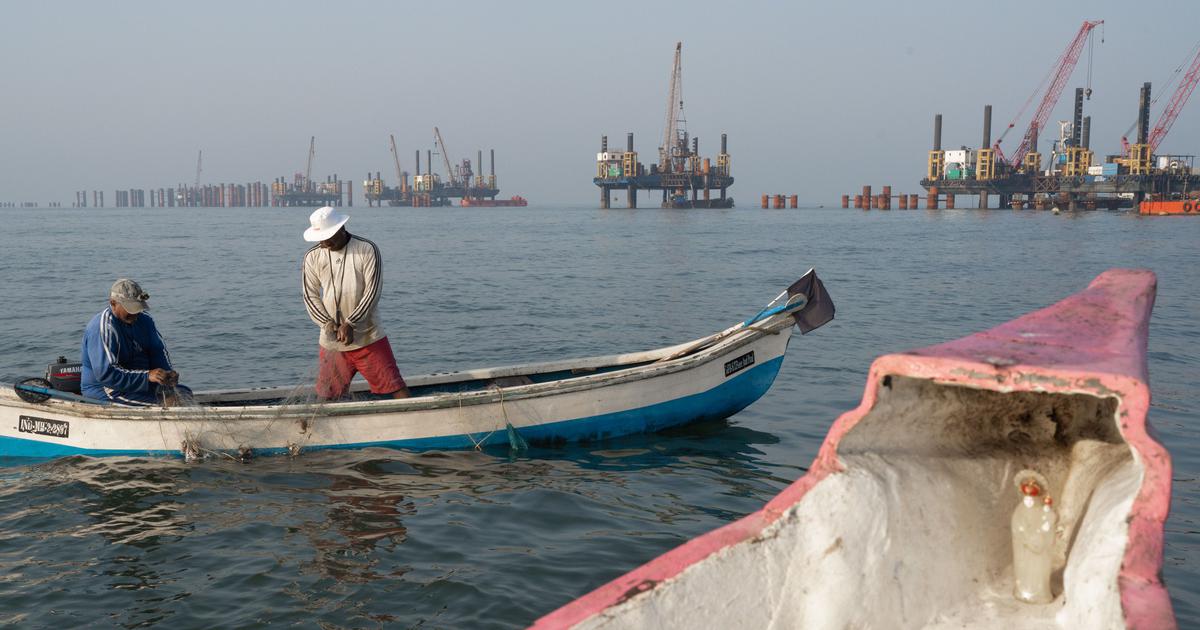
In the coastal village of Mora Gaon, located near Juhu beach in Mumbai, local fisherman Manav Mangela stands amidst the construction of pillars for the ambitious Coastal Road project. After a two-hour fishing trip that morning with his cousin and uncle, he proudly displays their modest catch, which earned them approximately Rs 1,500. Unfortunately, this sum barely suffices to support his family in one of India’s most affluent cities, reflecting the harsh realities faced by the fisherfolk community.
Historically, the Koli community, of which the Mangela family is a part, has resided in Mumbai for centuries, long before the city emerged as India’s financial powerhouse. Once situated on the edge of an estuary, their village enjoyed direct access to clean waters, vital for their livelihoods. However, as urban development surged over the past thirty years, the landscape has drastically changed. The mudflats that once nourished their community have been filled in, and the shoreline is now heavily polluted with industrial waste and plastics.
Today, an estimated 500,000 Kolis inhabit Mumbai, yet only a fraction—about 20%—still engage in traditional fishing practices. Their way of life is increasingly jeopardized by land encroachment and the deteriorating condition of the ocean. The impending Coastal Road, which carries a hefty price tag of Rs 14,977 crore (approximately $1.8 billion), poses yet another threat to their existence. While the project aims to enhance travel efficiency for car owners moving between South Mumbai and the western suburbs, it also signifies a potential end to the artisanal fishing practices that have sustained the Koli community for generations.
The Coastal Road project has sparked a wave of debates among environmentalists, local communities, and government officials. Proponents of the project argue that it will reduce congestion and provide much-needed infrastructure for a rapidly growing city. However, critics raise concerns over the environmental degradation and displacement of fishing communities. The toxic levels of pollution in coastal waters, coupled with the increasing competition for land from real estate developers, have resulted in a precarious situation for the Kolis.
As the construction progresses, many in the community feel a sense of despair and uncertainty about their future. The Kolis, traditionally skilled in their craft, find it increasingly challenging to sustain their livelihoods in the face of industrial expansion and governmental neglect. The Coastal Road could symbolize a pivotal moment where the needs of urban development overshadow those of vulnerable communities, raising the question: what price are we willing to pay for progress?