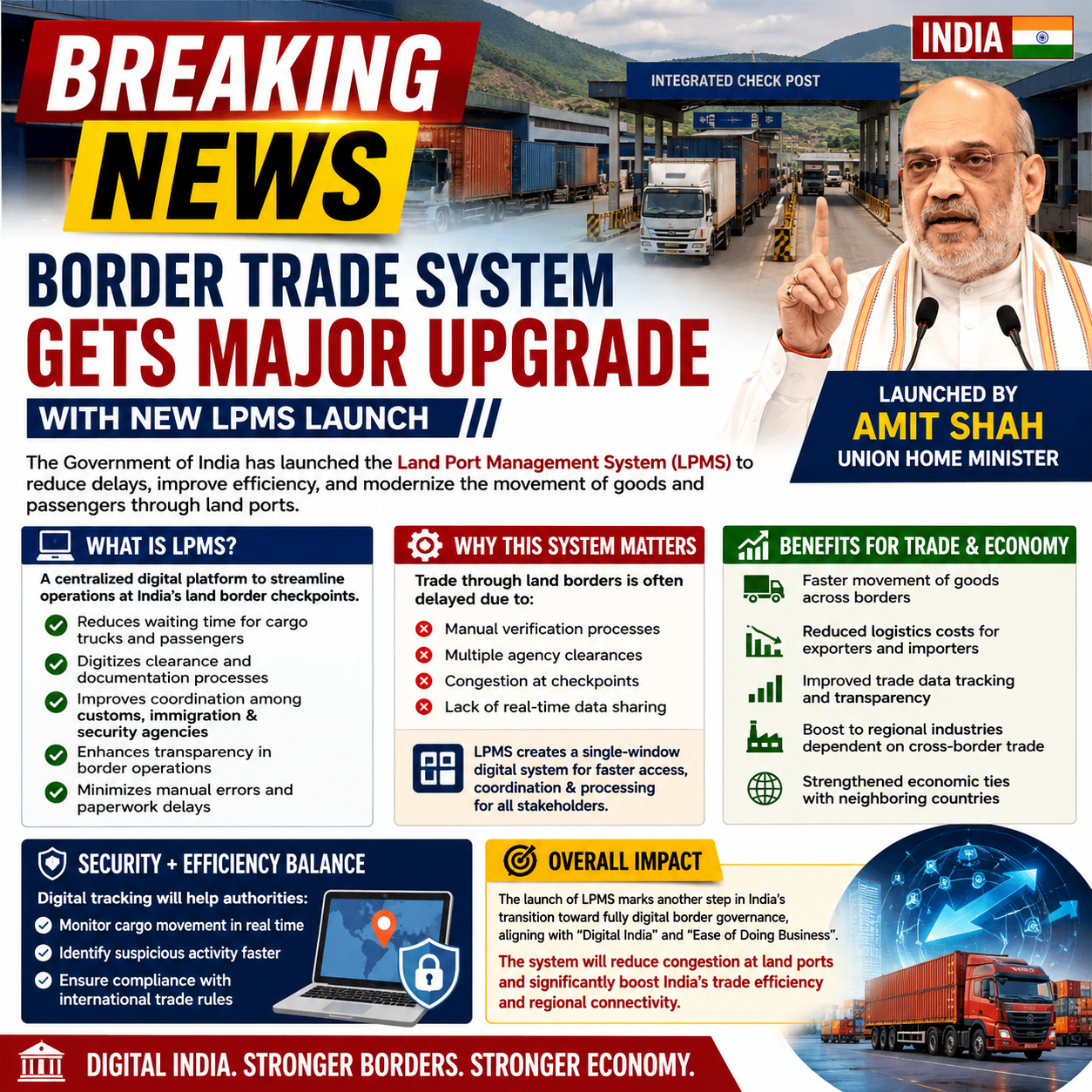
New Delhi: The Government of India has launched the Land Port Management System (LPMS), a digital platform aimed at improving the management of trade and passenger movement through land border checkpoints.
The system was launched by Union Home Minister Amit Shah as part of ongoing efforts to digitize border infrastructure and streamline operational processes at land ports.
What is LPMS?
The Land Port Management System (LPMS) is a centralized digital platform designed to support the management of cargo and passenger movement at India’s land ports.
According to officials, the system aims to:
- Reduce processing and waiting times
- Digitize documentation and clearance procedures
- Improve coordination among multiple agencies
- Enhance transparency in border operations
- Reduce paperwork and manual processing requirements
Addressing Operational Challenges
Land ports often handle large volumes of trade and passenger traffic. Authorities say the new system is intended to address challenges such as multiple clearance procedures, documentation delays, congestion and limited real-time information sharing among agencies.
The LPMS seeks to provide a unified digital framework for stakeholders involved in border operations.
Expected Benefits
Officials expect the system to support:
- Faster processing of cargo movement
- Improved logistics efficiency
- Better trade data management
- Enhanced coordination between agencies
- Greater transparency in border operations
Industry observers note that digital reforms in border infrastructure can contribute to smoother trade facilitation and improved operational efficiency.
Security and Monitoring
The platform is also expected to strengthen monitoring capabilities through digital record-keeping and improved information sharing. Authorities state that enhanced tracking mechanisms may assist in regulatory compliance and operational oversight.
Conclusion
The launch of LPMS marks a step toward the modernization of India’s land port infrastructure. Its effectiveness will depend on implementation, stakeholder adoption and continued integration with customs, immigration and other border management systems.