Assam Floods 2026: Northeast Once Again Feels Forgotten as Devastation Leaves Thousands in Crisis
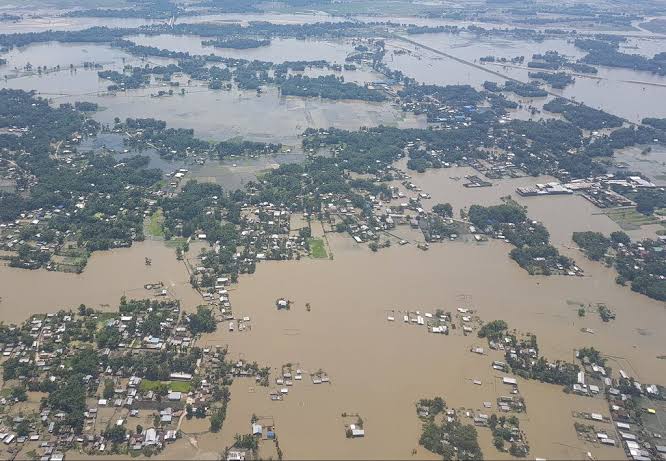
The devastating floods that struck Assam on July 19, 2026, have once again raised serious questions about the long-term preparedness, disaster management and political attention given to the Northeast region of India.
Several parts of Assam, particularly Sivasagar, Jorhat, Nazira, Sivasagar district and the greater Charaideo region, have reportedly faced severe destruction due to the unprecedented rise in floodwaters. According to estimates circulating in public discussions, the overall economic loss could be around ₹3,000 crore, while dozens of people have reportedly lost their lives and countless animals and livestock have also perished in the disaster.
The scale of the destruction has left thousands of families struggling to protect their homes, livelihoods and sources of income. Agricultural land, roads, infrastructure and other essential assets have also been severely affected in several areas.
Despite the magnitude of the crisis, concerns are being raised over whether the response from the Central Government has been adequate and proportionate to the scale of the disaster. Many people in Assam and across the Northeast feel that the region receives significant political attention during election periods, but that the same level of urgency and importance is often missing when the people face devastating natural disasters.
The recurring floods in Assam are not a new phenomenon. For decades, the people of the state have been demanding that the annual floods and erosion be treated as a national disaster, arguing that the scale and frequency of the devastation go far beyond the capacity of the state government alone to manage.
Questions have also been raised about the possible causes behind the sudden and extreme flooding. Some sections of the public have linked the disaster to water releases and events involving dams in neighbouring regions, while others have alleged that mining activities, including coal mining in the hills of Nagaland, may have contributed to environmental degradation and the accumulation or sudden release of water. However, these claims remain matters of public debate and require independent scientific investigation and official verification before any conclusion can be reached.
What is equally concerning is the limited national media attention given to the disaster. A catastrophe of such magnitude in Assam and the wider Northeast should receive extensive coverage across the country, allowing the rest of India to understand the human, economic and environmental cost being borne by the region.
The Northeast is an integral part of India, and its people deserve the same attention, compassion and policy priority as any other part of the country. Repeated natural disasters should not become routine headlines that disappear after a few days.
The people of Assam are therefore asking a simple but important question: How long will the Northeast continue to feel neglected?
The current crisis should serve as a wake-up call for both the Central and State Governments. Assam needs a long-term, scientific and sustainable flood-management strategy, stronger early-warning systems, better rehabilitation measures, environmental protection and greater financial support for disaster recovery.
The people of Assam do not seek sympathy alone. They seek action, accountability and equal importance.
As the state continues to recover from yet another devastating flood, the demand remains clear: Assam and the Northeast must no longer be treated as a peripheral region of India. The region deserves attention not only during elections, but every day.
BISWAJIT DAS
0 followers