Beyond the Result: What India Gained From the SLC XI Warm-Up and Why Sarfaraz Got the Call .
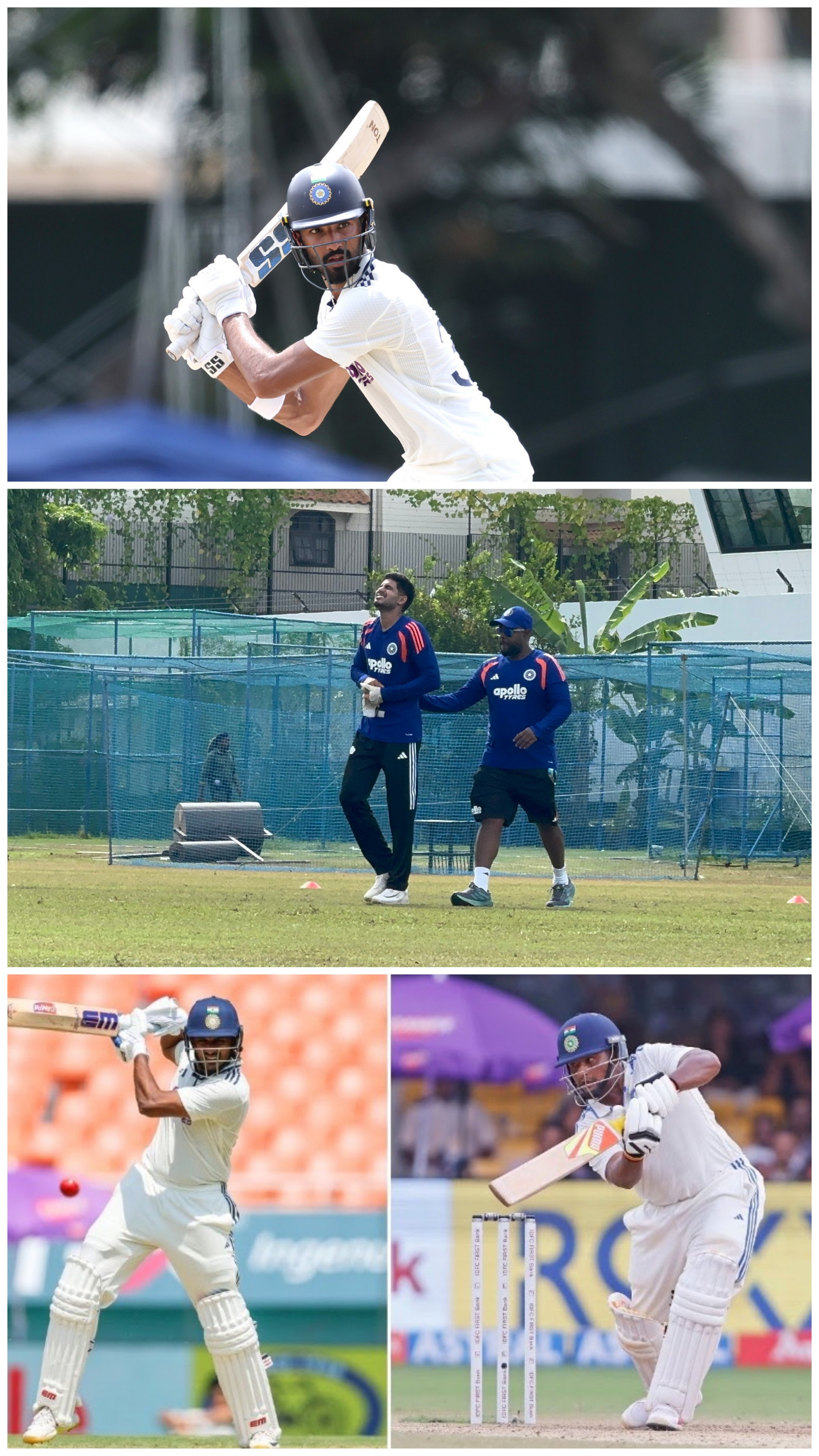
The three-day game in Colombo was never simply about winning. It was India's final laboratory before the Sri Lanka Tests—and it produced some important answers, along with a few fresh questions.
India's six-wicket victory over the Sri Lanka Cricket XI in Colombo may look straightforward on the scorecard, but the result was arguably the least important part of the three-day exercise.
For India's team management, the game was designed as a final competitive rehearsal before the Test series against Sri Lanka. After a break from Test cricket, India needed their players to rediscover the rhythm of the longest format, experience local conditions and give the selectors and coaching staff some final evidence before the first Test in Galle.
There was also an important selection question surrounding the No.3 position.
And then, during the course of the preparation, another question emerged: who would replace Sai Sudharsan after the left-hander was ruled out of the series?
By the end of the three days, India had received several useful answers.
The first objective: match practice
-------------------------------------
The biggest reason behind playing a three-day warm-up was competitive preparation.
There is only so much a player can gain from batting or bowling in the nets. A proper red-ball game demands patience, concentration and physical endurance. Batters have to construct an innings rather than simply face a fixed number of deliveries, while bowlers need to build spells and manage their workloads.
Sri Lanka XI's first-innings 363/8 declaration ensured India's bowlers had plenty of time in the middle.
For the pace attack, it was an opportunity to understand how the conditions affected movement, pace and lengths. For the spinners, it provided an early indication of how the surface behaved and how much assistance could potentially be available.
That experience could prove particularly valuable when India arrive in Galle, where adapting to spin-friendly conditions and maintaining discipline over long periods can determine the course of a Test.
On this count, the warm-up achieved its purpose.
Padikkal provides the biggest batting answer-
-----------------------------------------------
India also needed to assess their batting combinations.
The most encouraging development came from Devdutt Padikkal.
The left-hander produced an unbeaten 142, an innings that was important not simply because of its size but because of its context. He spent substantial time at the crease and demonstrated the patience and temperament expected from a Test middle-order batter.
His timing could not have been better.
With Sai Sudharsan subsequently ruled out of the Test series, India's No.3 equation suddenly became more complicated. Sudharsan had been expected to occupy that position after impressing during India A's tour.
Padikkal's hundred-plus score, however, has strengthened his own case considerably.
A warm-up match should never be treated as a definitive selection trial, but performances in such games matter when players are competing for places. Padikkal gave the management something very valuable: evidence that he could spend a long period at the crease in conditions similar to those India will encounter during the Test series.
Jaiswal and Gill provide additional positives-
-----------------------------------------------
Yashasvi Jaiswal's performance was another interesting takeaway.
The opener was dismissed for a duck in the first innings, but he responded with a fluent 61 from 46 balls during India's successful chase.
That second innings was important because India's openers will have a major role to play in Sri Lanka. Jaiswal's ability to change gears while still remaining effective against the conditions is one of India's biggest strengths.
There was also relief surrounding Shubman Gill.
India's captain had missed the first day after suffering an injury to his right ring finger during training. His return to the middle and subsequent 44 was therefore more important than the number itself.
For India, the objective was not necessarily to see Gill score a hundred. It was to make sure the captain was able to bat and field without complications before the first Test.
That box was largely ticked.
Not every question was answered
----------------------------------
The warm-up was encouraging, but it would be wrong to suggest India solved every selection issue.
Rishabh Pant scored 28, while Dhruv Jurel made 17. Neither was able to turn the opportunity into a major statement.
The bowling unit also got useful game time, but three days in Colombo cannot provide a complete picture of what India's attack will face in Galle.
The warm-up therefore provided information rather than certainty.
And that is precisely what India wanted.
Sai Su ruled out and Sarfaraz got a comeback call-
----------------------------------------------------
Sai Sudharsan's absence changed India's squad dynamics.
The left-hander had been in excellent form for India A, scoring two centuries in unofficial Tests in England before the Sri Lanka assignment. His injury therefore represented a significant setback.
Once it became clear that he would not recover in time for the Test series, the selectors had to decide who should join the squad.
Three names naturally entered the conversation: Sarfaraz Khan, Ruturaj Gaikwad and Shaik Rasheed.
Rasheed had a compelling case.
The young batter had already been with India A in Sri Lanka and had experienced the conditions first-hand. His scores of 45, 63 and 20 across his three innings demonstrated that he was comfortable enough in the environment to remain a serious contender.
Ruturaj offered another alternative.
He has substantial domestic experience and the versatility to operate in the top order. However, his recent India A performances did not provide the strongest argument when compared with the other candidates.
Sarfaraz ultimately emerged as the preferred choice.
Why Sarfaraz over Rasheed and Ruturaj?
---------------------------------------
If we go by sources at first team management wanted Ruturaj to be there in place of Sai and selectors were really impressed
of Shaik Rasheed but it was the skipper Shubman Gill who was eager and showed interest in Sarfaraz Khan and that's what really made the difference and made a strong case in favour of Sarfaraz.
The most obvious reason is Test experience.
Sarfaraz has already played six Tests for India and scored 371 runs at an average of 37.10.
That experience becomes particularly valuable when a player is being added to a squad immediately before a Test series.
India did not necessarily need another batter simply for development purposes. They needed someone who could enter the international environment without requiring an introduction to the demands of Test cricket.
Sarfaraz also has a reputation as a strong player of spin, which makes him a logical option for Sri Lankan conditions. His recent fitness work at the Centre of Excellence was another factor in his favour.
The selection therefore appears to have been less about declaring Sarfaraz superior to Rasheed or Ruturaj and more about what India needed right now.
Rasheed represents the future.
Ruturaj represents experience and domestic consistency.
Sarfaraz represents international readiness.
With the Test series only days away, that distinction mattered.p
Sarfaraz replaces Sudharsan in the squad—not necessarily the XI-
------------------------------------------------------------------
There is another important nuance.
Sarfaraz's selection does not automatically mean he will replace Sudharsan at No.3.
Padikkal's 142 has potentially changed that equation.
If the team management believes Padikkal has done enough to take the No.3 position, Sarfaraz could find himself providing middle-order cover rather than immediately walking into the playing XI.
That makes the warm-up performance even more significant.
India went into Colombo needing to answer questions about preparation, combinations and match fitness.
They got meaningful bowling workloads.
They saw Jaiswal find rhythm.
They saw Gill return safely.
They witnessed Padikkal make a compelling case.
They also discovered that some positions remain open.
And when Sudharsan's injury forced an unexpected selection decision, they opted for a player with proven Test experience.
The real value of the warm-up-
------------------------------
Ultimately, India's six-wicket victory should not be viewed simply as a successful result.
The real value of the three-day game was the information it generated.
India now have a better idea of where their players stand physically and technically before Galle. They have seen Padikkal handle pressure and time at the crease. They have seen Jaiswal respond positively after an early failure. They have seen Gill return after an injury concern.
And they have added Sarfaraz Khan to the squad at a time when experience could be crucial.
The warm-up did not answer every question.
But that was never its job.
Its job was to reduce uncertainty before the first Test.
And in that respect, India can consider the three days in Colombo a productive exercise.
The scorecard will remember a six-wicket win.
The Indian team management will remember something much more valuable: three days of information that could shape the XI, the batting order and India's approach when the real examination begins in Galle.