Bihar Was Never Behind. Perhaps Our Perception Was — A Bihari's Journey from Patna Museum to New York's Met.
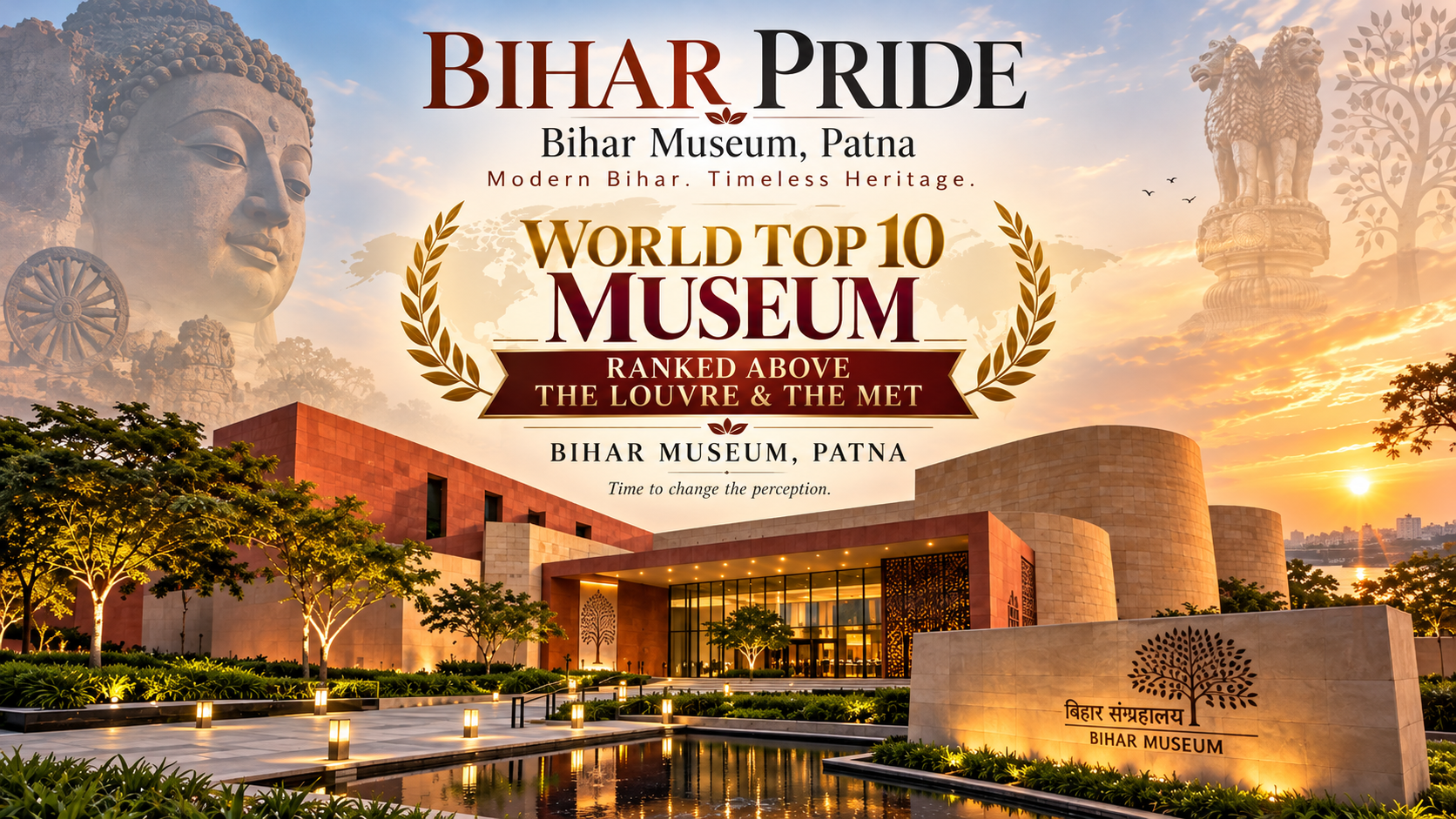
BIHAR WAS NEVER BEHIND. PERHAPS OUR PERCEPTION WAS.
Bihar Museum’s Global Recognition: A Bihari’s Personal Journey from Patna to New York
OPINION | HERITAGE | MINDSET
By Dr. Amit Premit
Author, Psychologist & Career and Mindset Mentor
PATNA, 31 OCTOBER 2026
What if a museum in Patna were ranked ahead of some of the world’s best-known museums in an international ranking? Would we celebrate the achievement immediately, or would we first question how a museum in Bihar could receive such recognition?
Perhaps that reaction itself deserves reflection.
Bihar Museum’s International Recognition
According to the published list titled “The World’s 100 Best Museums 2026” by the travel publication Worth a Journey, Bihar Museum in Patna is ranked ninth globally and is the highest-ranked museum in Asia on that particular list. The article’s cited references also place the Metropolitan Museum of Art in New York at tenth and the Louvre in Paris at thirty-first.
It is important to understand what these positions represent. This is a ranking published by a private travel publication using its own evaluation methodology. It should not be interpreted as a universal judgement that one museum has a historically or artistically superior collection to another. The ranking’s methodology and available scoring information should be considered when interpreting the results.
Nevertheless, such recognition offers an opportunity to discuss Bihar’s cultural heritage and the way it is perceived.
For me, this subject is personal.
I Have Seen Both Worlds—and I Have a Story to Tell
I have visited the historic Patna Museum many times. Its archaeological collections, sculptures, artefacts and historical treasures have always fascinated me.
I have also visited the Metropolitan Museum of Art in New York and other museums during my travels. The Met is remarkable for its collections representing cultures and civilisations from across the world.
Yet, in my personal opinion, Patna Museum possesses extraordinary historical richness, particularly when viewed through the lens of India’s ancient civilisational heritage.
This is a personal assessment, not an academic comparison of the museums’ collections. The historic Patna Museum and the newer Bihar Museum are distinct institutions, although their histories and collections are connected.
According to information cited from Bihar Tourism, artefacts were transferred from Patna Museum to Bihar Museum, including the celebrated Didarganj Yakshi sculpture. The newer museum also offers modern architecture, organised galleries and contemporary exhibition facilities.
Perhaps Bihar did not suddenly become extraordinary. Perhaps we are only now learning to recognise what was already there.
Another Personal Experience: Patna’s Planetarium
There is another experience that continues to make me smile.
Patna is home to the Indira Gandhi Planetarium, which Bihar Tourism describes as one of India’s largest planetariums.
During my time in the United States, I remember taking my children to a planetarium in Connecticut. Compared with the scale I remembered from Patna, the facility we visited felt much smaller.
That was my personal impression, not a technical comparison of dome sizes, seating capacities or scientific infrastructure.
But the experience raised an interesting question: why do we sometimes assume that everything in America or Europe must automatically be bigger, better or more advanced?
There is nothing wrong with appreciating international achievements. But should that appreciation come at the cost of overlooking our own?
Bihar: A Land That Has Shaped Civilisation
The region known today as Bihar has an extraordinary historical legacy.
Ancient Magadha became a major centre of political power and intellectual development. Pataliputra served as the capital of major empires. Nalanda and Vikramshila became renowned centres of learning, while Bodh Gaya remains one of the world's most significant Buddhist pilgrimage destinations.
The historical and intellectual traditions associated with figures such as Chanakya and Aryabhata continue to inspire generations.
These are not merely points of regional pride. They are chapters in the wider history of India and the world.
Yet modern Bihar is often discussed primarily through poverty, migration, unemployment and political controversies. These challenges are real and deserve serious public attention.
However, examining developmental shortcomings is different from allowing those shortcomings to define the identity of millions of people.
A Bihari should not have to succeed outside Bihar before being considered worthy of respect within India.
The Real Challenge: Changing the Mindset
As a psychologist, career counsellor and mindset mentor, I find this particularly relevant.
Human beings develop perceptions through experience, social conditioning and repeated exposure to particular narratives. Once these perceptions become deeply ingrained, we may begin interpreting new information through old assumptions.
Limiting beliefs can become obstacles to individual growth. I believe a similar phenomenon can influence how people perceive an entire state.
Perception is not always reality, and repetition does not turn a stereotype into a fact.
When counselling students, we encourage them to recognise their strengths, examine assumptions and challenge limiting beliefs. Why should we not apply the same approach when judging Bihar?
A museum ranking cannot solve Bihar’s developmental challenges. It cannot erase economic inequalities or automatically create employment opportunities. However, it can provide a reason to pause and reconsider an inherited narrative.
Perhaps the first step towards progress is learning to recognise potential where we have been conditioned to see limitations.
Pride Must Be Matched with Progress
Celebrating Bihar’s heritage should never become an excuse to ignore its shortcomings.
Bihar needs stronger infrastructure, better educational opportunities, employment generation, improved civic facilities, heritage conservation and sustained investment in tourism.
Recognition should inspire responsibility, not complacency.
We need to preserve the historic Patna Museum, strengthen the modern Bihar Museum and promote the state’s cultural and educational institutions to national and international audiences. We should also encourage students and families to explore these places.
Heritage is not merely something to photograph. It helps each generation understand its roots, identity and possibilities.
My Message: Visit Bihar Before Judging Bihar
Visit the Bihar Museum.
Explore the historic Patna Museum.
Experience the Patna Planetarium.
Walk through Nalanda, Rajgir and Bodh Gaya.
Discover the Bihar that exists beyond political headlines and popular stereotypes.
And to my fellow Biharis, I would say: be proud of our roots, but never let pride replace the determination to improve.
Let us celebrate achievements while demanding accountability and progress. Let us challenge prejudice through knowledge, competence, character and contribution.
Bihar does not need sympathy. It needs opportunity, investment, accountability and a fair mindset.
The recognition given to Bihar Museum by Worth a Journey is one international publication’s assessment. It is neither the beginning nor the final measure of Bihar’s cultural worth. Nevertheless, it provides a welcome opportunity to challenge assumptions and encourage a more balanced conversation.
BIHAR WAS NEVER SHORT OF HISTORY.
BIHAR WAS NEVER SHORT OF TALENT.
BIHAR WAS NEVER SHORT OF POTENTIAL.
Perhaps it is time we changed how we look at Bihar.
Proud of Patna. Proud of Bihar. Proud of our heritage—and committed to a better future.
About the Author
Dr. Amit Premit is an author, psychologist, career counsellor and mindset mentor, and founder of Premit Brothers Career Mantra. He is the author of Kuch Kaam Kar Lo (K3L) and works towards helping individuals and students move from confusion to clarity through mentoring, psychological understanding and career planning.
Editorial Note
This opinion article reflects the author’s personal experiences and interpretation of publicly available information. The museum ranking discussed is attributed to Worth a Journey, an independent travel publication, and should not be interpreted as official international accreditation or a definitive measure of the relative cultural, artistic or historical value of the museums concerned. The author’s comparisons of museums and planetariums are subjective observations. The ranking and related factual claims should be checked against the original publications before publication.