"FEROZEPUR FORT (PB): THE SILENT SENTINEL OF INDIA’S MILITARY HISTORY"
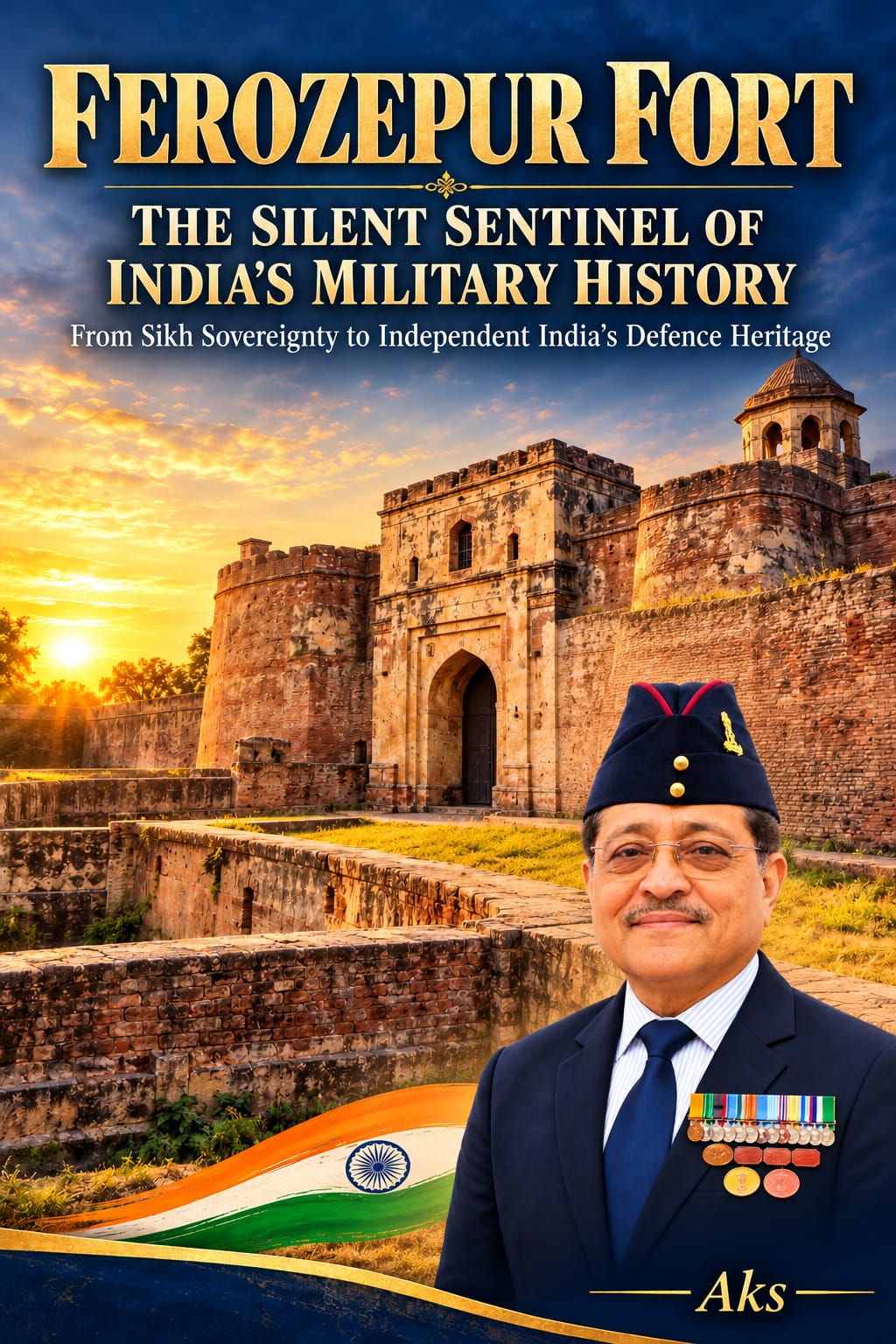
By
Col (Dr.) Ashwani Kumar, MiD, VSM (Retd).
From Sikh Sovereignty and British Imperial Power to the Defence Heritage of Independent India.
History is not preserved merely in the pages of books. It lives in the walls of ancient forts, the ruins of forgotten establishments and the memories of those who have walked through their gates. Ferozepur Fort in Punjab is one such historic monument, a silent witness to changing political powers, military campaigns and the evolution of India's defence landscape.
Situated in the strategically important border district of Ferozepur, near the Sutlej River and the India - Pakistan border, the fort represents far more than an architectural relic. Its history reflects the transition from regional Sikh authority to British colonial domination and, eventually, its continuing significance in the military heritage of independent India.
For me, however, Ferozepur Fort is not merely a subject of historical interest. It is also connected with my own memories of Ferozepur, my school and college days, and my tenure in the city. I have visited the fort many times, yet every visit offered a new experience. The same walls, the same historic surroundings and the same silent structures seemed to reveal a different dimension of the past on every occasion. That personal connection makes the fort's history all the more meaningful to me.
From Sikh Authority to British Occupation.
The history of Ferozepur is closely linked to the political developments of 18th - and 19th century Punjab. The region witnessed the rise and consolidation of Sikh authority before becoming an important component of British imperial strategy.
Sardar Dhanna Singh exercised control over the territory, and following his death, his widow, Sardarni Lachhman Kaur, continued to defend her position during a period of considerable political uncertainty. Her role represents a relatively neglected chapter in the history of Punjab, when local rulers and their families struggled to preserve their authority amid the expansion of British power. Following her death in 1835, the East India Company took control of Ferozepur. By 1839, the British had established the fort as a military garrison, transforming the area into an important centre of their expanding military presence in north-western India.
This transition marked a decisive turning point. A territory that had formed part of Punjab's political landscape was drawn into the machinery of British imperial power. The fort became an instrument through which that power could be maintained, reinforced and projected across the region.
A Fortress Designed for War.
The architecture of Ferozepur Fort reflects the military requirements of its age. Its defensive arrangement, comprising a star shaped outer defence, a hexagonal middle section and a rectangular inner core, demonstrates the importance attached to fortification and the protection of military installations.
The fort was developed under the supervision of General Sir Henry Lawrence and became an important British military establishment. Its significance, however, extended far beyond its walls. It served as a garrison and arsenal, supporting the storage, movement and distribution of military supplies.
During the nineteenth century, military power depended not only on the courage of soldiers or the outcome of battles, but also on the ability to maintain reliable supply lines. Ammunition, weapons, provisions and transport animals were indispensable to the functioning of an army. Ferozepur's strategic location made it a valuable part of this logistical network.
During the First Anglo - Afghan War of 1838 - 42, Ferozepur also served as a base for British military operations towards Afghanistan. Its role demonstrated how a military establishment in Punjab could support imperial ambitions extending far beyond the immediate frontier. The fort's history therefore illustrates an essential principle of military strategy, the strength of an army rests not only on its fighting formations but also on the infrastructure, logistics and supply systems that sustain them.
The Revolt of 1857: A Dark Chapter.
The uprising of 1857 remains one of the defining episodes in India's struggle against British rule. What began as a military rebellion developed into a wider challenge to the authority of the East India Company. Ferozepur Fort, with its military garrison and arsenal, occupied a sensitive position during this upheaval. Historical accounts record an attack by rebels, although the British retained control of the fort. The subsequent arrests and executions associated with the uprising reveal the brutal character of the confrontation between colonial authority and those who challenged it. The fort thus acquired a dual historical significance. For the British, it represented the preservation of a strategically important military installation. For those who resisted colonial rule, it became part of the landscape of repression and sacrifice.
Historical accounts report that approximately 140 rebels were arrested following the events associated with the attack, and 40 were executed within the fort. These figures deserve to be examined in the context of reliable historical records, but the broader significance is unmistakable, the maintenance of colonial authority came at a terrible human cost. The events of 1857 remind us that the history of colonial India cannot be understood solely through the policies of rulers or the movements of armies. It must also account for the experiences of those who resisted imperial power and the price they paid for doing so.
The Arsenal and the Machinery of Empire.
The military importance of Ferozepur Fort continued to grow. Its arsenal operations expanded, and it became an important centre for the storage and supply of weapons and ammunition. Its infrastructure supported the broader requirements of British military operations in the subcontinent.
The fort's history also intersects with the two world wars. During the Second World War, it continued to be associated with military supply operations. Popular accounts suggest that ammunition originating from Ferozepur attracted the attention of Nazi Germany and that Adolf Hitler contemplated attacking the town. However, the more dramatic versions of this story remain insufficiently substantiated by reliable documentary evidence and should not be presented as established fact.
This distinction between historical evidence and popular legend is important. A monument's genuine history is sufficiently compelling without embellishment. Ferozepur's documented military significance, its strategic location and its role in the organisation of military supplies already establish its importance. The fort reminds us that military history is not simply a chronicle of battles. It is also the history of arsenals, supply depots, transport systems and the countless activities that make military operations possible.
From Colonial Garrison to Independent India.
The Partition of 1947 transformed the political geography of Punjab and gave Ferozepur renewed strategic significance. Its proximity to the newly established international border placed the region within the frontline considerations of independent India's defence planning. The fort continued to serve military purposes after Independence and became part of the military heritage associated with the Indian Army. Its history therefore spans several distinct eras: the political ascendancy of Sikh chiefs, the expansion of British power, the uprising of 1857, the world wars and the security requirements of a sovereign India.
Few military establishments offer such a concentrated illustration of the relationship between geography, military logistics and political power.
The continuity of military use also gives the fort a distinctive place in India's national memory. Although the political circumstances changed fundamentally after 1947, the strategic importance of the region remained. The fort stands as a reminder that military establishments often outlive the political systems for which they were originally built.
Bringing History Back to the People.
A significant development occurred on 1 June 2025, when the Indian Army's Golden Arrow Division opened a portion of Ferozepur Fort to the public. The initiative offered visitors an opportunity to encounter a historic military establishment that had long remained largely inaccessible.
The opening was important not merely as a tourism initiative but as an exercise in public history. It created an opportunity for students, researchers and citizens to understand the evolution of military architecture, the organisation of colonial military power and the strategic importance of Punjab. Among the surviving features associated with the fort are its historic Darbar Hall, military structures, defensive installations and an old well identified in published accounts as Well No. 85. These remnants offer glimpses into the practical and institutional life of the establishment.
The Indian Army's role in preserving and presenting this heritage deserves recognition. Military institutions are custodians not only of operational capability but also, in appropriate circumstances, of historically significant places that illuminate the country's defence past.
The opening of the fort should be viewed as the beginning of a larger endeavour. Systematic documentation, conservation, archival research and educational programmes could transform it into an important centre for the study of military history.
A Personal Connection: Memories of Ferozepur and Its Fort.
My association with Ferozepur Fort goes beyond historical accounts and published narratives. It is deeply rooted in my personal memories of Ferozepur, a place connected with my school days, college years and professional tenure.
I distinctly remember those years and the many occasions on which I visited the fort. Despite having been there numerous times, I never felt that I was merely revisiting a familiar place. Every visit was a new experience. Something about its surroundings, its old structures or its historical atmosphere would invariably prompt a fresh thought or a deeper reflection.
The fort was never just a military installation to me. It was a living link between the past and the present, where history seemed to acquire a tangible form. Walking through its historic surroundings encouraged me to think about the generations who had lived, served and struggled within its walls, and about the extraordinary changes that the region had witnessed.
There is a unique difference between reading about a monument in the pages of a book and experiencing it repeatedly over the years. With every visit, familiarity may increase, but so can curiosity. A structure that appears ordinary at first can gradually reveal its deeper significance when viewed through the lens of history and personal experience.
My memories of Ferozepur are therefore inseparable from my understanding of its fort. The place connects the formative years of my life with a much larger historical narrative the rise and fall of political powers, the demands of military service and the enduring importance of India's frontier regions.
Looking back, I realise that the fort's enduring fascination lies in its ability to connect individual memory with collective history. Its walls have witnessed events far greater than any one person's experience, yet they also preserve the intimate associations that people develop with places over the course of their lives. That is why the renewed public interest in Ferozepur Fort is particularly meaningful to me. I hope future generations will have the opportunity to explore it, understand its significance and develop their own sense of curiosity and attachment. A monument truly lives when it becomes part of people's memories and when those memories encourage a deeper understanding of the past.
Why Ferozepur Fort Deserves National Recognition.
India possesses a remarkable heritage of forts, battlefields and military establishments. Yet the national historical narrative often concentrates on royal palaces, celebrated monuments and famous battles, overlooking the strategic infrastructure that made military power possible. Ferozepur Fort deserves a more prominent place in this narrative. It provides an opportunity to examine how armies were supplied, how colonial authority was sustained, how resistance was suppressed and how the strategic landscape evolved after Independence.
Its history should be documented through authentic archival sources, carefully researched publications, oral histories and appropriate interpretation of the surviving structures. The fort's role in the history of Punjab and India's defence establishment should also find a place in educational programmes and heritage initiatives.
Particular attention should be paid to recording the memories of former residents, military personnel and people who have maintained a long association with Ferozepur. Such personal recollections, when carefully documented and distinguished from independently established historical facts, can add an invaluable human dimension to the monument's story.
Equally important is the responsibility to preserve the fort without compromising its present military requirements. Heritage conservation and national security need not be conflicting objectives. With appropriate planning, they can reinforce one another.
The fort could become a valuable destination for students of history, military enthusiasts, researchers and visitors interested in Punjab's heritage. Proper interpretation of its structures and events would allow visitors to appreciate not only what survives but also what those remains tell us about the past.
A Silent Sentinel That Still Speaks.
At the end Ferozepur Fort is much more than a surviving military structure. Its walls have witnessed the transition from regional authority to colonial domination, the violence of rebellion, the demands of global warfare and the emergence of independent India. For those who study military history, it offers lessons in strategy, logistics and the relationship between geography and national security. For historians, it provides an opportunity to examine the complex interplay of power, resistance and political change. For people like me, who have visited it repeatedly and carry personal memories of Ferozepur, it represents something more intimate: a connection between one's own life and the unfolding story of the nation.
The fort's significance lies in the meeting of these perspectives. It is at once a military establishment, a historical monument and a repository of collective memory. The opening of a portion of Ferozepur Fort to the public provides an opportunity to reconnect this important chapter with the national consciousness. The task ahead is to ensure that its significance is researched, preserved and communicated with the seriousness it deserves.
We must not allow such monuments to survive merely as silent structures whose stories remain unknown. Their history should be recorded, their remains protected and their lessons passed on to future generations. Ferozepur Fort stands as a silent sentinel of India's military history. I have visited it many times, and every visit has offered me a new experience. Its walls may no longer echo with the movements of imperial armies, but they continue to speak of strategy, sacrifice, political transformation and the enduring importance of preserving our national heritage. The fort has witnessed the passage of centuries. It is now our responsibility to ensure that its history continues to inspire generations to come.
Author’s Note
Col Kumar writes from a deep personal association with Ferozepur, recalling his school and college days, as well as his professional tenure in the city. His repeated visits to Ferozepur Fort have strengthened his appreciation of its historical significance and enduring military heritage. I love my Ferozepur.
Disclaimer:
This article combines historical accounts with the author’s personal recollections and interpretations. While every effort has been made to present the historical narrative responsibly, certain details and popular stories may require further archival verification. The article is intended for historical awareness and public interest, and should not be treated as an exhaustive or definitive historical record.
*********