FREX 2026: Bengaluru's Franchise Market Is Changing
An on-ground report from Hall 1, Bangalore International Exhibition Centre (BIEC)
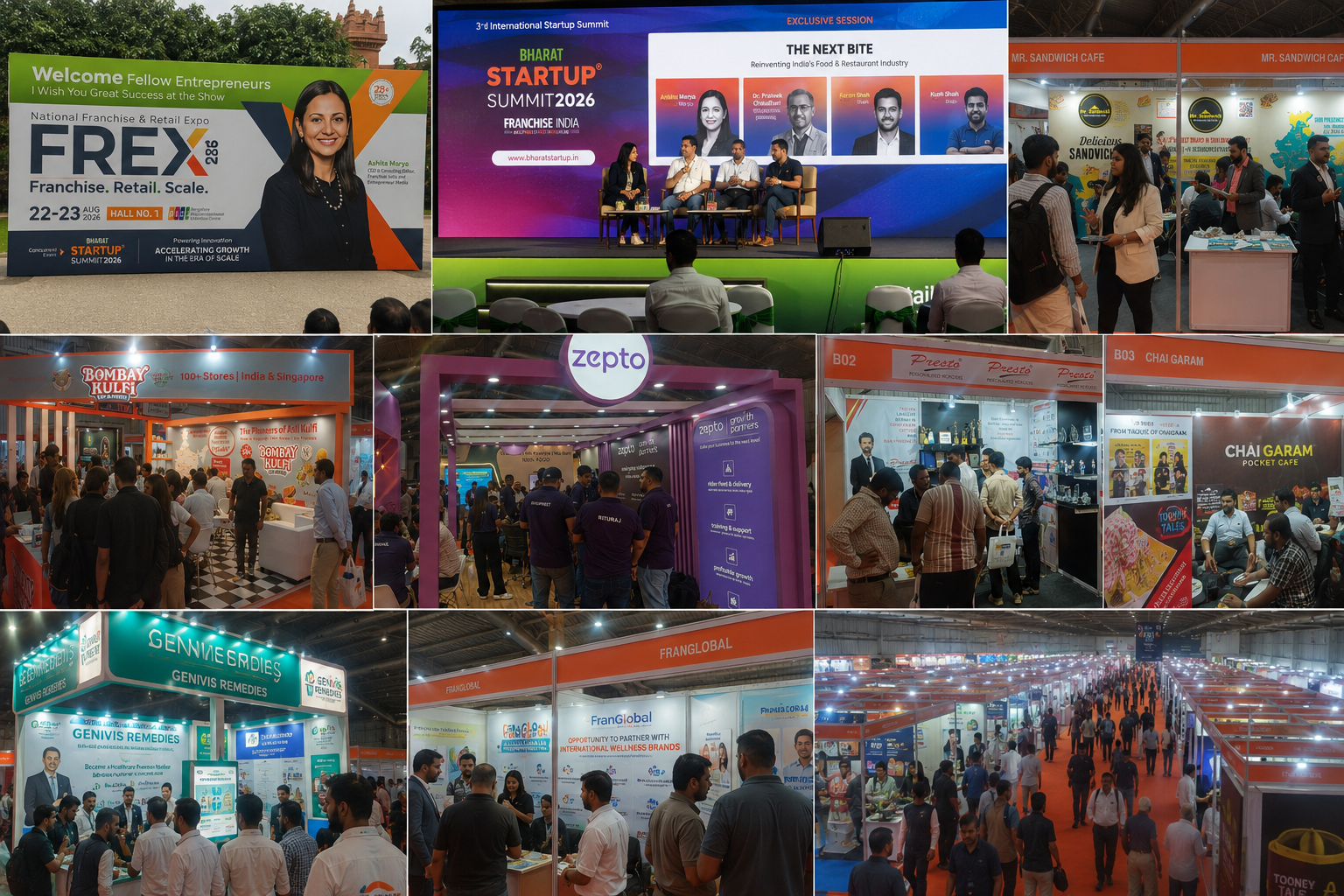
BENGALURU, 22 August 2026: I visited FREX 2026 — Franchise. Retail. Scale., held at the Bangalore International Exhibition Centre (BIEC), Madavara. Organised by Franchise India alongside the Bharat Startup Summit 2026, the two-day exhibition brought together more than 200 franchise brands, startup founders, investors and business seekers from across India.
After spending several hours across Hall 1, attending the Bharat Startup Summit and interacting with exhibitors, one conclusion became very clear: India's franchise market is moving strongly towards food, wellness and service businesses, while several traditional retail sectors are noticeably missing.
Food is no longer a category — it is the centre of the franchise business
Walking through the exhibition, almost every walkway was filled with restaurants, cafés and quick-service food brands. Popular exhibitors included Bombay Kulfi, Chai Garam Pocket Café, Mr. Sandwich Café, Franks, Figaro's Pizza, Barcelos, BurgerTory, Wrapafella and several regional food concepts.
These brands were not merely displaying products; they were offering complete franchise models with investment plans, operational support and expansion opportunities. The crowd around food stalls remained consistently high throughout the day, indicating that investors continue to see food as the safest and fastest-growing franchise segment.
Wellness and healthcare have become premium business opportunities
The second-largest presence belonged to wellness and healthcare. Brands such as Genivis Remedies, Neoskin, GP Life Wellness and Celebrate Life showcased organised healthcare franchise models ranging from clinics and dermatology to preventive wellness services.
Unlike traditional medical businesses, these companies positioned themselves as scalable franchise opportunities with standardised operations, technology support and recurring customer demand. The premium stall designs and visitor interest reflected the growing confidence in India's wellness economy.
Laundry and dry-cleaning quietly emerged as a rising sector
One of the most surprising observations was the number of laundry and garment care brands participating in the expo. Wash Kiya, LaundryTo, Laundry Pro, Primus Laundromat and Mera Laundry represented a category that rarely received attention a few years ago.
This indicates an important shift in urban business behaviour. As Bengaluru's apartment culture and working population continue to grow, organised laundry services are becoming attractive franchise investments with comparatively lower operational complexity than restaurants.
Technology supported businesses, not retail stores
Technology companies such as Zepto Growth Partners, Vyapar, Tally, GETPOS and TechnoPoints were present, but their focus was different. Instead of selling retail outlets, they offered business infrastructure, POS systems, financing, logistics and operational partnerships.
The Zepto booth attracted continuous enquiries, showing that modern franchise growth is increasingly connected with technology-enabled supply chains rather than conventional storefront expansion.
The biggest question: Where was textile retail?
For an exhibition carrying the title Franchise. Retail. Scale., the absence of textile and fashion brands was impossible to ignore.
I did not find any major apparel retail chains, ethnic wear brands, footwear franchises or organised clothing retailers. Bengaluru is one of India's strongest fashion and garment cities, yet this important industry had almost no visibility on the exhibition floor.
Education was another underrepresented sector. Apart from a couple of preschool and training institutions, there were very few schools, coaching networks or educational franchise opportunities.
This creates an interesting contrast. While organisers projected a broad franchise ecosystem, the actual exhibition was heavily concentrated around food, salons, wellness, laundry and business services.
What FREX 2026 tells us about the market
The exhibition successfully connected entrepreneurs with investors and demonstrated the strength of India's organised franchise industry. However, it also revealed where business confidence currently exists.
Investors today appear to favour businesses that offer recurring daily demand — food, beverages, healthcare, beauty and essential services. Sectors such as fashion retail, books, cultural businesses and education need stronger representation if future editions are to reflect the complete diversity of Indian entrepreneurship.
FREX 2026 was therefore more than an exhibition. It was a mirror of changing consumer behaviour and a reminder that the next phase of franchise growth will be driven not only by products, but by convenience, wellness and service-led businesses.