
Government Jobs Demand Accountability, Not Just Authority: A Call for Responsible Public Service
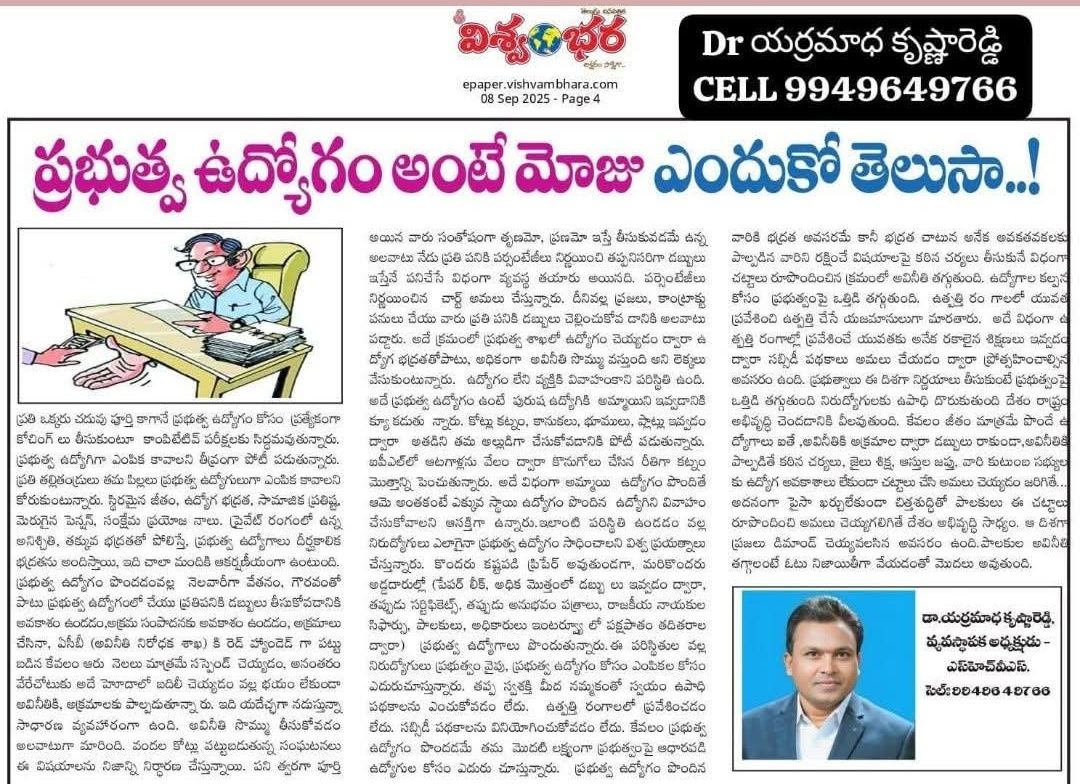
Primary Keyword: Government Jobs
Government jobs have long been regarded as symbols of stability, security and social respect. However, an important perspective highlighted in a Telugu opinion article focuses on a deeper question: should public employment be viewed merely as a secure career, or as a position carrying serious responsibility toward citizens? The discussion examines the changing nature of government jobs, rising public expectations and the need to balance employment security with accountability.
Government Jobs Carry a Larger Public Responsibility
For millions of people, securing a government job remains a major life ambition. Competitive examinations attract enormous numbers of candidates because public sector employment is traditionally associated with job security, predictable income and social recognition.
Yet, the fundamental purpose of public employment extends beyond individual benefits. A government employee is directly or indirectly connected with the delivery of essential public services. Whether working in administration, education, healthcare, revenue or other departments, the efficiency and conduct of public servants can significantly affect ordinary citizens.
The central perspective is that a government position should not become merely a protected seat of employment. Security and authority must be accompanied by responsibility, responsiveness and accountability.
Job Security Should Not Mean Absence of Accountability
One of the strongest attractions of government jobs is employment stability. Unlike many private-sector positions, government employment generally provides structured service rules and protections.
However, employment protection should never be misunderstood as freedom from professional responsibility.
Every institution functions effectively when rights and duties move together. Public employees deserve fair working conditions and legal protections, while citizens have an equally legitimate expectation that government offices will function efficiently and respectfully.
When delays, indifference or procedural negligence become routine, the consequences are often borne by people dependent on public services. A delayed certificate, pension, welfare benefit or administrative approval can create serious difficulties for individuals and families.
This makes public service accountability an essential pillar of good governance.
Changing Expectations From Public Servants
Society has changed significantly, and citizens today are increasingly aware of their rights. They expect transparency, accessibility and timely delivery of government services.
Digital governance has further transformed these expectations. Online applications, digital records and technology-based systems have reduced tolerance for unnecessary delays and complicated procedures.
Government employees are therefore expected to move beyond mechanical administration. Modern public administration increasingly requires professional efficiency, communication skills, technological awareness and a citizen-oriented approach.
Rules remain essential, but the ultimate purpose of rules should be effective governance and public welfare.
Accountability Must Be Balanced With Respect
Demanding accountability does not mean disregarding the challenges faced by government employees. Many public servants work under difficult circumstances, including staff shortages, heavy workloads and inadequate infrastructure.
Teachers, healthcare professionals, police personnel and field-level administrative employees often perform responsibilities extending well beyond conventional working hours.
Therefore, discussions surrounding government jobs must remain balanced. The objective should not be to weaken legitimate employee protections but to build a system where sincere employees receive recognition and support while deliberate negligence, corruption and inefficiency are addressed fairly.
A strong administrative system protects both honest employees and citizens.
Citizen-Centric Governance Is Essential
The relationship between citizens and government institutions should not become an exhausting maze of offices, files and unnecessary delays.
People approaching a government department deserve clarity regarding procedures and respectful treatment. Officials should recognise that behind every application may be a student awaiting a scholarship, a senior citizen expecting a pension or a family dependent on an essential welfare benefit.
This human dimension makes government employee responsibility particularly important.
Every administrative decision has consequences beyond paperwork. Recognising this can transform routine official duties into meaningful public service.
Reforms Should Strengthen Efficiency and Fairness
Improving public administration requires constructive reforms rather than criticism alone. Government institutions need better infrastructure, simplified procedures and effective use of technology.
Training programmes can help employees adapt to changing administrative demands. Transparent performance mechanisms can identify areas requiring improvement, while effective grievance systems can protect the interests of both citizens and employees.
The broader objective should be to create an administrative culture where responsibility receives the same importance as authority.
A government position brings employment security, but it also carries public trust. Maintaining that trust requires commitment from policymakers, institutions and public servants alike.
The Future of Government Employment
The future of government employment will increasingly be shaped by digital transformation, transparency and rising citizen expectations. Technology may change service delivery, but human responsibility will remain at the heart of governance.
Government employees who combine competence, integrity and empathy will play an increasingly important role in building effective institutions.
The true value of government jobs lies not merely in employment security but in their capacity to serve society. Public employment becomes meaningful when authority is exercised responsibly and services are delivered with dignity.
Authorship Credit
This article is based on the views and original Telugu commentary of Dr. Yerramada Krishna Reddy (ఎర్రమాడ కృష్ణారెడ్డి), as featured in the referenced newspaper publication. He is identified in the publication's profile section as Founding President, SHVS. Due credit and authorship for the original viewpoint belong to Dr. Yerramada Krishna Reddy.