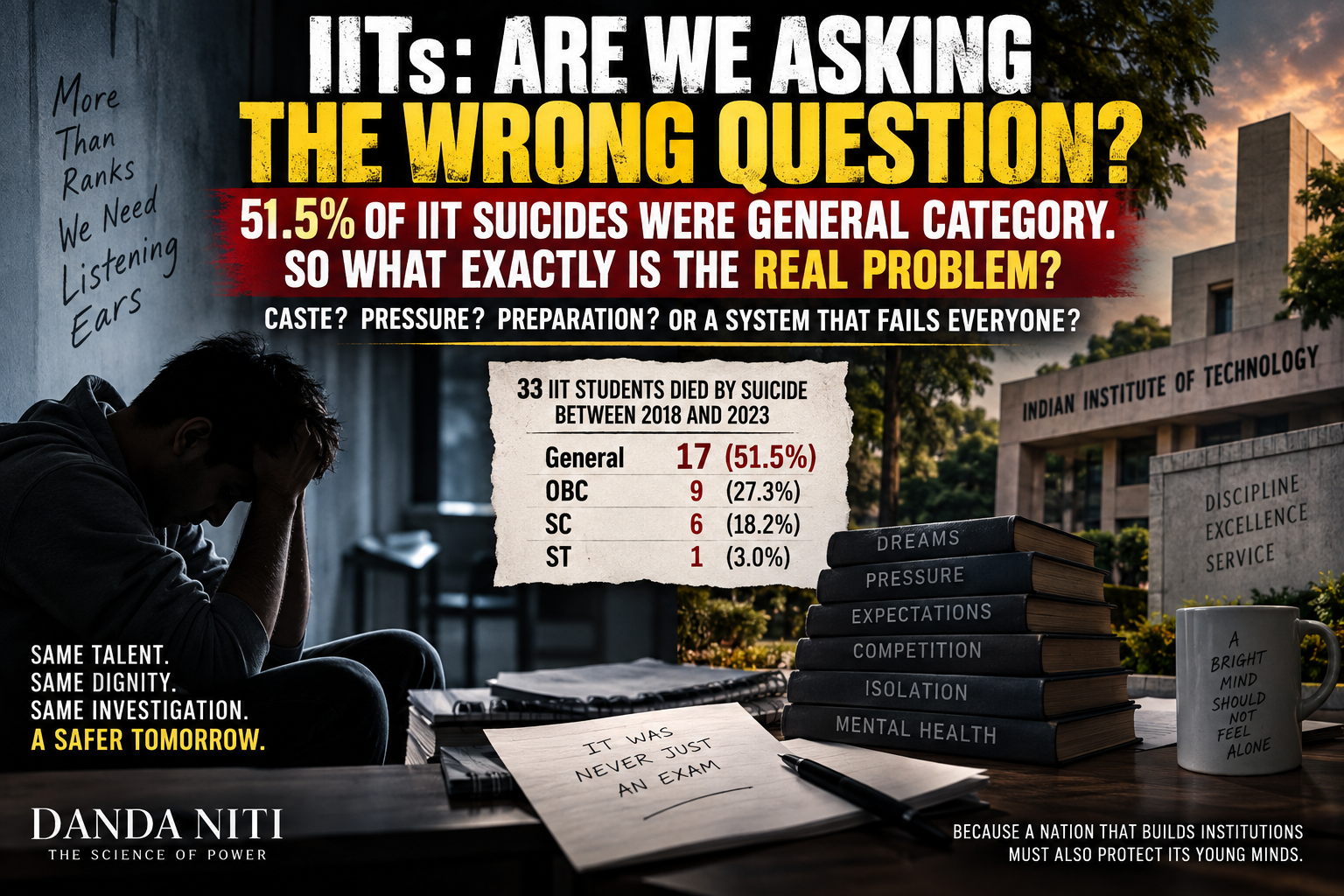
IITs: ARE WE ASKING THE WRONG QUESTION? 51.5% OF IIT SUICIDES WERE GENERAL CATEGORY. SO WHAT EXACTLY IS THE REAL PROBLEM?
IITs: Are We Asking the Wrong Question?
51.5% of IIT suicide cases in government data were from the General category. What does the data actually tell us?
By DANDA NITI | The Science of Power
Every time an IIT student dies by suicide, questions arise about academic pressure, mental health, caste discrimination and the support systems available on campus.
Caste-related discrimination must be investigated whenever there is credible evidence. At the same time, the available data should be examined carefully before drawing conclusions about the cause of any individual death.
What does the government data show?
According to data provided by the Ministry of Education in Parliament in March 2023, 33 IIT students died by suicide during the five-year period from 2018 to 2023. Of these, 17 were from the General category, 9 were OBC, 6 were SC and 1 was ST.
The 17 General-category cases account for about 51.5% of the 33 cases. However, this figure by itself does not establish that General-category students face a higher or lower risk of suicide than students from other categories. To calculate category-wise rates, the relevant student population of each category would also be required.
Similarly, the category of a student does not by itself establish the reason for an individual suicide. The circumstances of each case require separate investigation.
So what are the other questions?
IITs bring together students from different educational, social and economic backgrounds. Students may also enter with different levels of academic preparation and access to coaching or other educational resources.
That raises several questions about what happens after admission:
- Are students who face academic difficulties identified early?
- Is appropriate academic and mentoring support available?
- Can students access counselling and mental-health services when required?
- Are complaints of discrimination properly examined?
- Do institutions have effective systems for responding to students in distress?
Avoiding assumptions
A student's social category should not automatically be treated as proof of the cause of a suicide. At the same time, the absence of evidence in one case should not be used to dismiss allegations of discrimination in another.
Student distress can have multiple contributing factors, including academic pressure, financial difficulties, social isolation, discrimination, family circumstances, mental-health concerns and institutional conditions. The relative importance of these factors can vary from case to case.
What the National Task Force is examining
The Supreme Court constituted a National Task Force in 2025 to examine student mental health and suicides in higher educational institutions. Its mandate includes examining academic pressure, caste-based and other forms of discrimination, financial burdens, mental-health support, institutional frameworks and other factors associated with student distress.
The Ministry of Education has also said that the Task Force has conducted field visits and consultations on subjects including caste discrimination, mental health, student suicides and concerns involving students from marginalised communities.
The data question
The 2018–2023 category-wise figures are useful, but they are only one part of the picture. A more meaningful analysis would require category-wise student populations alongside data on suicides, academic outcomes, dropouts, counselling access and complaints, with consistent definitions and time periods.
Such data could help researchers distinguish between the number of cases and the relative rate of cases across different student groups.
The larger question for IITs
IITs are institutions where students arrive after highly competitive selection processes. Admission is an important milestone, but it is not the end of the educational journey.
The broader institutional question is whether students from different backgrounds receive adequate academic, emotional and social support after entering the institution.
That does not require assuming that every student who dies by suicide was a victim of discrimination, nor does it require assuming that academic pressure was the sole cause.
It requires evidence, case-specific investigation and reliable institutional data.
The Danda Niti Question
The debate should therefore move beyond a simple General-versus-reserved-category comparison.
The more useful questions are: What happened to the individual student? What warning signs, if any, were present? What support was available? Were complaints properly addressed? And what institutional measures could help prevent similar tragedies?
Whether a student belongs to the General, OBC, SC or ST category, the standard should remain the same: evidence before assumptions, proper investigation before conclusions, and meaningful support before a crisis escalates.
DANDA NITI | The Science of Power