Inflation: The Invisible Tax That Is Shrinking Every Family's Savings
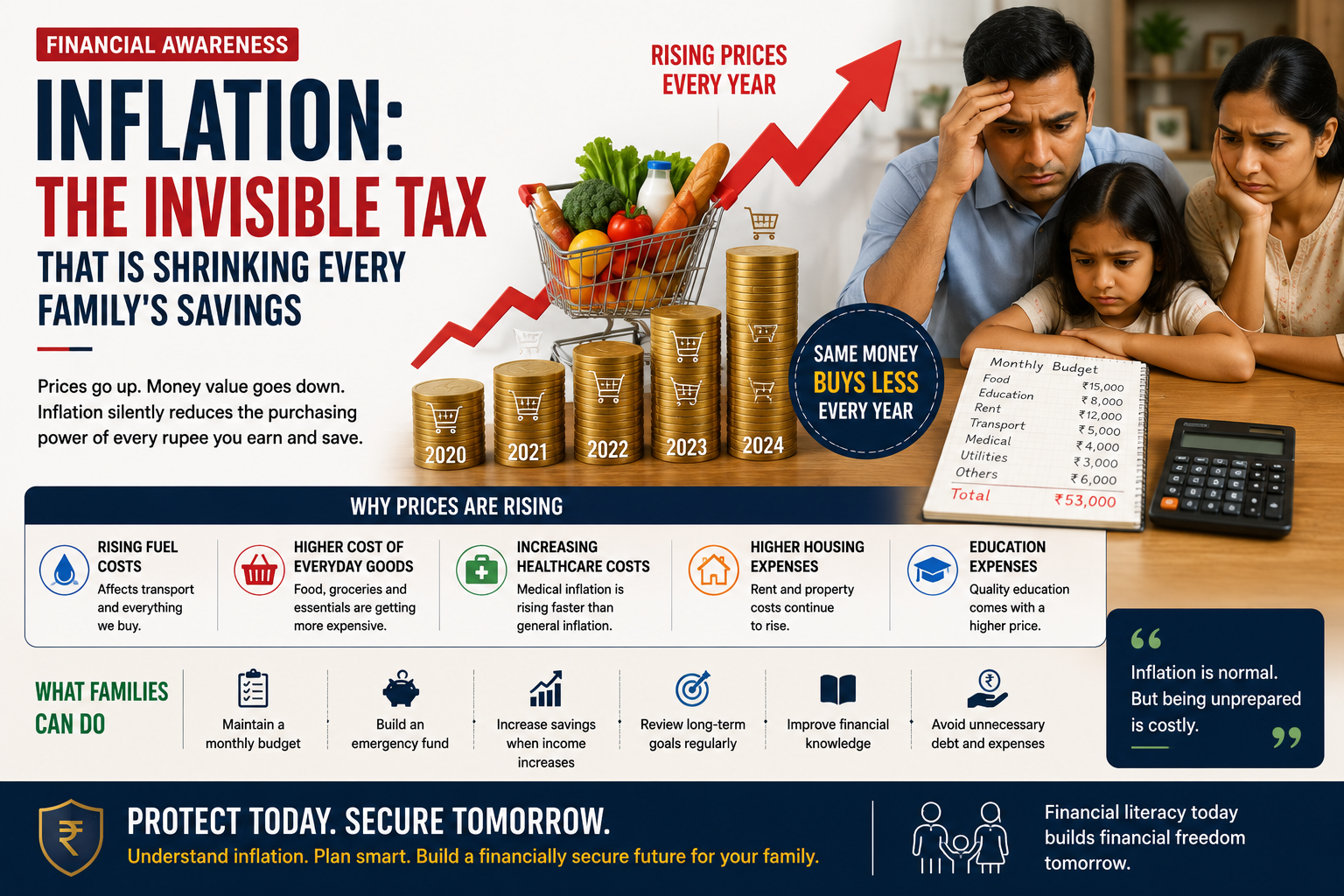
When people think about losing money, they often imagine stock market declines, business losses, or financial fraud.
However, one of the biggest threats to household wealth rarely makes headlines.
It is called inflation.
Unlike a visible tax imposed by governments, inflation quietly reduces the purchasing power of every rupee we earn and save. Families may not notice it immediately, but over time its impact becomes impossible to ignore.
## Why Prices Keep Rising
Almost every household has experienced it.
The grocery bill is higher than it was a few years ago.
School fees continue to increase.
Medical expenses have become more expensive.
Fuel prices fluctuate, affecting transportation and the cost of goods.
House rents in many cities have steadily risen.
Even everyday services—from eating at restaurants to household repairs—cost significantly more than they once did.
For most families, income grows gradually, but expenses often rise much faster.
## The Real Cost of Inflation
Imagine a family that spends ₹50,000 every month today.
If prices continue to rise over the coming years, that same lifestyle could require ₹80,000 or even ₹1,00,000 per month in the future.
Nothing has changed about the family's needs.
The purchasing power of money has changed.
This is why many people feel that their salaries no longer stretch as far as they once did.
## Why Saving Alone Is Not Enough
Many people believe that keeping money safely in a savings account is enough.
Saving is certainly an important financial habit.
However, if the return earned on savings remains lower than the rate at which prices rise, the real value of money gradually declines.
In simple terms, money that sits idle loses purchasing power over time.
This is one reason financial experts often encourage households to think beyond saving alone and develop long-term financial plans.
## How Families Can Respond
Inflation cannot be controlled by individual households.
What families can control is how they prepare for it.
Some practical steps include:
* Maintain a monthly household budget.
* Avoid unnecessary debt and impulse purchases.
* Build an emergency fund.
* Review long-term financial goals regularly.
* Increase savings whenever income increases.
* Continue improving financial knowledge and awareness.
Small, disciplined actions repeated over many years often produce meaningful financial stability.
## Financial Literacy Is the Best Defence
Inflation affects everyone, regardless of profession or income level.
The difference lies in preparation.
Families that understand how inflation works are better equipped to make informed financial decisions and adjust their plans as economic conditions change.
Financial literacy does not eliminate inflation.
It helps families reduce its impact.
## Looking Ahead
Economic conditions will continue to evolve.
Prices will rise and fall.
Markets will change.
New financial products will emerge.
But one principle will always remain true:
The value of money depends not only on how much we earn, but also on how wisely we manage it.
Understanding inflation is the first step toward protecting the financial future of every household.
---
**About the Author**
**Vaasu Challa** is a Financial Journalist and Public Interest Writer dedicated to promoting financial literacy and helping Indian families understand the economic issues that influence their daily lives.