Jantar Mantar: When the Voices of Citizens Are Drowned Out
New Delhi | 20 July 2026
A democracy is not judged by how comfortably those in power govern.It is judged by how safely ordinary citizens can question those in power.
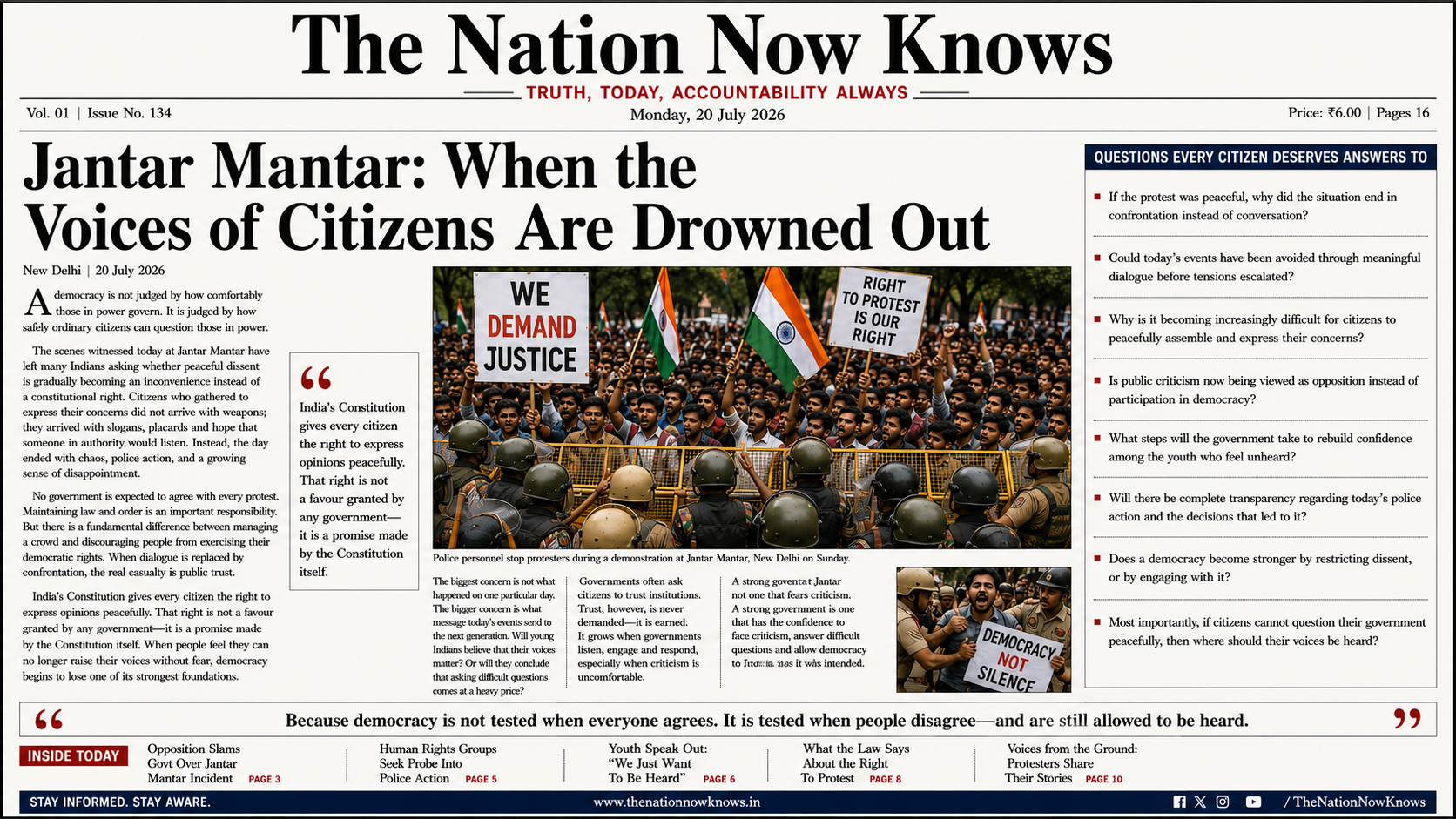
The scenes witnessed today at Jantar Mantar have left many Indians asking whether peaceful dissent is gradually becoming an inconvenience instead of a constitutional right. Citizens who gathered to express their concerns did not arrive with weapons; they arrived with slogans, placards and hope that someone in authority would listen. Instead, the day ended with chaos, police action, and a growing sense of disappointment.
No government is expected to agree with every protest. Maintaining law and order is an important responsibility. But there is a fundamental difference between managing a crowd and discouraging people from exercising their democratic rights. When dialogue is replaced by confrontation, the real casualty is public trust.
India's Constitution gives every citizen the right to express opinions peacefully. That right is not a favour granted by any government, it is a promise made by the Constitution itself. When people feel they can no longer raise their voices without fear, democracy begins to lose one of its strongest foundations.
The biggest concern is not what happened on one particular day. The bigger concern is what message today's events send to the next generation. Will young Indians believe that their voices matter? Or will they conclude that asking difficult questions comes at a heavy price?
Governments often ask citizens to trust institutions. Trust, however, is never demanded—it is earned. It grows when governments listen, engage and respond, especially when criticism is uncomfortable.
Questions Every Citizen Deserves Answers To
If the protest was peaceful, why did the situation end in confrontation instead of conversation?
Could today's events have been avoided through meaningful dialogue before tensions escalated?
Why is it becoming increasingly difficult for citizens to peacefully assemble and express their concerns?
Is public criticism now being viewed as opposition instead of participation in democracy?
What steps will the government take to rebuild confidence among the youth who feel unheard?
Will there be complete transparency regarding today's police action and the decisions that led to it?
Does a democracy become stronger by restricting dissent, or by engaging with it?
Most importantly, if citizens cannot question their government peacefully, then where should their voices be heard?
A strong government is not one that fears criticism. A strong government is one that has the confidence to face criticism, answer difficult questions and allow democracy to function as it was intended.
Today's events at Jantar Mantar should not become another headline that fades with the news cycle. They should become a moment of reflection, for those in power and for every citizen who believes that the strength of India lies not in silencing voices, but in listening to them.
Because democracy is not tested when everyone agrees.
It is tested when people disagree—and are still allowed to be heard.