"Ladies First: A Lesson Beyond Uniforms"
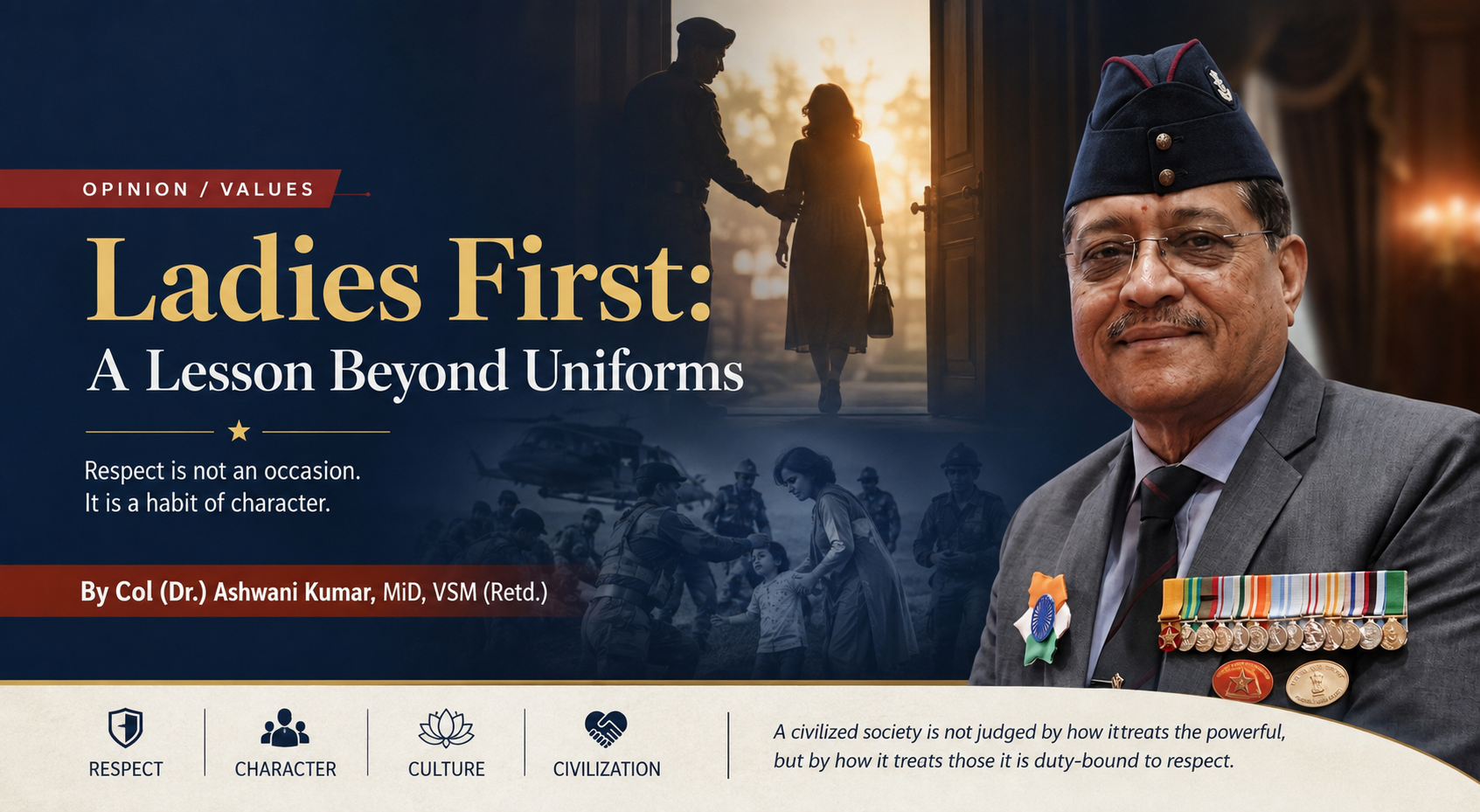
By Col (Dr.) Ashwani Kumar, MiD, VSM (Retd.)
The phrase "Ladies First" is so common that most people use it without ever pausing to think about its true meaning. Some dismiss it as an outdated custom. Others consider it merely a social formality. Yet, during my long years in uniform and later in civil life, I have come to believe that these two simple words represent something far deeper than etiquette.
They represent respect, character, culture, and civilization.
My understanding of "Ladies First" did not come from books or history lessons. It came from experience. As a young officer, I had the privilege of serving as ADC (Aide-de-Camp) to a General Officer and later as Staff Officer to the Chief of Staff. These appointments exposed me to the finest traditions of military life. I accompanied senior commanders at official functions, military ceremonies, conferences, social gatherings, and interactions with civil dignitaries. While I learnt much about leadership, administration, and command, some of the most valuable lessons came not from formal instructions but from observing the conduct of great soldiers and gentlemen.
One lesson stood out above all others:
Respect is a habit, not an occasion. I still remember attending a formal military function where a senior General reached the entrance of a dining hall. Several officers and guests were approaching the doorway at the same time. Without any display or announcement, the General simply stepped aside and invited the ladies present to enter first.
A young officer standing nearby remarked to his immediate senior that perhaps in the spirit of modern thinking, "Sir, today everyone is equal. Why should ladies go first?"
The General who heard his words looked at him smiled and replied:
"Young man, equality is about rights. Courtesy is about character."
That single sentence remained with me throughout my career.
One aspect often overlooked is where these values originate. In the Armed Forces, such conduct is not accidental. It is cultivated from the very first day a young man enters a military academy as a Gentleman Cadet.
Military training is not limited to weapons, tactics, physical endurance, or battlefield skills. Equal importance is given to character, discipline, manners, social conduct, and respect for others. Young cadets are taught how to conduct themselves in public, how to interact with families, how to treat women with dignity, and how to uphold the highest standards of personal behaviour.
When a young officer joins his first unit, these lessons continue. Senior officers, JCOs, and experienced soldiers quietly mentor him in the unwritten code of military conduct. He learns that leadership is reflected not only in giving orders but also in showing consideration for others.
These values are passed from one generation of officers to the next.
No textbook can fully teach them.
They are learnt through observation, example, and tradition.
My own experiences as ADC and later as Staff Officer reinforced these lessons every day. Watching senior commanders interact with families, civil officials, soldiers, and ordinary citizens taught me that true leadership begins with humility and respect.
Another significant influence on my understanding of these values came during my tenure as a Senior Instructor and Head of Department at military training institutions. Training establishments are the custodians of military traditions, and it was there that I witnessed how deeply these values are embedded in the culture of the Armed Forces.
Every new officer, regardless of his background, arrives with academic qualifications, ambition, and enthusiasm. Yet the academy and training institutions transform him into a gentleman officer. Alongside military skills, leadership, and operational knowledge, young officers are taught the importance of courtesy, dignity, empathy, and respect for others. These lessons are reinforced daily through example, discipline, and tradition.
As an instructor, I observed that these values did not diminish with changing times. On the contrary, they continued to be nurtured and passed on from one generation of officers to the next. Whether in the Officers' Mess, training exercises, social functions, or interactions with civilians, respect for women remained an integral part of military culture.
During my interactions with various civil organizations after retirement, I often felt that this aspect of character-building was not always given the same emphasis. Civil institutions undoubtedly produce excellent professionals, administrators, scientists, and managers, but the systematic teaching of social etiquette, courtesy, and gentlemanly conduct often receives less attention.
This is not a criticism of civil society. Rather, it is an observation.
The difference lies not in the quality of individuals but in the nature of their initial training.
Military academies consciously shape character alongside competence.
Perhaps that is why, decades after leaving the academy, many officers still instinctively stand when a lady enters a room, offer a seat to an elderly woman, or step aside and say, "Ladies First."
During my service in operational areas, I witnessed another dimension of the same principle.
On one occasion, following severe weather in a remote border region, helicopter evacuation became necessary. Space was limited and priorities had to be established. Soldiers who had endured harsh conditions for weeks willingly stepped aside and ensured that women, children, and elderly civilians were evacuated first.
No one argued.
No one sought recognition.
No one even used the words "Ladies First."
Yet the spirit behind those words guided every decision.
The welfare of others came before personal comfort.
That is what military culture teaches.
After retirement, I entered the corporate and civil world. There I encountered a society that was changing rapidly. The pace was faster, competition was greater, and traditional courtesies often seemed to be disappearing.
One day, while waiting in a crowded bank, I noticed an elderly lady searching for a seat. The hall was packed. Most people were occupied with their phones and avoided eye contact. Finally, a young soldier on leave quietly stood up and offered her his chair.
The lady thanked him warmly.
The soldier simply smiled.
Watching that scene, I realised something important. Uniforms may be removed. Values remain.
Today, we speak extensively about women empowerment. Governments formulate policies, organizations conduct seminars, and society rightly demands equal opportunities for women. Yet an important question remains:
Do we truly respect women, or do we respect only those who are powerful, wealthy, influential, or socially prominent?
It is easy to show courtesy to a successful executive, a celebrity, a senior official, or the wife of an important person. Status naturally attracts attention.
The real test of our character lies elsewhere.
Do we show the same respect to an elderly woman waiting in a queue?
To a domestic worker returning home after a tiring day?
To a widow struggling to support her family?
To a village woman who possesses neither wealth nor influence?
To a young girl trying to find her place in society?
If our behaviour changes according to a woman's social standing, then it is not respect.
It is merely recognition of power.
True respect makes no distinction between rich and poor, powerful and powerless, educated and uneducated, urban and rural.
A soldier is taught to treat the wife of a General and the wife of a sepoy with the same courtesy.
Because dignity does not come from status.
It comes from humanity.
The phrase "Ladies First" was never intended to grant privilege. Nor was it meant to suggest that women are weak. Modern women command military units, fly fighter aircraft, lead corporations, govern nations, conduct scientific research, and contribute equally to nation-building.
The time has come for society to consciously revive and strengthen these values.
Today, women share equal responsibilities in every sphere of life. If society rightly expects women to shoulder equal responsibilities, then society must also ensure that they receive equal respect, dignity, safety, and consideration.
Respect is not a concession.
It is a recognition of dignity.
The true meaning of "Ladies First" is not privilege; it is appreciation. It is a small but meaningful acknowledgment of the immense contribution women make to families, institutions, and nations.
Indian civilization has always understood this principle. We worship Durga as the embodiment of strength, Saraswati as the source of knowledge, and Lakshmi as the symbol of prosperity. Every soldier carries the blessings of his mother when he leaves home for duty. Every family takes pride in the achievements and sacrifices of its daughters.
Respect for women has never diminished strength.
It has always reflected culture and character.
The military did not invent these values.
It simply preserved and practised them.
Today, whenever I hear the words "Ladies First," I do not think of etiquette manuals or ceremonial customs.
I think of the Generals under whom I served as ADC and Staff Officer.
I think of instructors and commanders who taught young officers that leadership begins with humility.
I think of soldiers waiting for the last helicopter so that others could be safe.
I think of a young jawan offering his seat to an elderly woman in a crowded bank.
And I think of a society that often speaks about women empowerment but still has much to learn about everyday respect.
Perhaps the phrase "Ladies First" has survived for centuries because it expresses a timeless truth:
A civilized society is not judged by how it treats the powerful, but by how it treats those it is duty-bound to respect.
As soldiers, we were taught that courtesy costs nothing but reveals everything about a person's character.
In a world increasingly focused on rights, let us not forget the importance of respect.
Because empowering women begins not in legislation, but in everyday behaviour.
And perhaps that is why these simple words still matter today:
"Ladies First."
Not because women are weaker.
Not because they need special treatment.
But because a gentleman knows that respect is the first duty of character.
Author's Note
This article is not an academic study of etiquette or social customs. It is a reflection drawn from a lifetime of experiences in uniform and beyond. As a young officer, ADC, Staff Officer, Senior Instructor in an esteemed Training Institute, and later as a citizen observing society from outside the military environment, I often noticed how simple acts of courtesy reveal the deeper values of an individual and an institution.
The lessons shared here were learnt from commanders, instructors, fellow officers, soldiers, and ordinary people whose actions demonstrated that respect is not measured by words but by conduct. In an age where equality is rightly celebrated, I believe courtesy and respect remain equally important virtues.
If this article encourages even a few readers to reflect upon how they treat the women around them regardless of their status, wealth, or position its purpose will have been fulfilled.
"Equality gives rights. Character gives respect. A great society needs both."
Disclaimer:
The views expressed in this article are solely those of the author and are based on his personal experiences, observations, and reflections accumulated during military service, civil service and subsequent as civilian in society. They do not represent the official views of any government, military, corporate, educational, or other organization with which the author is or has been associated. The article is intended to encourage discussion on values, courtesy, and social conduct and should be read in that spirit.