Liquid Vitamins and the Absorption Myth: What the Experiment Claims to Show
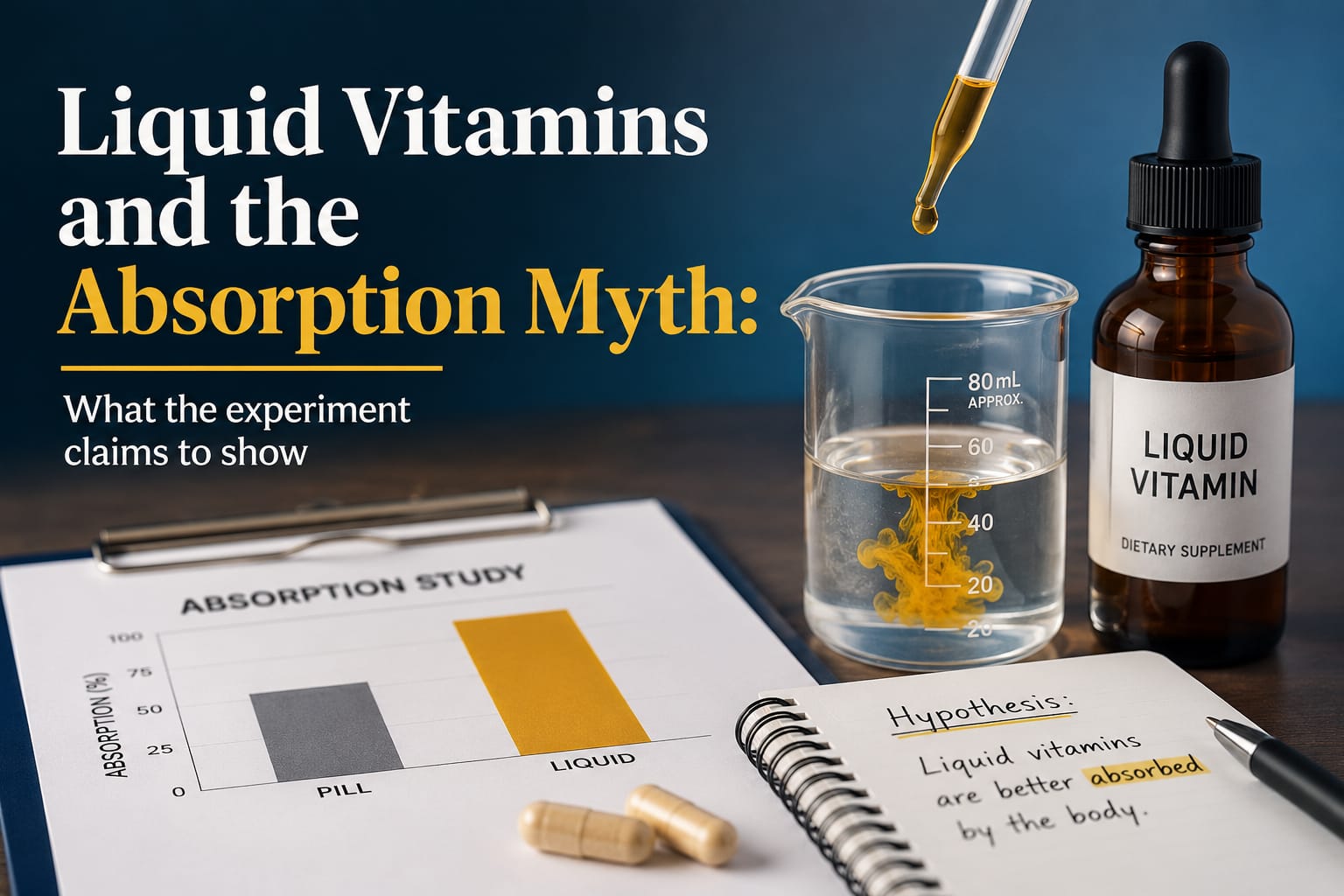
Liquid vitamins have gained significant attention in the supplement market, with manufacturers and consumers debating whether they offer better absorption than traditional pills. One of the most persistent claims is that liquid vitamins are absorbed far more efficiently than tablets or capsules. An experiment described as a simple visual test attempts to demonstrate that difference.
The central theory behind the experiment is that nutrients must be broken down before they can cross membranes and enter the bloodstream. According to the claim, pill-form supplements require digestion before absorption, while liquid supplements are already dissolved and may therefore become available for absorption more quickly.
The experiment used household materials to create a simplified model of the digestive process. A coffee filter represented a permeable membrane, while lemon juice was used as an approximation of stomach acid. Lemon juice has a pH of about 2.3, within the acidic range associated with stomach conditions. Two commonly available vitamin supplements—one liquid and one in pill form—were tested without identifying their brands.
Before and after the test, the components were weighed. Both supplements were exposed to the acidic liquid for the same amount of time and then passed through the coffee filter. The experiment was designed to imitate certain aspects of digestion, including the time supplements may spend in the stomach.
According to the reported results, approximately 0.2 ounces of material from the liquid supplement passed through the filter, compared with 0.8 ounces from the pill-form supplement. The experiment's interpretation was that the greater amount passing through the filter demonstrated substantially higher absorption efficiency for the liquid supplement.
However, the test should not be considered definitive scientific proof of human vitamin absorption. A coffee filter cannot accurately reproduce the complex functions of the gastrointestinal tract, including digestive enzymes, intestinal transporters, metabolism, and individual differences in nutrient absorption. Likewise, the amount of material passing through a filter does not directly equal the percentage of a vitamin absorbed into the human bloodstream.
The experiment nevertheless highlights why liquid vitamins have attracted consumer interest. Their formulation may affect how quickly certain ingredients become available during digestion, but actual absorption depends on the specific nutrient, formulation, dose, and individual physiology. Consumers should therefore evaluate strong absorption claims carefully and look for evidence from controlled human studies rather than relying solely on simplified demonstrations.
Relevant Topic: Health, Vitamins and Dietary Supplements