"Pakistan at the Edge: Internal Crisis, PoK, and the Future of South Asia"
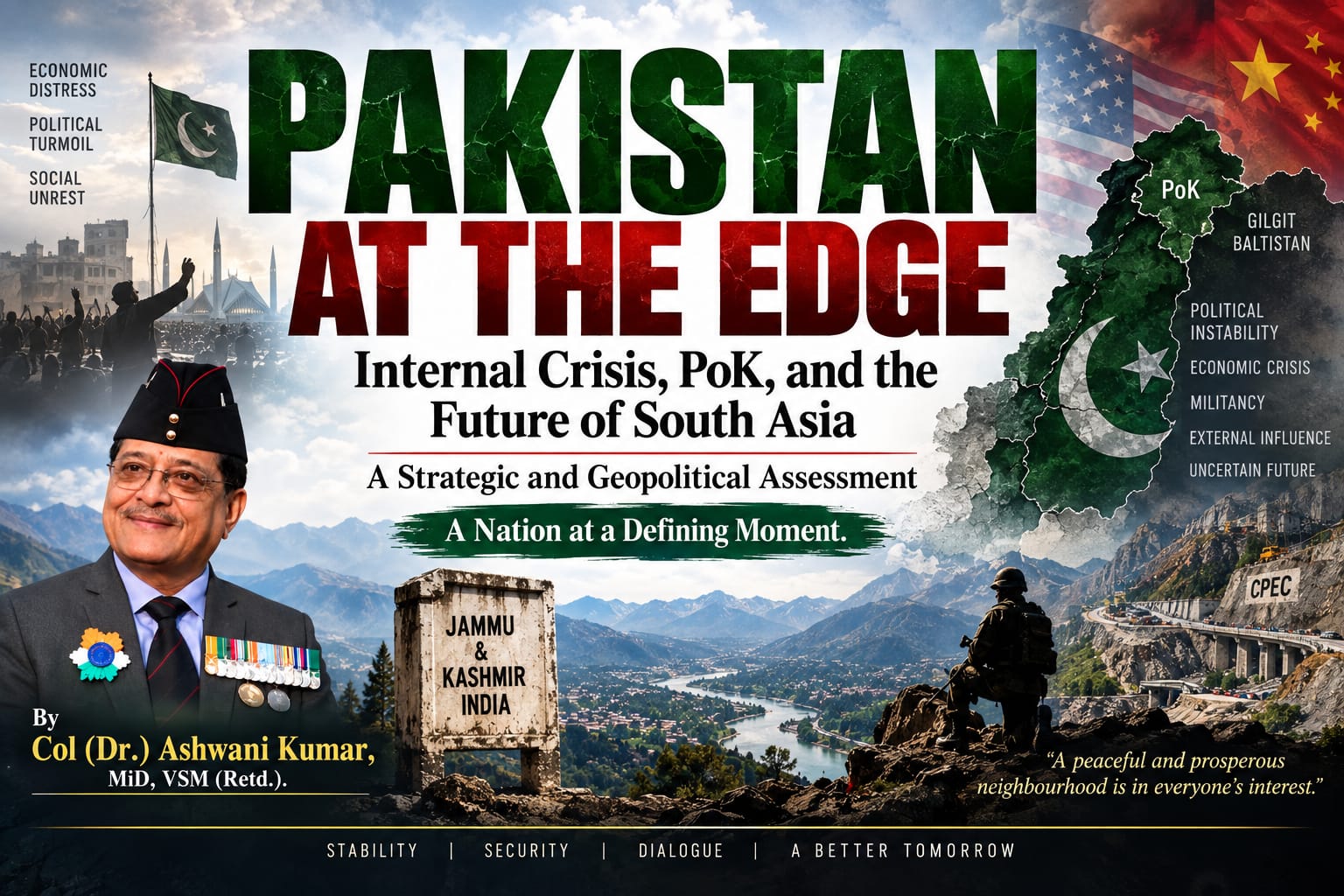
A Strategic and Geopolitical Assessment of Pakistan
By Col (Dr.) Ashwani Kumar, MiD, VSM (Retd.)
A Nation at a Defining Moment
Few nations in South Asia occupy as pivotal a geopolitical position as Pakistan. Situated at the crossroads of South Asia, Central Asia, the Middle East, and China, Pakistan has long been regarded as a state of significant strategic importance. Since its creation in 1947, it has influenced regional security, international diplomacy, and some of the major developments in modern Asian history.
Today, Pakistan faces a combination of economic pressures, political polarization, institutional challenges, militancy, regional unrest, and diplomatic difficulties. The extent and consequences of these challenges remain subjects of considerable debate among analysts.
As a military officer who spent nearly a decade serving in Jammu and Kashmir in various operational, intelligence, and staff appointments, I have observed the complexities of the India-Pakistan relationship and the impact that developments within Pakistan can have on regional security. The realities witnessed on the ground can differ significantly from narratives presented in political speeches, television debates, or diplomatic communications.
This article examines Pakistan's challenges through a strategic lens and considers whether the country can strengthen its institutions and pursue meaningful economic and political reforms.
The answer is important not only for Pakistan but also for India, China, Afghanistan, and the wider South Asian region.
Historical Roots of the Present Crisis
To understand Pakistan's present circumstances, one must first consider the foundations upon which the state was built. Pakistan emerged from the partition of British India in August 1947 amid one of the largest and most traumatic migrations in modern history. The new state inherited significant administrative challenges, limited resources, and an uncertain political future.
Muhammad Ali Jinnah envisioned a modern state capable of accommodating diversity while safeguarding the interests of its citizens. Yet his early death and the absence of stable political institutions created challenges for successive governments.
Unlike countries where civilian institutions gradually consolidated authority, Pakistan experienced repeated interruptions in democratic governance. Military interventions became recurring features of political life, while national security considerations played a major role in policymaking.
The wars of 1947–48, 1965, and 1971, followed by the Soviet invasion of Afghanistan in 1979 and the 1999 Kargil conflict, shaped Pakistan's strategic outlook. The Afghan conflict brought substantial foreign assistance and strategic relevance but also contributed to the growth of militant networks whose consequences continued to affect the country.
The separation of East Pakistan and the emergence of Bangladesh in 1971 highlighted the consequences of political exclusion and regional alienation. Similar governance and representation questions continue to feature in discussions about Pakistan's political structure.
Political Instability and Civil-Military Relations
No assessment of Pakistan can ignore the role played by civil-military relations. The military remains one of Pakistan's most organized and influential institutions and has historically played a significant role during periods of political instability.
Repeated military involvement in political affairs has also generated debate about institutional development and democratic continuity. Political parties have frequently faced periods of confrontation, while questions surrounding governance, elections, judicial interventions, and political polarization have affected public confidence.
Recent political uncertainty has also created challenges for economic decision-making, investment confidence, and administrative efficiency. For a country dealing with economic and security pressures, prolonged political confrontation can create additional difficulties.
Economic Pressures and Reform
Pakistan's economy remains an important factor in determining its future. The country has faced high public debt, fiscal pressures, currency depreciation, inflation, energy-related challenges, unemployment, and dependence on external financial assistance.
Repeated engagement with international financial institutions has highlighted structural weaknesses in the economy. At the same time, recent economic developments have included stabilization measures and ongoing reform efforts, meaning the situation should not be described solely in terms of economic decline.
Economic pressures have social and political consequences. Rising prices can affect household finances and public confidence, while prolonged economic uncertainty can make policy implementation more difficult.
Pakistan nevertheless possesses considerable economic potential. Its population exceeds 240 million people, while its geographic position and agricultural resources provide opportunities for growth.
Sustained economic development requires policy continuity, investment confidence, educational advancement, institutional transparency, and effective governance.
Security Challenges and Militancy
Security remains another major concern. For decades, Pakistan has confronted militant organizations operating within and along its borders. Although counter-terrorism operations have achieved significant results at different times, militant violence remains a challenge.
The changing situation in Afghanistan following the return of the Taliban has created additional security concerns. Cross-border militancy, extremist networks, and ideological radicalization continue to be issues for Pakistani authorities.
At the same time, separatist sentiments in Balochistan and unrest in other regions point to wider questions involving governance, development, and political representation.
From a strategic perspective, security challenges cannot be addressed solely through military measures. Long-term stability also depends on economic opportunity, political inclusion, education, effective governance, and public confidence in state institutions.
Pakistan-occupied Kashmir and Gilgit-Baltistan: The Strategic Frontier
No discussion of Pakistan's future is complete without examining Pakistan-administered Kashmir and Gilgit-Baltistan. These territories occupy an important strategic position connecting South Asia with Central Asia and China and are relevant to regional connectivity initiatives.
From India's constitutional and legal standpoint, these territories are regarded as integral parts of the former princely state of Jammu and Kashmir.
During my years of service in Jammu and Kashmir, one lesson became increasingly clear: geography shapes strategy. Mountain passes, valleys, ridgelines, and communication corridors can influence political and security decisions alongside ideology and diplomacy.
The region's strategic significance has increased further with infrastructure projects associated with the China-Pakistan Economic Corridor (CPEC). Questions concerning political representation, governance, economic development, and local aspirations also remain part of discussions surrounding these regions.
India's Role: Stability, Security, and Strategic Patience
India's relationship with Pakistan has been shaped by history, geography, conflict, and diplomacy. From India's perspective, national security and regional stability remain important considerations in dealing with developments in Pakistan.
India faces the challenge of protecting its territorial integrity and citizens while also seeking to avoid developments that could contribute to wider regional instability.
The events of the past several decades have demonstrated that instability in Pakistan can have regional implications. Terrorism, radicalization, narcotics trafficking, illegal arms networks, and refugee concerns have at various times affected neighboring countries.
The abrogation of Article 370 in 2019 represented a significant change in India's constitutional and administrative approach toward Jammu and Kashmir. Political assessments of that decision differ, while its implications continue to be discussed in India and abroad.
For India, development, governance, infrastructure, and democratic participation remain important components of discussions concerning long-term stability in Jammu and Kashmir.
China, CPEC, and the Changing Strategic Environment
Any serious discussion about Pakistan's future must also consider China and its expanding strategic relationship with Pakistan.
Over the past two decades, Pakistan and China have developed extensive economic and strategic ties. The China-Pakistan Economic Corridor represents a major component of this relationship, involving infrastructure, transportation, energy, and regional connectivity projects.
Supporters regard CPEC as an important development opportunity, while critics have raised questions about debt sustainability, transparency, local participation, and long-term strategic dependence.
For China, Pakistan provides strategic access toward the Arabian Sea and forms an important component of its Belt and Road Initiative.
For Pakistan, Chinese investment provides opportunities for infrastructure development and economic cooperation. However, infrastructure alone cannot guarantee prosperity. Roads, ports, and power projects require stable governance, effective institutions, security, and investor confidence to deliver long-term benefits.
The United States and a Changing Strategic Environment
For much of the Cold War and post-Cold War period, Pakistan occupied an important position in American strategic calculations. Relations between the two countries have evolved according to changing regional security priorities and broader international developments.
Pakistan's geographic location, security environment, economic needs, and relationships with China, Afghanistan, India, and the United States continue to influence its strategic importance.
For India, the stakes are also significant. A stable and peaceful neighborhood has implications for India's long-term security and economic interests.
The Coming Decade
The future of Pakistan will depend on how effectively its institutions respond to economic pressures, political disagreements, security challenges, and demands for development.
The country's geographical position ensures that its internal developments will remain important for South Asia and beyond. Economic reform, institutional continuity, political participation, security, and regional diplomacy will all influence the direction Pakistan takes.
History will ultimately record whether Pakistan was able to address the structural challenges inherited from its past and pursue reform, reconciliation, and institutional renewal.
Author's Note
The views expressed in this article are personal and based on the author's professional experience, historical study, and strategic assessment. The purpose of this article is to encourage informed discussion on regional security, geopolitics, and South Asian affairs. It does not seek to promote hostility toward any nation or community.
About the Author
Col (Dr.) Ashwani Kumar, MiD, VSM (Retd.) is a veteran Indian Army officer, defence analyst, author, and commentator on national security and strategic affairs. Having served for nearly a decade in various operational, intelligence, and staff appointments in Jammu and Kashmir, he brings professional experience to discussions concerning regional security, cross-border dynamics, and South Asian geopolitics.
Disclaimer: The views expressed in this article are those of the author. Images accompanying the article are used for illustrative purposes only. The author does not claim ownership, copyright, or any proprietary rights over the images unless specifically stated otherwise.