RAHUL GANDHI: THE FAILURE OF THE OPPOSITION Has India's Leader of the Opposition Delivered on the Responsibilities of His Office?
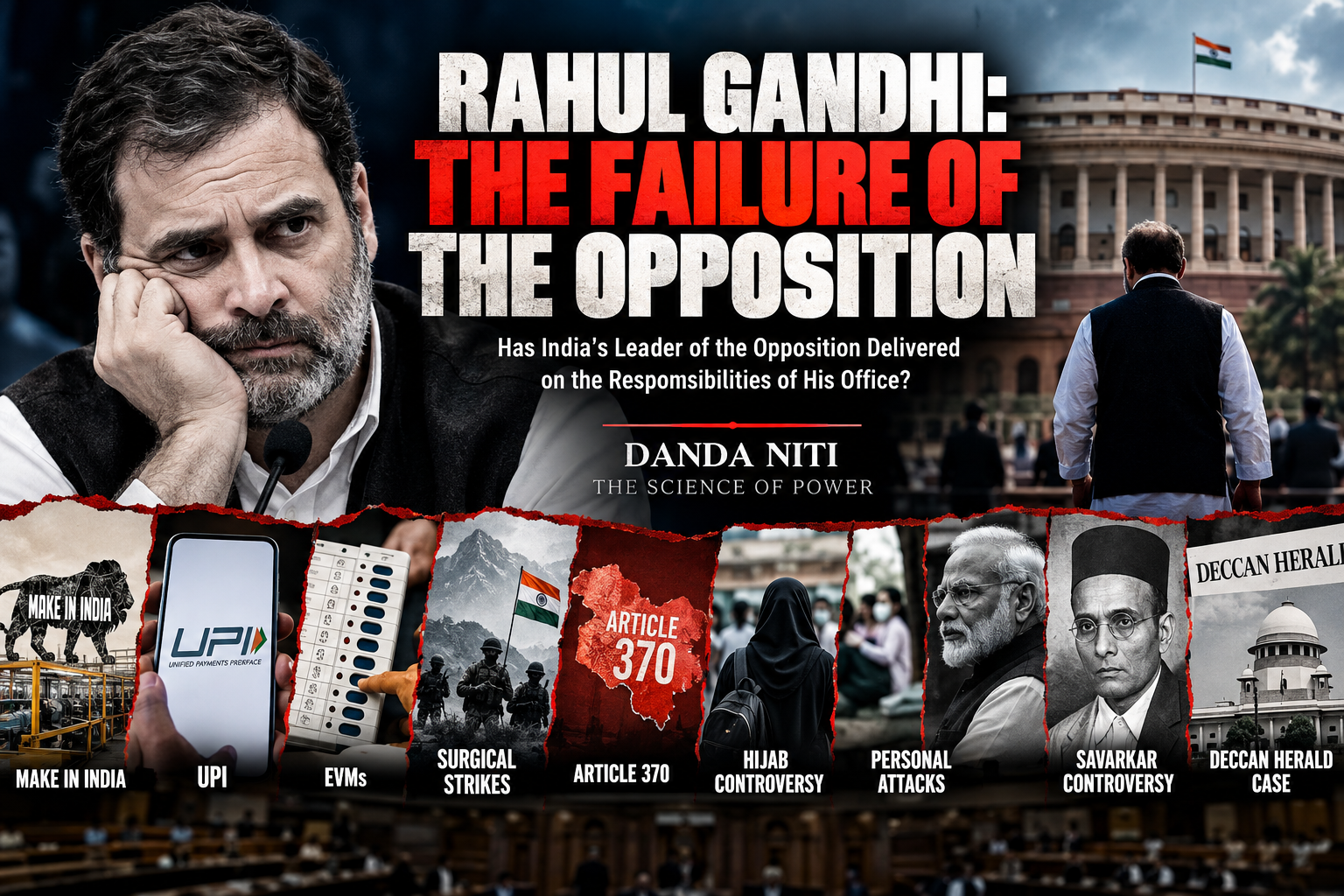
RAHUL GANDHI: THE FAILURE OF THE OPPOSITION
Has India's Leader of the Opposition Delivered on the Responsibilities of His Office?
DANDA NITI | The Science of Power
THE LEADER OF THE OPPOSITION: A POSITION OF POWER, A TEST OF RESPONSIBILITY
In a parliamentary democracy, the Leader of the Opposition is not merely the most prominent critic of the government. The office carries a constitutional responsibility to scrutinise power, challenge policy with evidence, demand accountability, and present credible alternatives.
Rahul Gandhi occupies one of the most consequential positions in India's parliamentary system. Yet the central question is whether his political conduct has consistently matched the responsibilities of that office.
Has he built a sustained record of parliamentary scrutiny? Has he translated his criticism into detailed policy alternatives? Has he used constitutional institutions to pursue allegations of wrongdoing? And has he offered the country a coherent alternative to the government's agenda?
These are not questions that can be answered through speeches, slogans, or political theatrics. They require evidence, institutional engagement, and measurable outcomes.
The office of Leader of the Opposition is not a platform for permanent protest. It is a responsibility to make the government answerable.
1. PARLIAMENTARY PERFORMANCE: WHERE IS THE SUBSTANCE?
Rahul Gandhi's parliamentary record before becoming the Leader of the Opposition raises serious questions about his legislative engagement.
During the 17th Lok Sabha, from 2019 to 2024, his attendance was 51%, compared with a national average of 79%. He participated in eight debates, against a national average of 46.7, and asked 99 questions, compared with the national average of 210. He introduced no Private Member's Bills. These figures are reported by PRS Legislative Research.
These figures do not capture every dimension of a parliamentarian's work. But they raise a legitimate question: how much of his political energy was devoted to sustained legislative scrutiny?
The responsibility became greater when he assumed the office of Leader of the Opposition.
PRS data for the 18th Lok Sabha, covering June 2024 to August 2026, records 17 debates and 64 questions for Gandhi. His attendance is not reported in the usual manner because the Leader of the Opposition does not sign the attendance register.
A Leader of the Opposition must do more than command public attention. He must scrutinise legislation, demand answers, examine public expenditure, and hold the executive accountable.
The question is not how loudly the opposition speaks. It is how effectively it makes power answerable.
2. MAKE IN INDIA: CRITICISM WITHOUT A CREDIBLE ALTERNATIVE?
Make in India was launched in 2014 to strengthen manufacturing, attract investment, and create employment.
The programme's performance must be assessed against measurable outcomes: manufacturing's share of GDP, industrial employment, investment actually realised, domestic value addition, and export performance.
Rahul Gandhi's criticism of the programme should be examined against those benchmarks.
If the programme has fallen short of its objectives, the opposition should identify the failures with data and explain what it would do differently. If particular sectors have expanded, those results should be acknowledged and examined.
A political leader cannot establish that a programme has failed simply by ridiculing its slogan. Nor does a successful sector establish that every national manufacturing objective has been achieved.
The relevant question is whether Gandhi has presented a detailed, credible alternative for manufacturing growth, industrial employment, and India's integration into global supply chains.
A country seeking to become a manufacturing power needs more than political commentary. It needs a serious industrial policy debate.
3. UPI: WHEN REALITY OVERTAKES POLITICAL SCEPTICISM
India's Unified Payments Interface has developed into a major real-time digital payment infrastructure, connecting consumers, merchants, and financial institutions.
The expansion of UPI makes earlier political debates about digital payments worth revisiting.
But the exact statements attributed to Rahul Gandhi and former Finance Minister P. Chidambaram must be verified before they are quoted.
The more substantive question is whether the opposition recognised the potential of India's digital public infrastructure and whether it has offered a coherent vision for its future.
UPI's growth is measurable. So are the challenges: fraud prevention, platform concentration, merchant costs, and the sustainability of low-cost transactions.
The test of political leadership is not whether a leader can mock an idea. It is whether he can understand a changing economy and offer a credible alternative.
4. EVMs AND VOTE CHORI: WHERE IS THE EVIDENCE?
The integrity of elections is fundamental to democracy. Any credible allegation of electoral malpractice deserves examination.
But an allegation is not a finding.
When Rahul Gandhi raises concerns about electronic voting machines or electoral rolls, the public deserves specific evidence, a clear explanation of the alleged irregularity, and a transparent account of the steps taken to seek redress.
The Election Commission has published explanations addressing allegations concerning EVMs and election procedures. Those explanations must be examined alongside evidence presented by political parties and any findings by competent authorities.
If Gandhi believes that an election has been compromised, the questions are straightforward:
* What specific irregularity does he allege?
* What verifiable evidence supports the allegation?
* What formal complaint or legal remedy has he pursued?
* What findings have the relevant authorities or courts made?
The same standard must apply to every political party, whether in government or in opposition.
Democracy cannot be strengthened by asking citizens to accept allegations on political authority alone. It requires evidence, due process, and accountability.
5. SURGICAL STRIKES: NATIONAL SECURITY IS NOT A POLITICAL SPECTACLE
The September 2016 surgical strikes became a major political controversy.
The opposition has a legitimate responsibility to scrutinise government claims about national security. But a responsible debate must distinguish between examining the government's presentation of an operation and questioning the armed forces themselves.
The precise remarks attributed to Rahul Gandhi about the surgical strikes must be established from reliable records before they are quoted or interpreted.
The larger issue is whether political debate about national security is conducted through evidence and institutional accountability or reduced to competing slogans.
National security deserves scrutiny, not political theatre.
6. ARTICLE 370: BEYOND POLITICAL POSITIONING
The changes concerning Article 370 and the reorganisation of Jammu and Kashmir were among the most consequential constitutional decisions in recent Indian politics.
The opposition's responsibility was to articulate its constitutional objections, examine the implications for federalism and civil liberties, and scrutinise the government's decisions.
A serious assessment of Rahul Gandhi's role must distinguish his own statements from the Congress party's position and examine the relevant parliamentary record and subsequent legal developments.
The Supreme Court upheld the constitutional validity of the abrogation of Article 370 in December 2023. That legal outcome should be distinguished from continuing political arguments about the policy's consequences.
The question is whether the opposition developed a sustained constitutional argument and pursued it through meaningful institutional action.
7. THE HIJAB CONTROVERSY: PRINCIPLES, CONSISTENCY, AND PUBLIC POLICY
The Karnataka hijab controversy raised questions about religious freedom, educational institutions, constitutional rights, and the uniform policies of schools and colleges.
Any assessment of Rahul Gandhi's role must begin with his exact statements and distinguish them from the positions taken by the Congress party and the Karnataka government.
The objective should be to evaluate the political argument, not to assume that a disagreement over religious freedom or educational policy proves hypocrisy.
8. MODI'S MOTHER, PUBLIC GESTURES, AND THE POLITICS OF PERSONAL ATTACKS
Political criticism is an essential part of democracy. Personal attacks, however, do not automatically advance public accountability.
The substantive question is whether such rhetoric contributes to a serious examination of governance, economic policy, public expenditure, or institutional accountability.
The opposition's role is to challenge the government's record, not to make personal symbolism the centre of political debate.
A political leader's credibility is built through the substance of his arguments, not merely the force of his attacks.
9. SAVARKAR, DEFAMATION, AND THE RESPONSIBILITY OF PUBLIC SPEECH
The controversy surrounding Rahul Gandhi's remarks about Vinayak Damodar Savarkar has involved legal proceedings and political debate.
10. THE BIGGER QUESTION: IS THE OPPOSITION OFFERING A GOVERNING ALTERNATIVE?
The most consequential test of Rahul Gandhi's leadership is not any single speech, controversy, or political campaign.
It is whether the opposition has developed a coherent alternative programme for governing India.
That means detailed positions on manufacturing, employment, public finances, digital infrastructure, national security, constitutional institutions, and social policy.
It also means demonstrating the ability to coordinate opposition parties, scrutinise legislation, and convert political criticism into proposals that can be debated and evaluated.
The Leader of the Opposition does not have to agree with the government. He does, however, have a responsibility to make the disagreement substantive.
Opposition is not simply the ability to say no. It is the ability to explain what should happen instead.
CONCLUSION: THE OFFICE DEMANDS MORE
Rahul Gandhi occupies a position that carries responsibilities far greater than those of an ordinary political campaigner.
His record should be judged by the quality of his parliamentary scrutiny, the evidence supporting his allegations, the seriousness of his policy alternatives, and his ability to strengthen the institutions through which the opposition holds the government accountable.
The figures from his earlier parliamentary tenure raise questions about legislative engagement. His public interventions on manufacturing, digital payments, elections, and national security invite scrutiny of the relationship between rhetoric and evidence.
But a credible historical verdict requires a consistent comparison with previous Leaders of the Opposition, not merely a collection of controversies.
The opposition is indispensable to democracy. Its failure to scrutinise power effectively would weaken the very system it is meant to protect.
The ultimate question for Rahul Gandhi is simple: Will his leadership be remembered for the political battles he fought, or for the institutional accountability and credible alternatives he helped build?
That is the standard the office demands.