The Day My Father Forgot His Password, And I Realised the World Is Not Ready for Old Age
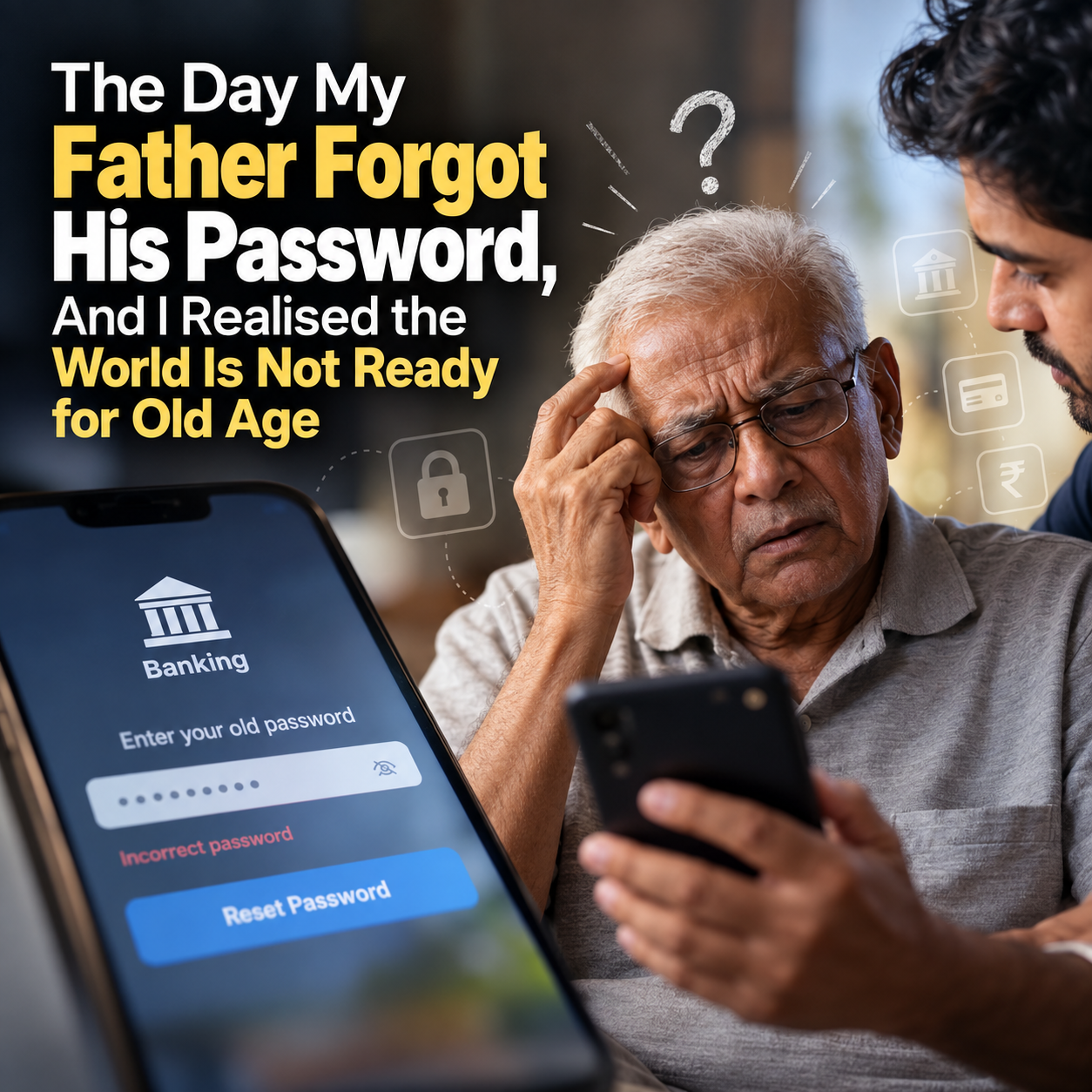
A silent digital crisis is growing inside our homes, and nobody is talking about it. This morning, inside my home, I witnessed something that at first looked ordinary, almost insignificant. But the more I thought about it, the more I realised it represents one of the biggest human problems quietly emerging in the digital age. My father was trying to log into his banking application. Nothing urgent. Nothing dramatic. Just another routine morning task that millions of elderly parents now perform every day — checking balances, viewing transactions, managing pensions, or simply making sure everything is fine. Then suddenly, the application logged him out. A message appeared on the screen asking him to reset the password for security reasons. Like most modern banking systems, the app first asked him to enter the old password before creating a new one. My father stopped. He stared at the phone silently for a few moments. Then he entered one password. Wrong. He tried another. Wrong again. Then he slowly looked at me and said something that stayed with me the entire day: “I don’t remember.” Luckily, I had already anticipated this problem years ago. Over time, I had quietly created backup systems, recovery methods, alternate authentication structures, password management solutions, and secure recovery access for my parents. As a single son, I had gradually taken responsibility for managing these invisible digital complications before they could become emergencies. Within a few minutes, I managed to solve the issue. The bank application reopened. The problem disappeared. But my mind could not move on so easily. Because one disturbing thought kept repeating inside my head: What about all the other parents who live alone? What happens to elderly couples whose children live abroad? What happens to widows managing finances independently after losing their spouses? What happens to retired individuals sitting alone in apartments trying to understand OTPs, password resets, authentication loops, recovery emails, and app updates that change every few months? Most importantly, what happens when memory itself slowly begins to weaken? The world today proudly speaks about artificial intelligence, digital banking, fintech revolutions, biometric authentication, cashless economies, and app-based governance. Governments celebrate paperless systems. Banks reduce physical branches. Customer support becomes automated. Human interaction is shrinking while digital dependency grows larger every year. But hidden beneath all this technological progress is a silent crisis almost nobody is openly discussing. The modern digital world still depends heavily on one fragile thing: human memory. Every important system today ultimately asks human beings to remember invisible information created months or years earlier — passwords, PINs, security questions, recovery phrases, verification patterns, and backup credentials. For younger generations deeply immersed in technology every day, this feels manageable. Password resets have become routine. OTPs feel normal. Two-factor authentication is just another part of life. But aging changes the way human memory works. Elderly people do not interact with technology continuously enough to retain complex digital information forever. Many access certain accounts only occasionally. Some open investment portals once a year. Others use banking applications only during specific needs. Their brains naturally discard information that is not repeatedly used. Unfortunately, cybersecurity systems expect the opposite. Modern digital systems demand machine-level precision: exact symbols, exact uppercase letters, exact recovery answers, exact phone continuity, exact authentication paths. Human beings were never designed to function like permanent storage devices — especially not in old age. What makes this situation more frightening is that society believes it has already solved the problem. Fingerprint unlocking, Face ID, OTP verification, trusted devices, and biometric banking have certainly made daily access easier for elderly users. Phones can now open using fingerprints. Banking applications can recognise familiar devices. Transactions can be approved through facial recognition. But these systems only postpone the real problem. Because eventually, every platform reaches a point where it demands the original password again. A software update triggers re-authentication. A phone replacement breaks trusted access. A suspicious login freezes the account. A SIM card changes. An app suddenly asks: “Enter your old password.” And at that moment, the entire structure collapses again. A forgotten password today is no longer a small inconvenience. It can temporarily block access to savings, pensions, healthcare systems, insurance policies, investments, utility payments, and critical financial records. In many cases, elderly users are not losing access because they are incapable. They are losing access because modern cybersecurity systems were built on a dangerous assumption: that human memory remains permanently reliable. But aging does not work that way. Memory becomes selective. Recently created information fades faster. Complex patterns become harder to retain. Familiar systems suddenly feel unfamiliar after interface updates or device changes. Yet digital systems rarely show empathy toward this reality. Ironically, the systems created to protect people are slowly excluding the very generation that built the institutions behind them. Banks understand the issue. Technology companies understand it. Governments understand it. Yet no truly fail-proof solution exists because every alternative creates another serious risk. If passwords disappear entirely, fraud risks increase dramatically. If family members receive unrestricted access, elder abuse becomes a major concern. If AI begins continuously recognising behavioural identity patterns, surveillance fears emerge immediately. If centralised biometric systems become permanent identity tools, privacy concerns become enormous. Every possible solution creates another ethical problem. So the industry continues relying on temporary fixes instead of building systems truly designed for aging populations. And this problem is only going to grow larger. The entire world is rapidly moving toward complete digital dependency while global populations simultaneously grow older. The collision between these two realities may become one of the defining crises of the coming decades. This morning, while helping my father recover access to a simple banking application, I realised something deeply uncomfortable: Cybersecurity systems were designed to protect institutions from strangers and attackers. They were never designed to protect ordinary human beings from time itself. Yet aging is not a technical exception. It is the final destination for every human being alive today. One day, even the young engineers building these systems will grow old. One day, even digital natives may forget passwords they once created effortlessly. And perhaps someday society will finally realise that the greatest weakness in cybersecurity was never human carelessness. It was the assumption that human memory could remain permanent forever.