The Great Migration of Power: Cultivating Future-Ready Citizens Through Experiential Learning
For generations, the bedrock of global education has rested on a single, unshakeable maxim: knowledge is power. Schools, universities, and societal hierarchies were constructed around the logic of scarcity, those who memorized the facts, controlled the information, or mastered predictable cognitive outputs held the keys to success.
Today, that foundation is shifting beneath our feet. We have entered an era where artificial intelligence has rendered basic cognitive output, summarizing, drafting, analyzing, coding, and explaining, abundant, cheap, and instantly accessible.
When answers become a commodity, the fundamental question for educators, leaders, and parents changes entirely. The defining question is no longer: Who has the answers? It is: Who can make them mean something?
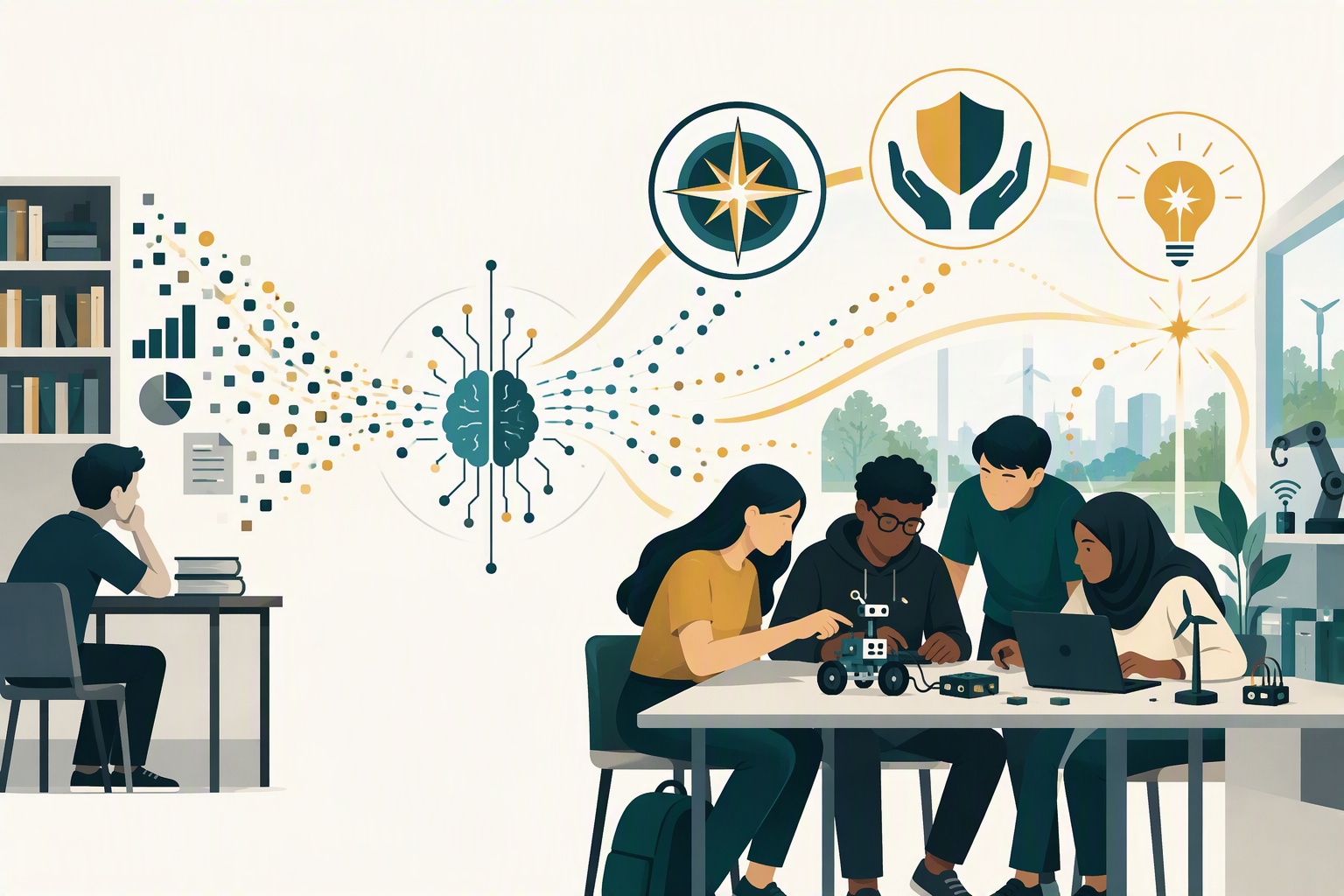
As a technological wave, AI does not erase human expertise; it fundamentally raises the bar. When machines can mass-produce information at scale, the premium shifts dramatically toward qualities that cannot be automated. This is the "Migration of Power." Power is moving away from the gatekeepers of knowledge and toward those who possess what can be defined as the Three New Scarce Commodities:
1. Judgment Under Uncertainty
AI can generate infinite options and raw data points, but it lacks situational awareness. Human beings must decide what actually matters, what fits the unique cultural or emotional context, and what is truly worth acting on.
2. Responsibility, Ethics, and Trust
Automated systems can fail, mislead, hallucinate, or cause unintended harm. A machine cannot stand in a court of law, nor can it look a stakeholder in the eye. Human accountability, verification, and ethical governance are more crucial now than ever before.
3. Originality and Human Connection
While generative tools excel at replicating patterns from existing data, a distinct point of view, authentic creative taste, and genuine human empathy cannot be mass-produced. The most deeply human qualities are precisely what have become most valuable.
As Tom Gruber, one of the original creators of Siri, aptly noted:
“The real question isn’t whether a tool is powerful, it’s whether you’re using it to augment what you do, or to replace the thinking entirely.”
Redefining the Classroom: From Standalone Labs to Holistic Experiential Learning
To prepare students as future-ready citizens of this world, the education sector must undergo an urgent strategic shift. If the curriculum continues to reward passive consumption, rote memorization, or isolated technical skills, it risks preparing students for a world that no longer exists.
The solution does not lie in building standalone robotics or coding labs where students follow static, step-by-step recipes to build pre-determined models. True readiness requires moving beyond isolated tool-handling to sustainable, holistic, and integrated and inter-disciplinary experiential learning directly within the daily classroom ecosystem.
When futuristic technologies, such as AI, Robotics, and the Internet of Things (IoT), are woven seamlessly into an experiential learning framework, the entire nature of a lesson changes:
From Theory to Application: Students do not just read about algorithmic bias or automated mechanics; they actively deploy these tools to solve real-world problems, witnessing firsthand where automated logic succeeds and where it falters.
Fostering Critical Judgment: By engaging in creation-based projects, learners are forced to interpret data, evaluate machine outputs, and make high-stakes decisions under uncertainty.
Cultivating Accountability: Working through collaborative, hands-on STEAM based experiential challenges teaches students to take ownership of their designs, troubleshoot system failures, and evaluate the ethical implications of their creations on society and the environment.
Embracing this reality requires a synchronized effort from every pillar of our educational community.
School Principals and Administrators: Must shift institutional metrics of success away from standardized data-recall toward frameworks that measure critical thinking, structured problem-solving, and adaptive learning. Leadership must champion the integration of core technologies as cross-disciplinary tools rather than isolated elective subjects.
Teachers and Educators: Must transition from being the primary "source of knowledge" to becoming facilitators of discovery and curators of context. The goal is to guide the mind holding the tool, teaching students how to ask the right questions, challenge assumptions, and inject human perspective into automated outputs.
Parents: Need to pivot their expectations away from traditional, rigid career benchmarks. Success in an AI-rich future depends on adaptability, emotional intelligence, and a mindset geared toward sustainable creation rather than mere compliance.
Students: Must view technology not as a shortcut to bypass thinking, but as an intellectual amplifier. The challenge ahead is to develop a distinct voice, a sharp ethical compass, and the resilience to iterate when automated systems fail.
History reminds us that when photography emerged, painting did not die, it evolved to focus on expression, abstraction, and deeper emotional truth. Technology simply forces humanity to climb higher up the cognitive value chain.
The future belongs to individuals who do not compete with machines, but who harmonize advanced technology with irreplaceable human judgment, creativity, and accountability. By transforming classrooms into spaces of active, holistic experimentation today, we ensure our students do not just survive the technological shift, they lead it, creating a more sustainable and thoughtful world.