
THE ILLUSION OF THE FIST. Taught to Win — Not to Lose
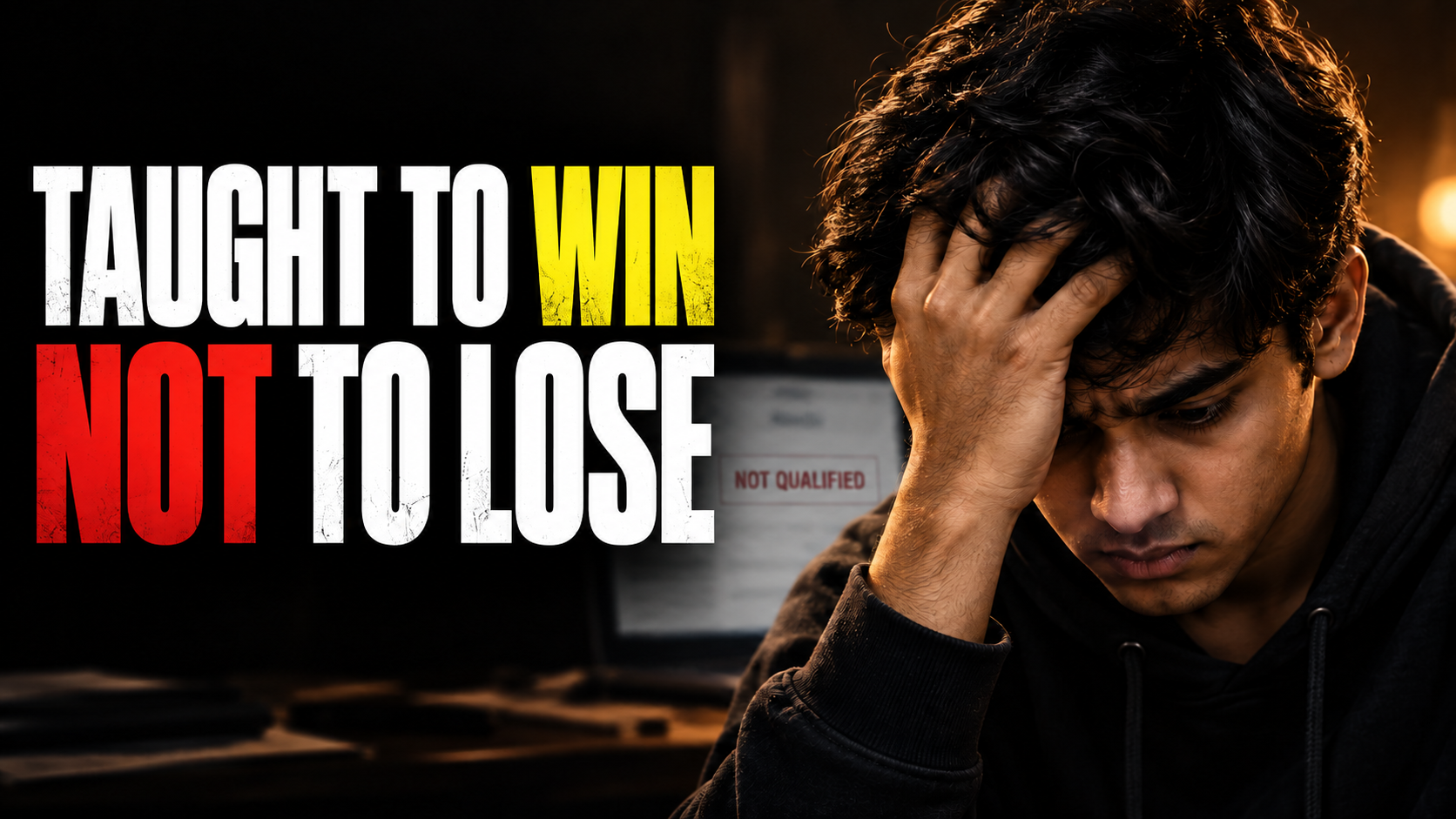
THE ILLUSION OF THE FIST
Taught to Win — Not to Lose
The article opens with an anecdote about how a person’s understanding of destiny and control can change with age and experience.
It describes a passionate young man who believes that destiny is entirely within his hands. He feels that if he works hard enough and makes enough sacrifices, he can achieve anything.
At 19, 20 or 21, life may seem like a simple equation. You work hard, you study, and you succeed.
But imagine the same person two decades later.
He is now forty. Some of the promises he once made to himself remain unfulfilled. The dream college, the elite career, or the single goal he had set for himself did not happen as he had imagined.
Ask him what happened to his belief in absolute control over life.
He no longer shows you his fist.
Instead, he looks up at the sky, folds his hands, and sighs: “There is something else at play. Everything is not in my hands.”
This transition is not necessarily weakness. It can be a natural, though sometimes painful, lesson that comes with life.
But what happens when an 18- or 19-year-old, who still believes that everything is within his closed fist, suddenly faces a major setback?
Every year, many ambitious students spend long hours preparing for competitive exams like JEE, NEET or NDA.
They may sacrifice sleep, friendships and peace of mind because they believe in the power of hard work and determination.
But then the results appear.
They miss the cutoff by a small margin, and suddenly their entire world seems to collapse.
When they break down in their bedrooms, their parents—usually over forty and looking at life with the wisdom of experience—rush in with the best of intentions.
They say: “It’s just an exam. Life is long. You don't win every time.”
But these words may fail to provide comfort.
The child simply cannot understand them at that moment.
Why does a parent's hard-earned perspective sound like a foreign language to a heartbroken nineteen-year-old?
________________________________________
Author’s Note:
The insights in this article are based primarily on the author's personal experiences and observations, rather than a formal psychological study.
They come from the realities of life and from watching high-achieving young students struggle when faced with sudden setbacks.
This is a perspective drawn from real-life experiences, written because no parent should have to watch their child withdraw into isolation, and no young person should have to face such difficult moments alone.
________________________________________
The Unvaccinated Achiever
We often believe that a child who wins trophies, excels in sports and consistently tops the class is naturally resilient.
However, this may not always be the case.
Some high-achieving students may find it particularly difficult to cope with a major setback, especially if they have had limited experience dealing with failure.
A student who has scored average marks or faced rejection early in life may have already developed some experience in handling disappointment.
They may know what disappointment feels like, how to cope with it, and that life continues even after a setback.
The lifelong topper, however, may have grown accustomed to constant validation.
For an 18- or 19-year-old, a major setback can therefore feel like their first serious emotional shock.
If they have had little experience recovering from failure, they may struggle to believe that they can overcome it.
They may also experience what the author describes as "emotional time-blindness."
An adult may handle failure differently because they have a mental archive of past experiences.
They can remember: “At 25, I lost a job. But at 26, I found a better one.”
An 18- or 19-year-old's life graph may have been a straight upward line—and now it has suddenly crashed.
They may find it difficult to imagine a comeback because they have never experienced one.
To them, this is not a temporary dip in a long graph.
It may feel like the final point on the page.
________________________________________
What Do They Face or Fear to Face?
For an achiever who has known mostly praise, public failure can feel like walking through a crowd of critics.
They may face several emotional challenges:
• The Pressure of Peer Taunts: In highly competitive coaching environments, peers may sometimes create psychological pressure. It may not come as open insults. It can come through sharp questions: “You studied so much. What went wrong?” or “Maybe you just panicked.” To avoid becoming the "cautionary tale" of the batch, the student may choose to remain invisible.
• Parental Frustration: The student may notice the pressure on their parents—the money spent on coaching, the sacrifices, the family vacations missed, and the silence or disappointment at home. What is actually parental anxiety about the child's future may be interpreted by the child as a withdrawal of love.
• The Identity Vacuum: Years may have been spent chasing marks and ranks while giving up hobbies, sports and other interests. They may no longer know who they are outside the exam. When the achievement disappears, they may struggle to understand their identity beyond academic success. Withdrawing from others can then feel like a way to protect their self-esteem.
So, it is possible that they retreat into their shell to avoid these challenges.
When the illusion of the fist breaks, a high-achieving young person does not simply become sad.
They may withdraw into a shell.
Their bedroom becomes a fortress.
They may delete social media apps, leave group chats, stop answering friends and avoid family dinners.
This withdrawal may be an attempt to cope with emotional distress.
The Immediate Intervention: The Parent as a Shield
When a child retreats into this shell, they may cut themselves off from the world.
Friends are avoided. Teachers may represent the system that rejected them.
At this moment, parents can play an important role in helping them feel supported and understood.
To help a child through this difficult period, parents may need to change their approach.
1. Stop Fixing, Start Holding Space: Do not immediately start talking about backup colleges, alternative careers or a drop year. To a burnt-out mind, this can feel like being asked to run another marathon with broken legs. Sit with them and acknowledge their feelings. Say: “It is okay to be devastated. You worked incredibly hard, and it hurts that it didn't happen. I am here with you. Let's face it together.”
2. Dismantle the "Achievement Rent": Achieving children can unconsciously learn that they have to earn their parents' pride through trophies and marks. Parents must clearly separate love from achievement. Tell them: “We are proud of your character and discipline, not just your rank. You don't have to win a trophy to be loved.”
3. Become a Fortress: Do not allow relatives, neighbours or acquaintances to interrogate your child. Handle those conversations yourself. Tell outsiders: “The results are out. We are proud of our child's effort, and we are taking some quiet family time right now.” When the child sees the parent standing up for them, home can become a safe space.
4. Lend Them Your "Resilience Bank": Do not rely only on famous examples like Abraham Lincoln or Abdul Kalam. Those stories may feel distant. Share your own experiences. Say: “I felt exactly as you do right now—like my life was over. When I was your age, I faced a major failure. But look at me today. I survived, and you can find your way forward too. I know you have the strength to keep going.”
Parents should also remember that if a child's distress continues, becomes severe, or affects their daily functioning, seeking help from a qualified mental-health professional can be an important step.
The Long-Term Fix: Psychological Vaccination
Immediate support can help a child during a difficult period.
But the long-term goal of parenting should also include preparing children to deal with life's uncertainties.
We do not protect children from every challenge by keeping them in a sterile bubble. We help them develop the skills and confidence to face difficulties.
In the same way, parents can help children become emotionally prepared for life's uncertainties long before they turn eighteen.
• Never Be Boastful: When your child tops the class, do not turn them into a trophy for society. Avoid constantly bragging about them or posting their report cards on social media. Excessive expectations can make setbacks feel even more difficult. Encourage achievements while keeping them in perspective.
• The Laboratory of Sports: Encourage children to take part in structured, competitive sports early in life. In academics, hard work may often produce predictable results. In sport, you can train for months, give your best and still lose because the opponent was better, the referee made a mistake, or it simply wasn't your day. Learning to accept defeat in a football match at twelve may help a child develop the ability to handle setbacks later in life.
• Praise the Process, Not the Identity: Stop telling children, “You are a genius” or “You are a natural winner.” This can create a rigid and fragile identity. Instead, praise what they can control: “I am proud of how disciplined you were this week,” or “I love how hard you fought even when the game was slipping away.”
• Diversify Their Self-Worth Portfolio: Do not allow academics to become the child's only source of self-worth. Encourage other interests, such as playing an instrument, sketching, volunteering or simply doing something they enjoy. When academic pressure becomes overwhelming, they need a space where nobody is scoring, ranking or judging them.
Closing the Gap
We must stop preparing the path for the child and start preparing the child for the path.
Life is full of uncertainty, rejection and unexpected challenges.
To help the eighteen-year-old who knows only how to hold life in a tight, desperate fist, the forty-year-old parent must first offer support, acknowledge the shock of the moment, and then gently help the child look up and see the sky.