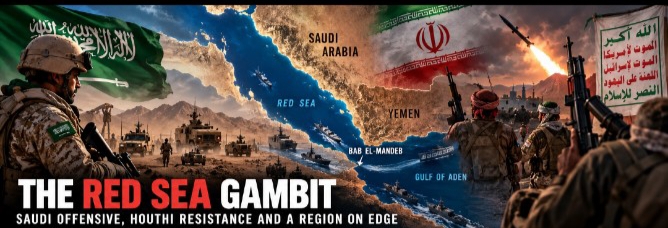
"The Red Sea Gambit: Saudi Arabia’s Security Burden, Pakistan’s Dilemma and Iran’s Strategic Leverage".
By Colonel (Dr.) Ashwani Kumar, MiD, VSM (Retd.)
Will Riyadh Secure Bab-el-Mandeb or Create Another Endless War?
The emerging contest could redraw the regional balance of power.
Saudi Arabia is approaching a defining moment in its regional security policy. The Saudi-backed Yemeni government’s offensive against Yemen’s Houthi movement, aimed at recovering strategic coastal positions and restoring security around the Bab-el-Mandeb Strait, represents far more than a military operation. It could mark the beginning of a prolonged security commitment extending from Yemen’s fragmented political landscape to the wider Red Sea maritime theatre.
The central question is no longer whether Saudi Arabia possesses the military resources to support an offensive. It is whether Riyadh can translate battlefield gains into durable political stability without becoming the principal guarantor of an increasingly expensive and complicated regional security order.
Three interconnected dilemmas will determine the outcome:
- The sustainability of Saudi military intervention.
- The reliability of the American security umbrella.
- The extent to which Iran may deepen its support for the Houthis.
A fourth dimension is also emerging: Pakistan’s possible involvement and the strategic consequences of its military support for Saudi Arabia. A direct Pakistani combat role in Yemen could place Islamabad in a difficult position, potentially straining relations with neighbouring Iran. The unfolding situation may ultimately become a contest not merely for territory, but also for influence, endurance and the redistribution of regional security responsibilities.
The Strategic Prize: Bab-el-Mandeb
The Bab-el-Mandeb Strait is a strategic gateway connecting the Red Sea with the Gulf of Aden and the Indian Ocean. It links Asian trade and energy flows with the Suez Canal and Mediterranean markets. Its importance has increased further amid instability around other major maritime routes, including the Strait of Hormuz.
The Houthi presence along Yemen’s western coastline has transformed the domestic conflict into an international security concern. For Saudi Arabia, the stakes are particularly high. The Kingdom’s Red Sea ports and East-West oil transportation infrastructure are essential to its economic resilience. Any sustained threat to maritime access, coastal installations or energy infrastructure could undermine the benefits of geographical diversification.
Riyadh’s support for a Yemeni counteroffensive is therefore understandable from a security perspective. Allowing an armed non-state movement to threaten a major international shipping corridor could establish a dangerous precedent. However, recovering territory is only the first phase of the challenge.
The Military Victory Trap
Saudi Arabia has experienced the limitations of military solutions in Yemen before. The intervention that began in 2015 aimed to restore the internationally recognised Yemeni government and contain Houthi expansion. Despite considerable military resources, the conflict evolved into a prolonged war characterised by fragmented alliances, humanitarian suffering, cross-border attacks and repeated diplomatic efforts.
The present situation risks reproducing that strategic dilemma under more dangerous regional circumstances.
A Saudi-supported offensive may dislodge Houthi forces from selected coastal positions. However, holding territory, securing supply routes, protecting civilians and preventing the return of insurgent networks would require a sustained commitment. The most difficult question is who will administer the recovered territory.
Yemen’s anti-Houthi camp is not a unified political or military organisation. Its factions have different political ambitions, regional loyalties and priorities. A military coalition assembled against a common adversary does not automatically become a stable governing authority.
If Saudi Arabia helps recover the coastline but fails to establish an inclusive and functional local administration, it may find itself responsible for financing, training and protecting a new security structure indefinitely. That would turn an offensive intended to reduce insecurity into another long-term liability.
The financial implications could also be considerable. Saudi Arabia’s Vision 2030 requires sustained investment in economic diversification, infrastructure, tourism, technology and human capital. A renewed Yemen campaign could divert resources and strategic attention from these priorities. The danger is not simply the cost of war, but also the opportunity cost of maintaining peace after the fighting ends.
America’s Security Umbrella: Guarantee or Convenience?
The role of Washington is another consequential factor. Recent reporting indicates that the United States has continued to support Saudi Arabia through intelligence sharing and other forms of military cooperation. The precise scope of American involvement in individual offensive operations, however, should be distinguished from a commitment to participate directly in ground combat.
This distinction deserves serious attention.
Intelligence support can improve operational effectiveness, but it is not equivalent to a commitment to fight when an ally faces retaliation. Saudi Arabia has relied on American military cooperation, advanced weapons, intelligence capabilities and regional deterrence for decades. The current crisis nevertheless raises fundamental questions about the reliability and limits of that arrangement.
Washington’s priorities include the security of American forces, the protection of maritime commerce, its confrontation with Iran and the avoidance of additional military entanglements. For American policymakers, Yemen competes with other regional priorities. For Saudi Arabia, the threat to its territory and nearby maritime routes is an immediate security concern.
This difference in threat perception could become a weakness in the bilateral security relationship. The United States may remain committed to protecting its strategic interests in the Gulf without accepting responsibility for every military objective pursued by Riyadh.
Saudi Arabia must therefore distinguish between access to American military capabilities and an assured American security guarantee. The two are not interchangeable.
Any limits on direct American participation should not automatically be interpreted as the end of the security relationship. Washington may continue providing defensive assistance, intelligence, diplomatic backing and military supplies. Nevertheless, Riyadh would be unwise to assume that American forces will always intervene directly. Saudi Arabia may have to shoulder more responsibility for its regional security strategy while continuing to depend on American technology and military cooperation.
Iran’s Strategic Opportunity: The Power of Indirect Warfare
Iran’s relationship with the Houthis adds another dimension to the crisis. Tehran has developed a regional network of relationships and partnerships that enables it to exert influence beyond its borders. The Houthis are an important component of this strategic landscape. However, the movement should not be treated merely as an Iranian military proxy. It has its own political leadership, domestic constituency, ideological outlook and strategic calculations.
This distinction matters because Iranian influence does not necessarily translate into complete operational control.
A direct Iranian military deployment into Yemen would represent a substantial escalation, particularly amid wider regional tensions involving Iran, the United States and Israel. It could expose Iranian forces and assets to additional military pressure, widen the conflict and invite retaliation against Iranian territory or interests.
Tehran may therefore find indirect support more attractive than overt intervention. Such support could involve political backing, military expertise, intelligence cooperation, technological assistance or efforts to sustain Houthi missile and drone capabilities. The extent of any specific assistance should be assessed against reliable evidence rather than assumption.
Even without direct Iranian combat participation, the Houthis could impose significant costs on Saudi Arabia through asymmetric warfare. Missiles, drones, maritime threats and attacks on energy infrastructure can create disproportionate strategic effects against a technologically superior opponent.
Iran’s strategy could therefore involve avoiding an open conventional confrontation while ensuring that Saudi Arabia cannot achieve a low-cost victory. In such a scenario, the battlefield becomes an instrument of strategic exhaustion. The objective would not necessarily be to defeat Saudi Arabia militarily, but to make the cost of intervention sufficiently high that Riyadh eventually seeks a negotiated settlement.
Pakistan’s Possible Role: An Ally Caught Between Riyadh and Tehran
Another important question is whether Pakistan could become more deeply involved in the Saudi-led response to the Houthi threat through troop deployments, military assistance or an expanded security commitment.
Pakistan and Saudi Arabia share a longstanding defence relationship. Recent reporting indicates that Pakistan and Turkey have committed to supporting Saudi Arabia under a joint defence arrangement. However, the announcement of military support or the deployment of personnel to Saudi Arabia should not automatically be interpreted as confirmation that Pakistani troops will take part in ground combat inside Yemen.
Pakistan shares a long border with Iran and has significant strategic, economic and security interests in maintaining a workable relationship with Tehran. Any direct Pakistani participation in offensive operations against the Houthis could create a difficult contradiction: defending Saudi interests while risking an indirect confrontation with a neighbouring country.
Can Pakistani Troops Withstand Yemen’s Desert and Mountain Environment?
The operational environment presents another challenge. Yemen’s coastal belt, mountainous terrain and desert conditions would demand specialised preparation, logistics and sustained operational support.
Pakistan’s armed forces possess experience operating in arid environments. It would therefore be premature to predict failure simply because of climatic conditions. The greater challenge would be the combination of extreme heat, mountainous terrain, irregular warfare, drone and missile threats, difficult supply lines and potentially prolonged deployments.
The question is not simply whether Pakistani soldiers can fight in Yemen. It is whether they would be adequately supported, appropriately tasked and provided with a clearly defined political end-state.
A force deployed to defend Saudi territory or critical installations would face a substantially different mission from one committed to offensive operations against Houthi-controlled territory. This distinction could determine the operational and political sustainability of Pakistan’s participation.
The Iran Complication
Pakistan must also consider the consequences of becoming involved in a conflict in which the Houthis receive Iranian political and military support. Even without direct Iranian-Pakistani hostilities, such involvement could strain bilateral relations, complicate border security and create additional pressure on Pakistan’s already demanding internal and external security commitments.
The danger is that a mission initially presented as assistance to a strategic partner might eventually become a costly commitment with uncertain prospects of success.
For Islamabad, the decision involves more than military capability. It requires a calculation of national interest, diplomatic consequences and the risk of becoming entangled in a conflict whose strategic objectives are not entirely its own.
Pakistan would be wise to distinguish between defending Saudi Arabia against an external attack and participating in an offensive campaign that could place it in indirect confrontation with Iran. Its possible contributions could include defensive cooperation, training, intelligence coordination or the protection of designated strategic installations rather than a direct ground-combat role.
Pakistan may possess the military capability to operate in Yemen, but that does not automatically make participation strategically desirable.
Will the Conflict Spread Across the Wider Red Sea?
The danger extends beyond Saudi Arabia and Yemen. The Bab-el-Mandeb Strait sits within a complex geopolitical environment involving Egypt, Djibouti, Eritrea, Sudan, Ethiopia and the wider Horn of Africa.
Any prolonged confrontation could affect shipping insurance, commercial freight costs, energy transportation, port operations and international naval deployments. Egypt would have particular reasons to be concerned about the security of the Suez Canal and the wider Red Sea shipping system.
For India, the implications would also be significant. Indian commercial shipping, energy security, overseas citizens and trade with Europe and the Gulf are all affected by stability along these maritime corridors. A prolonged disruption could increase transportation costs and expose Indian commercial interests to wider geopolitical uncertainty.
The crisis should therefore be viewed not simply as a Saudi-Houthi confrontation, but as a potential strategic contest over access, influence and maritime security.
Predicting the New Game: Five Emerging Strategic Possibilities
The most likely development is not necessarily a single decisive military victory. It may instead be a layered regional contest in which different powers pursue their objectives while attempting to avoid the costs of direct confrontation.
1. Saudi Arabia Seeks a Coalition, Not Merely an Army
Riyadh may attempt to distribute the military and financial burden among regional partners. Pakistan could be approached for military cooperation, while Egypt and other regional actors may be drawn into maritime security arrangements.
The objective would be to prevent Saudi Arabia from becoming the sole guarantor of the recovered Yemeni coastline. However, the coalition’s sustainability would depend on whether its members share a common political end-state. A coalition capable of launching an offensive may not necessarily be capable of governing the territory it recaptures.
2. Iran Chooses Attrition Over Direct Confrontation
Iran may seek to avoid openly deploying regular forces into Yemen while maintaining political and strategic support for the Houthis. This approach could allow Tehran to impose costs on Saudi Arabia without immediately inviting a direct Iranian-Saudi war.
The Houthis could remain a source of pressure on maritime traffic, Saudi infrastructure and regional military deployments. The result could be a prolonged contest in which the costs of maintaining security become as important as the ability to conduct offensive operations.
3. America Becomes the Strategic Manager, Not the Principal Combatant
Washington may seek to preserve its influence through intelligence, weapons, air-defence cooperation and naval deployments while encouraging regional partners to shoulder a greater share of the burden.
This would not necessarily mean American abandonment of Saudi Arabia. It could, however, suggest a more selective security relationship in which American intervention depends on the nature and scale of the threat to US interests.
Saudi Arabia may consequently accelerate its pursuit of independent military capabilities and diversified strategic partnerships.
4. Pakistan Attempts Strategic Balancing
Pakistan could find itself under pressure to demonstrate solidarity with Saudi Arabia while avoiding a deterioration of relations with Iran. Its preferred option may be to offer defensive assistance without becoming a principal participant in offensive operations.
If Islamabad commits ground forces to an open-ended campaign, it risks acquiring an additional security burden without gaining a decisive strategic advantage. If it avoids direct combat participation, it may face pressure from Riyadh but retain greater diplomatic flexibility.
The choice will test Pakistan’s ability to separate its defence partnership from automatic military participation.
5. A Negotiated Security Arrangement Emerges After Military Exhaustion
A prolonged conflict could eventually create incentives for a negotiated arrangement involving Saudi Arabia, the Yemeni parties, Iran and international maritime stakeholders.
Such an arrangement might include guarantees against attacks on commercial shipping, restrictions on cross-border strikes, agreements for local administration and a broader political settlement.
This outcome is not assured. It would require the parties to recognise that neither military escalation nor indefinite containment offers a sustainable solution. Nevertheless, the possibility of a negotiated settlement may grow as the financial and political costs of continued confrontation increase.
Saudi Arabia’s Difficult Choices
Riyadh faces three broad strategic options.
The first option is a decisive military offensive intended to recover the strategic coastline and weaken Houthi control. Its attraction is immediate and visible, but its risks include retaliation, escalation and a prolonged stabilisation commitment.
The second option is a limited military campaign combined with renewed diplomacy. This may reduce the probability of a wider war, but it would require difficult compromises and credible guarantees concerning maritime security.
The third option is a broader regional security arrangement involving Gulf states, Egypt, Pakistan and other partners, with clearly defined responsibilities for maritime surveillance, air defence and protection of commercial shipping.
The third approach may offer the greatest long-term sustainability, provided it is supported by concrete operational commitments rather than diplomatic declarations. Saudi Arabia should also strengthen its independent defensive capabilities, particularly integrated air and missile defence, critical infrastructure protection, maritime surveillance and the resilience of alternative energy transportation routes.
The objective must be to reduce vulnerability rather than simply increase military expenditure.
Conclusion: A Victory That Could Become a Regional Liability
Saudi Arabia and its partners may achieve immediate military objectives, recover important territory, weaken Houthi positions and improve security around the Red Sea. However, success should not be measured exclusively by the number of positions recaptured or missile installations destroyed.
The real test will be whether Saudi Arabia can prevent a renewed insurgency, establish a legitimate political arrangement in Yemen, protect its own territory and maintain maritime security without carrying the entire financial and military burden.
The United States must also confront a strategic contradiction. Regional partners cannot be expected to underwrite the security of vital international waterways indefinitely while remaining uncertain about the extent of American support during a crisis.
Iran must recognise that support for actions threatening international shipping and neighbouring states risks creating a wider conflict whose consequences could extend far beyond Yemen.
Pakistan, meanwhile, must calculate whether its defence partnership with Saudi Arabia justifies the possibility of an indirect confrontation with Iran. Military capability alone cannot resolve the political and strategic risks of an open-ended deployment.
The most plausible emerging scenario is therefore one of selective military engagement, asymmetric pressure, regional burden-sharing and eventual diplomatic bargaining. Saudi Arabia may seek a military victory, Iran may seek strategic endurance, Pakistan may seek to preserve its balancing position, and the United States may attempt to retain influence without assuming the entire operational burden.
The greatest danger is that a campaign intended to contain the Houthis could create a wider confrontation involving Saudi Arabia, Pakistan and Iran, while Washington remains selectively engaged.
Ultimately, the Red Sea crisis is not simply about who controls a strip of Yemen’s coastline. It is about who will pay for its security, who will guarantee freedom of navigation, and whether the pursuit of regional influence will once again leave the people of Yemen and the wider international community bearing the cost of another endless war.
The greatest strategic victory for Saudi Arabia would not be to inherit the Red Sea’s security burden, but to create an arrangement in which no single nation is forced to carry it alone.
Colonel (Dr.) Ashwani Kumar, MiD, VSM (Retd.)
Defence Expert | Intelligence Professional | Strategic Affairs Commentator