"WHEN KRISHNA RETURNS"
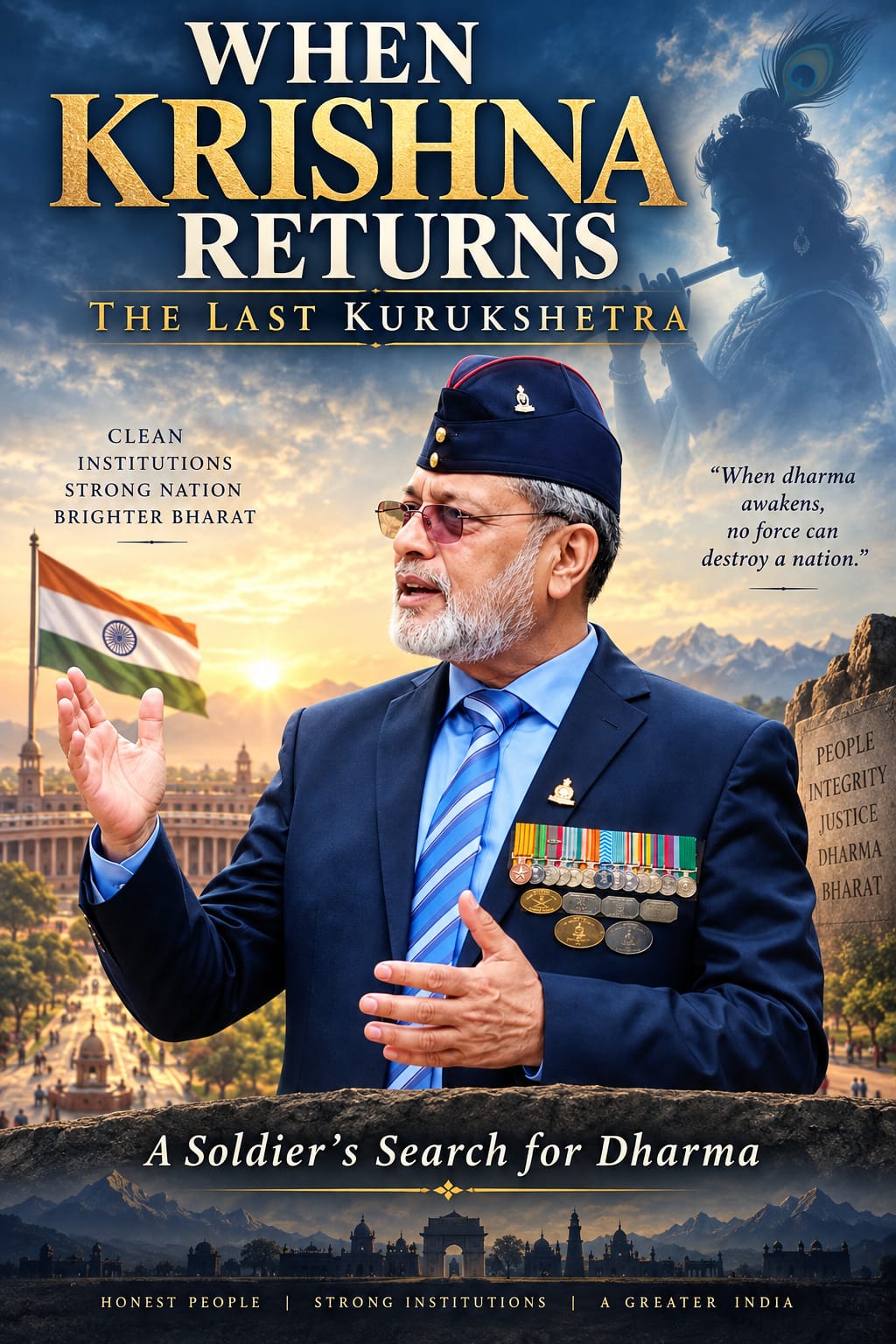
=# The Last Kurukshetra: A Soldier’s Search for Dharma
**By Col. (Dr.) Ashwani Kumar, MiD, VSM (Retd.)**
*Note: This is a fictional and reflective narrative inspired by Indian philosophical and cultural traditions. The characters, political developments and events described in the story are fictional and should not be interpreted as factual accounts.*
There are questions that do not belong to one generation. They survive kingdoms, empires and civilizations. One such question has travelled with India for thousands of years.
**Will Krishna return?**
The answer has been interpreted in many ways.
Some wait for a divine figure to descend from the heavens. Some believe that whenever dharma declines, the Divine manifests in another form. Others believe that Krishna never truly leaves, and that his consciousness appears whenever courage rises against injustice.
But perhaps there is another question.
If Krishna returned today, would we recognize him?
Would we recognize him if he did not carry a Sudarshan Chakra? If he did not wear a crown? If he did not perform miracles?
What if he entered Parliament instead of a battlefield?
What if his battlefield was corruption?
What if his weapons were truth, law, strategy and courage?
And what if the first person to recognize him was not a priest, but an old soldier?
## The Soldier’s Perspective
Colonel Kumar had spent most of his life serving India.
The Army had taught him that duty was not a matter of convenience. When the nation called, the soldier went. When danger appeared, the soldier stood. When fear entered the mind, discipline took its place.
He had served in difficult environments and had seen the country from places most citizens never saw. He had known the silence of mountains, the uncertainty of borders and the loneliness that comes with responsibility.
After retirement, he settled quietly in the hills. But retirement had not retired his mind.
He began writing.
History became his second battlefield. Among all the figures of India's ancient past, Krishna fascinated him most. Kumar did not study Krishna merely as the deity worshipped in temples. He studied the man behind the tradition—the child separated from his parents, the boy raised by Nanda and Yashoda, the strategist who understood when circumstances demanded difficult decisions, the builder of Dwarka, the student of Sandipani, the protector of the Pandavas, the friend who stood beside Draupadi and the charioteer who transformed Arjuna's despair into duty.
Kumar wrote in his diary:
> “Krishna's greatest miracle was perhaps not what he did. It was what he refused to become.”
He never allowed power to possess him. He carried responsibility without becoming attached to its rewards.
That lesson stayed with Kumar.
## The India of His Time
In Kumar's imagined India, the nation had changed enormously.
The country had nuclear weapons. Satellites circled the earth. Artificial intelligence was transforming human life. Indian scientists were reaching into space, young Indians were leading global companies and the economy was expanding.
The world was beginning to look toward India with respect.
And yet, beneath this extraordinary progress, Kumar sensed a dangerous weakness.
Corruption.
Not merely the exchange of money under a table, but something deeper—a culture in which influence could replace merit, money could replace fairness, connections could replace competence and fear could replace truth.
Political patronage could sometimes protect wrongdoing. Honest officers could face pressure for refusing to compromise.
Some citizens had become so accustomed to corruption that they had stopped believing change was possible.
The Colonel began writing again:
**“The Kauravas have returned.”**
Then he stopped.
The Kauravas of the modern age were not sitting together in Hastinapura. They were everywhere.
They were not one family.
They were a mindset—a belief that the nation existed for personal benefit, that institutions could be captured and that honesty was for fools.
Kumar closed his diary.
He stared out of his window.
And a question came to him:
**“If Krishna were alive today, what would he do?”**
## The Politician
The answer appeared on television a few weeks later.
A young fictional politician had suddenly begun attracting national attention.
His name was **Krish Dev**.
He was unlike the politicians Kumar had imagined in his writings. He did not arrive with a procession of luxury cars. He did not make extravagant promises. He refused expensive gifts and publicly disclosed his campaign finances.
When one of his own party members was accused of corruption, Krish Dev did not defend him.
Instead, he said:
> “If he is innocent, the law will protect him. If he is guilty, the law must reach him.”
The statement created an uproar.
A journalist asked him:
“Do you believe politics can become clean?”
Krish Dev smiled.
“Politics cannot become clean until people stop treating corruption as normal.”
Another journalist asked:
“Why did you enter politics?”
His answer was simple:
“Because public life should belong to the public.”
Kumar watched the interview twice.
Something about the man disturbed him.
Not because he seemed dangerous.
Because he seemed familiar.
## The Meeting
They met in Himachal Pradesh.
Krish Dev had come for a public programme and asked to meet Colonel Kumar privately.
“You wanted to meet me?” Kumar asked.
“Yes.”
“Why?”
“I have read some of your writings.”
“You read history?”
“I read anything that helps me understand India.”
Kumar smiled.
“That is an unusual quality in a politician.”
“Perhaps that is why I became one.”
They spoke for several hours.
About Krishna.
About Kurukshetra.
About the Constitution.
About national security.
About corruption.
About the future of India.
Finally, Kumar asked:
“What do you really want?”
Krish Dev looked toward the mountains.
“To restore trust.”
“In whom?”
“In the people.”
“And how will you do it?”
“By making honesty stronger than corruption.”
Kumar laughed.
“That sounds good in a speech.”
“I am not asking you to believe my speech.”
“What are you asking?”
“Test me.”
## The Team
Kumar agreed to help.
But he knew that one politician could not change a nation.
He assembled a team: a retired police officer whose career had suffered because he refused political pressure, a constitutional lawyer, a former judge, a technology expert, an investigative journalist, a civil servant known for integrity, an economist and young citizens who had refused to accept corruption as inevitable.
They met secretly at first.
Krish Dev looked at them.
“We are not creating another political organisation.”
“Then what are we creating?” Kumar asked.
“A mechanism through which honest people can finally protect one another.”
Kumar nodded.
For the first time, he saw a strategy.
The enemy was not a single individual.
The enemy was a system that protected corruption.
Break that protection, and corruption would weaken.
## The First Battle
The first investigation concerned government contracts.
For years, projects in the fictional setting had allegedly been awarded to favoured companies. Costs were inflated, middlemen allegedly received commissions and money appeared to move through layers of companies.
The Dharma Team began collecting evidence.
There were no dramatic raids.
No television spectacle.
No arbitrary arrests.
Every allegation was documented. Every transaction was traced. Every witness was protected. Every accused person was given due process.
Then the first arrest took place.
A powerful politician.
The country was stunned.
The second arrest involved a senior bureaucrat. The third involved a businessman. Then a police officer.
The message travelled across the country:
**The law had begun moving upward.**
## The Price of Honesty
But every battle has a price.
Kumar discovered this personally.
One evening, he found the name of an old colleague in the investigation—a man with whom he had served, a man who had once saved Kumar's life during a difficult operation.
The Colonel refused to believe it.
“This cannot be true.”
Krish Dev placed the file before him.
“Read it.”
Kumar read.
Bank transactions.
Property purchases.
Companies.
Payments.
Undisclosed interests.
The evidence appeared overwhelming.
Kumar closed the file.
“I know this man.”
Krish Dev replied:
“You know the man he was.”
Those words broke something inside Kumar.
For decades he had believed that loyalty was a virtue. Now he understood that loyalty to a wrongdoer could become complicity.
He went home and sat alone.
The next morning he returned.
“Tell me what I should do.”
Krish Dev shook his head.
“No.”
“Why?”
“Because you already know.”
“I want your decision.”
“You don't need my decision.”
“Then what do I need?”
“Your conscience.”
Kumar stared at him.
Krish Dev continued:
“Ask yourself one question. If this man were a stranger, what would you do?”
The Colonel knew the answer.
He signed the statement.
His old colleague was arrested.
Kumar was attacked publicly. He was accused of betrayal. Some friends stopped speaking to him.
For several months, the old soldier felt utterly alone.
One evening he told Krish Dev:
“I have lost everything.”
Krish Dev answered:
“No. You have only lost those who were comfortable with your silence.”
Kumar never forgot those words.
That was his personal Kurukshetra.
And he had won it.
## The Second Battle — The Police
Krish Dev now turned toward policing.
He told Parliament:
> “A policeman who fears a politician cannot protect a citizen.”
In the fictional narrative, police reforms followed.
Recruitment was strengthened. Transfers became more transparent. Investigations were protected from arbitrary political interference. Honest officers received institutional protection, while allegations of misconduct were examined according to law regardless of rank.
The message was clear:
**The uniform belonged to the Constitution, not to an individual politician.**
## The Third Battle — Justice
The next challenge was the justice system.
Krish Dev never attacked judicial independence.
Instead, he sought to strengthen it.
Corruption cases were given specialised mechanisms and time-bound procedures consistent with constitutional safeguards. Witnesses were protected. Technology reduced opportunities for manipulation. Evidence became harder to suppress.
Judges were protected from political pressure, while ethical standards and lawful accountability were strengthened.
Krish Dev said:
> “An independent judiciary must be fearless, and a fearless judiciary must serve the Constitution, not any government, party or individual.”
Public confidence slowly returned.
## The Fourth Battle — Parliament
Parliament was the hardest battlefield.
There were politicians who had become accustomed to power. There were people who believed politics existed primarily to secure the next election. There were those who opposed reforms that threatened their interests.
One night, an influential politician met Krish Dev privately.
“You will destroy your own government.”
Krish Dev replied:
“If my government survives by protecting corruption, then it deserves to fall.”
The politician stared at him.
“You don't understand politics.”
Krish Dev smiled.
“Perhaps.”
Then he added:
“I understand duty.”
## The Modern Kauravas Strike Back
The corrupt network understood that its survival was threatened.
It fought back.
False cases were created. Misinformation spread across social media. Fake documents appeared. Communities were provoked against each other. Money moved through hidden channels. Political pressure increased.
Then came the attack.
Krish Dev's convoy was ambushed.
Several security personnel were injured.
Kumar was furious.
“Now we fight.”
Krish Dev looked at him.
“No.”
“They attacked you.”
“I know.”
“We should destroy them.”
“No.”
“Why?”
“Because they want us to become them.”
Kumar fell silent.
“Find those responsible,” Krish Dev said.
“And then?”
“Give them to the law.”
The Colonel understood.
The modern Kurukshetra could not be won by becoming another Kaurava army.
## The Avatar of Modern Krishna
One night, Kumar finally asked the question that had been growing inside him.
“Are you Krishna?”
Krish Dev remained silent.
Kumar repeated:
“Are you?”
The young politician looked at him.
“What would happen if I said yes?”
“I would believe you.”
“And then?”
“I would follow you.”
Krish Dev smiled.
“That is exactly why I cannot say yes.”
“Why?”
“Because Krishna never asked Arjuna to stop thinking.”
Kumar looked at him.
“Then who are you?”
“A servant of dharma.”
“Are you an Avatar?”
Krish Dev looked toward the night sky.
“Perhaps.”
Kumar waited.
“An Avatar,” Krish Dev said slowly, “may not always arrive in the form people expect.”
“Then how will we know?”
“You won't.”
“Why?”
“Because the moment you become certain, you may stop thinking.”
He turned toward Kumar.
“Do not ask whether I am Krishna.”
“Then what should I ask?”
“Ask whether what I am doing restores dharma.”
Kumar had no answer.
He did not need one.
## The Last Kurukshetra
The final battle began when the corrupt network attempted to destabilise the country.
Its objective was larger than money. It wanted to destroy public confidence in institutions. If people stopped believing in Parliament, police, courts and administration, democracy itself would weaken.
The country came dangerously close to chaos.
Krish Dev addressed the nation.
He did not call for revenge.
He did not call for violence.
He did not ask citizens to hate their opponents.
He said:
> “India will not be destroyed by those who oppose her. India will be weakened only when Indians surrender their faith in truth, justice and duty.”
He asked soldiers to remain loyal to the Constitution. He asked police officers to remain impartial. He asked judges to remain fearless. He asked civil servants to remain honest.
And he asked Parliament to remember that power ultimately belonged to the people.
He asked citizens to do something even harder:
**To refuse corruption even when corruption was convenient.**
The country listened.
The institutions held.
The conspiracy collapsed.
## The New India
The transformation took years.
There was no single magical morning when corruption disappeared.
Instead, thousands of small victories accumulated.
A police officer refused a bribe.
A civil servant rejected political pressure.
A judge delivered a difficult judgment.
A businessman refused to pay a commission.
A teacher rejected influence in recruitment.
A doctor refused an illegal payment.
A citizen stopped offering money to get work done.
Honesty began to acquire institutional protection.
Corruption began to carry real consequences.
The greatest change was psychological.
People stopped saying:
“Nothing can change.”
They began saying:
**“We can change it.”**
## Bharat Rises
India entered a new era.
Its economy grew. Its technology became globally influential. Its armed forces remained strong. Its scientists led major international projects. Its universities attracted students from around the world.
In the imagined future, its villages became prosperous, its cities cleaner and better governed, its Parliament regained dignity, its police regained public trust, and its judiciary became more accessible.
Krish Dev, however, repeatedly warned against arrogance.
> “Power without character is only another form of weakness.”
India's strength was now measured not merely by GDP, weapons or technology.
It was measured by the confidence of its people that justice could be obtained without influence, that honesty could succeed without patronage, that public office was service and that the nation belonged equally to the powerful and the powerless.
## The Final Meeting
Many years later, Colonel Kumar met Krish Dev one last time.
The politician was sitting alone.
No crowd.
No cameras.
No security entourage.
Kumar smiled.
“You changed India.”
Krish Dev shook his head.
“No.”
“Then who did?”
“The people.”
“What did you do?”
“I reminded them.”
“Of what?”
“Of themselves.”
The Colonel looked at him for a long time.
He suddenly remembered the Krishna he had studied all his life—the child who survived danger, the strategist who knew when to fight, the statesman who built Dwarka, the friend who never abandoned the Pandavas, the charioteer who taught Arjuna how to face his own battle, and the man who carried responsibility without attachment.
Kumar finally asked:
“Will you stay?”
Krish Dev smiled.
“Krishna never stays where people want him to stay.”
“Where will you go?”
“Where dharma needs me.”
He stood.
As he walked away, Kumar noticed something on the table.
A small wooden flute.
He picked it up.
“Do you play?” he called.
Krish Dev turned.
For a moment, there was that familiar smile.
“Only when the world becomes quiet enough to listen.”
He walked away.
Kumar watched until he disappeared.
## Epilogue — The Answer
That evening, the old soldier opened his diary.
On the first page was the question he had written years earlier:
**“Will Krishna return?”**
He looked at it for a long time.
Then he wrote beneath it:
**“Perhaps the question was wrong.”**
He continued:
“Perhaps Krishna does not return merely to save humanity.”
He paused.
Then wrote:
“Perhaps he returns to awaken humanity so that humanity can save itself.”
Outside, the Indian flag moved gently in the evening breeze.
India was at peace.
Not because it had no enemies.
Not because corruption had become impossible.
But because the people had rediscovered the courage to resist it.
The Colonel closed his diary.
He looked toward the horizon.
For a fleeting moment, he thought he heard a flute.
Perhaps it was the wind.
Perhaps it was memory.
Perhaps it was Krishna.
He smiled.
He no longer needed to know.
Because the answer was no longer important.
The Avatar had done what an Avatar was meant to do.
He had awakened dharma.
He had reminded a nation of its strength.
He had made honest people fearless.
He had made corrupt people answerable.
He had restored dignity to institutions.
And, most importantly, he had taught a civilization that no nation can become great merely by becoming powerful.
A nation becomes great when power is guided by dharma.
Colonel Kumar closed the diary.
The sun was rising over Bharat.
And somewhere, beyond the mountains, a flute was playing.
Dharma had risen again.
Bharat had awakened.
And perhaps Krishna had never really left.
#Krishna#dharma#Indian politics#leadership#corruption#and a soldier’s perspective: Krishna Returns#Krishna and Dharma#Modern Krishna#The Last Kurukshetra#Indian Mythology#Bhagavad Gita#Dharma and Justice#Krishna Philosophy#Indian Politics#Corruption in India#Ethical Leadership#Soldier’s Perspective#Bharat Rising#Modern India#Ashwani Kumar
RAJAT MALHOTRA
3 followers