WHO ORDERED THE LATHI CHARGE — AND WHO BENEFITED POLITICALLY?
Who Ordered the Lathi Charge — and What Questions Remain?
Delhi: The recent student protest in Delhi has raised important questions about policing, political responsibility, administrative decision-making and whether greater dialogue could have helped prevent the confrontation.
By Suresh Dhundale
When students take to the streets with grievances, the first response in a democracy should ideally be dialogue and engagement. The recent protest has therefore left behind questions that deserve transparent answers.
One of the key questions is who authorised the use of force against the protesting students. If a senior police officer approved the action, the circumstances and justification should be examined. If the decision was taken at a higher administrative level, the relevant authorities should clarify the chain of responsibility.
Any allegations of misconduct or inappropriate behaviour toward women protesters should also be investigated fairly and impartially, based on available evidence.
Could Dialogue Have Changed the Situation?
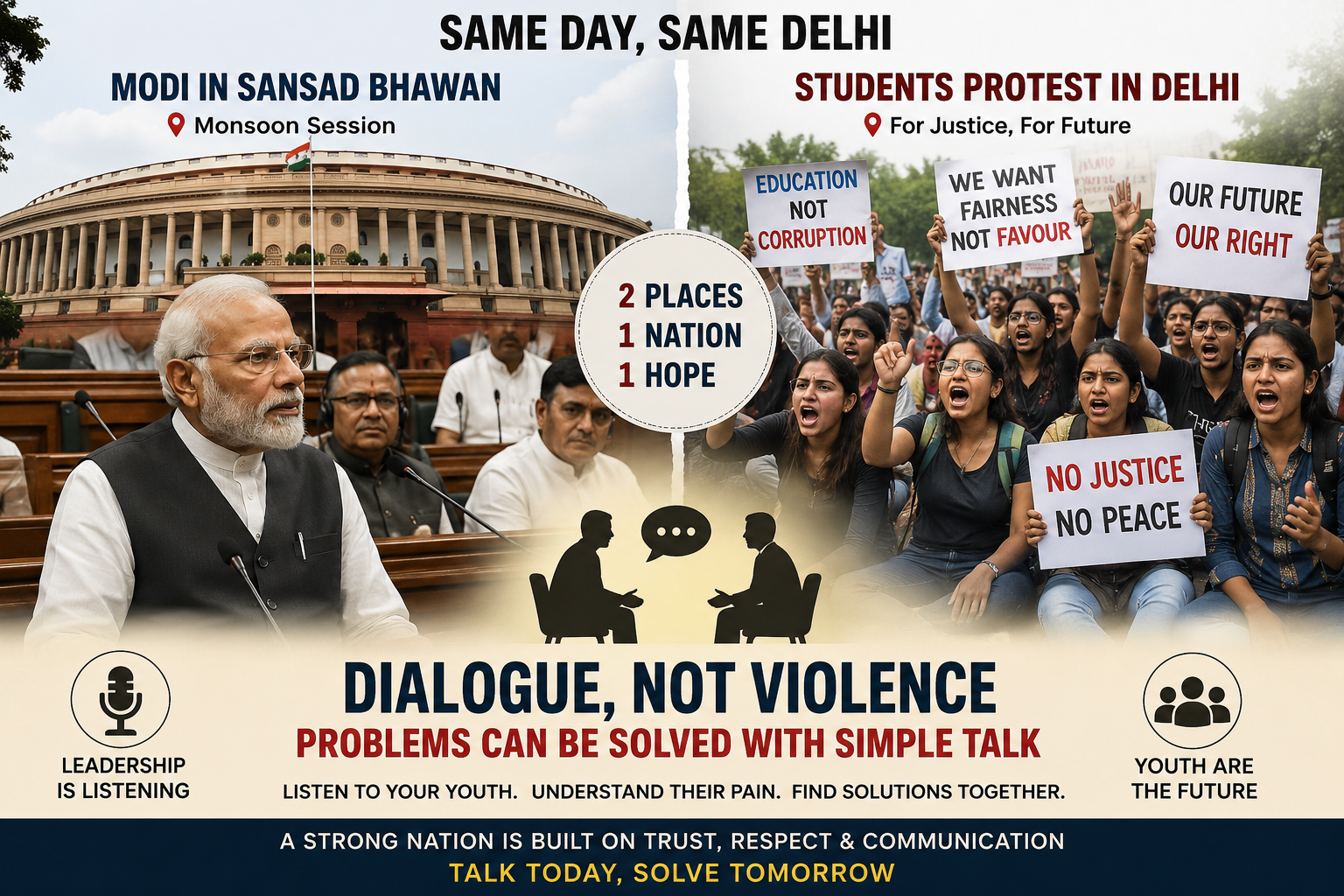
The timing of the incident has also attracted attention, as Parliament's Monsoon Session was underway and much of the country's political leadership was in Delhi.
It is worth asking whether a direct meeting between senior government representatives and student representatives could have helped reduce tensions. Such engagement may not have resolved every demand immediately, but political leadership can sometimes help create an atmosphere in which citizens feel that their concerns are being heard.
Why Did the Situation Escalate?
India has witnessed student demonstrations and protest marches in several cities, with police forces often managing large gatherings without serious confrontation. The Delhi incident therefore warrants an examination of what led to the escalation.
Were there shortcomings in crowd management? Did any protesters cross lawful limits? Was adequate communication maintained between student representatives and the police? Was the use of force proportionate to the situation?
These questions should ideally be examined through CCTV footage, body-camera footage where available, official communication records and an impartial inquiry, rather than through unverified political claims.
If protesters attacked police personnel or damaged public property, those responsible should be dealt with according to law. At the same time, if any police officer is found to have used unnecessary force against a peaceful protester or behaved improperly with a woman, appropriate accountability should follow.
A Serious Political Question
The incident has also generated political debate because it occurred at a politically sensitive time, when Parliament was in session and Prime Minister Narendra Modi was in the national capital.
Images of police action against young protesters can quickly attract public and political attention. Opposition parties may use such incidents to criticise the government, while the government may present its own explanation of the circumstances.
This raises a broader question about whether the situation was the result of administrative misjudgment, a breakdown in communication or inadequate crowd-management decisions. These are legitimate questions for journalists and citizens to examine. However, they should not be converted into allegations of deliberate political planning without credible evidence.
At present, unless an impartial investigation establishes otherwise, it would be irresponsible to claim that any political leader, party or official deliberately engineered the confrontation for political purposes.
What Should Happen Next?
The government should seek a clear account of how the situation developed. Questions that deserve examination include: Who was responsible for managing the operation? What instructions were issued before the protest? What efforts were made to communicate with student representatives? At what stage was force authorised, and why? Were established procedures followed?
If the action was lawful and necessary, the facts should be communicated clearly to the public. If mistakes were made, they should be acknowledged, and if anyone exceeded their authority, appropriate action should follow regardless of rank or position.
Students Are Not the Enemy
This issue is ultimately bigger than any individual political leader or political party. Students are an important part of India's future, and they have the right to raise concerns and question government decisions within the framework of law.
At the same time, protesters have a responsibility to remain peaceful and follow lawful restrictions. Police personnel have a responsibility to maintain public order and protect themselves and others. The State, however, carries an additional responsibility to exercise its considerable power with restraint and accountability.
A democracy becomes stronger when citizens believe that their concerns will be heard, even when the government disagrees with them.
India does not need every protest to become a confrontation. It needs political and administrative leadership capable of engaging with difficult situations through dialogue, accountability and lawful action.
Sometimes, meaningful conversation can prevent unnecessary escalation. The central question now is whether all possible avenues for dialogue were adequately explored before force was used.
Opinion/Commentary: The views expressed in this article are those of the author and do not necessarily reflect the views of the publication.
— Suresh Dhundale (Mumbai)
Slug: delhi-student-protest-lathi-charge-police-accountability-dialogue