WILL AI AFFECT THE NEXT GENERATION'S CREATIVITY?
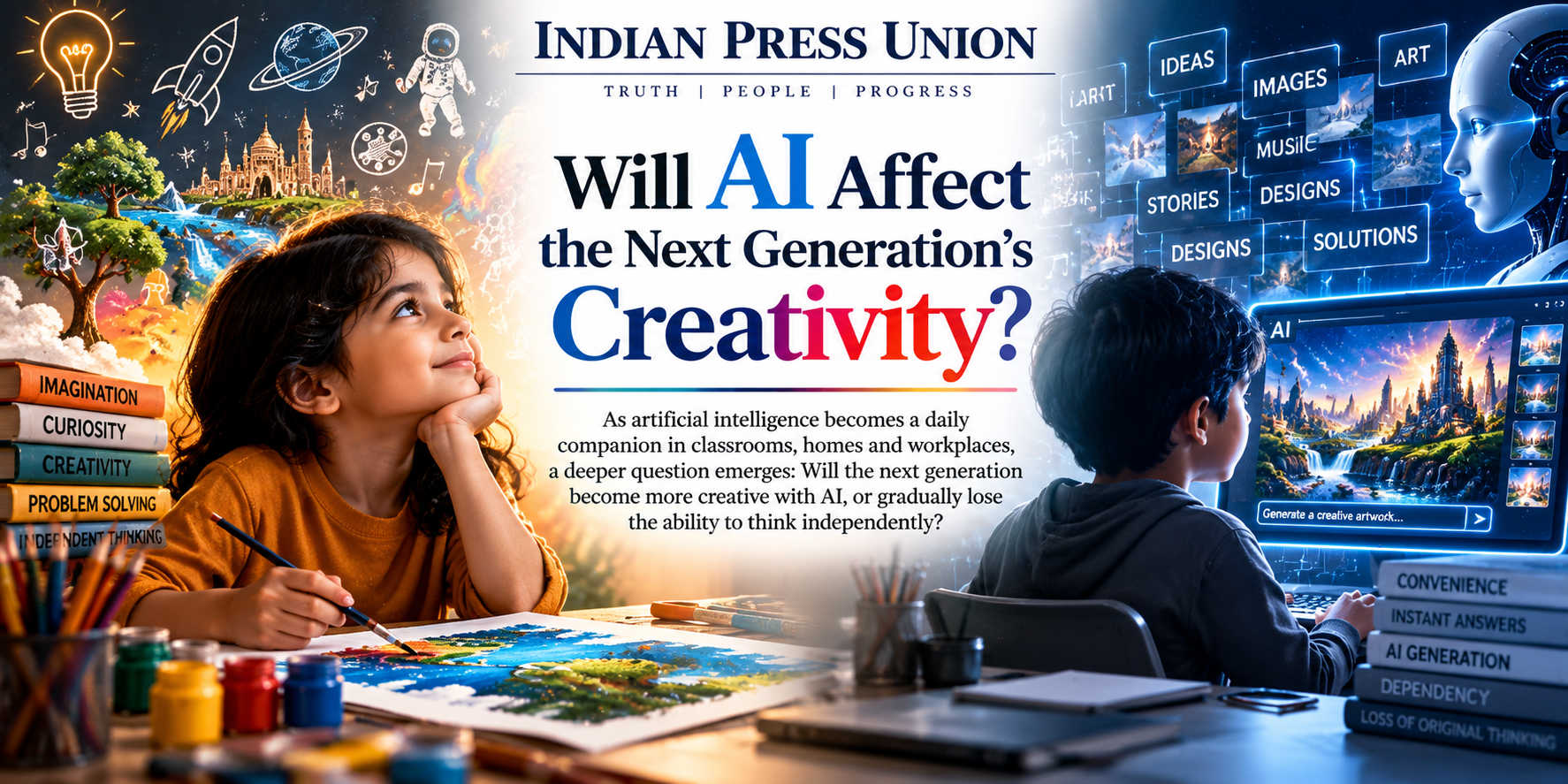
Will AI Affect the Next Generation’s Creativity?
As artificial intelligence becomes increasingly common in classrooms, homes and workplaces, an important question emerges: Will the next generation become more creative with AI, or lose opportunities to develop independent thinking?
Imagine a classroom in 2035. One student uses artificial intelligence to write an essay within seconds. Another creates a digital painting without traditional tools, while a third develops an application with AI assistance. The results may be impressive, but they raise a fundamental question: how much of the thinking comes from the student?
Artificial intelligence is changing how people learn, work and create. Its long-term influence may depend not only on what machines can produce, but also on how people choose to use them.
Intelligence and Creativity Are Different
Intelligence helps people understand information, recognise patterns and solve problems. Creativity involves imagination, curiosity, experimentation and the development of original ideas.
AI systems can generate writing, images, music, software and other forms of content. However, a polished result does not necessarily demonstrate that a student has independently developed the skills needed to produce it.
Human creativity is shaped by personal experiences, emotions, cultural influences and the willingness to question familiar ideas. The concern is not simply that AI can create content, but that excessive dependence on it could reduce opportunities for young people to practise these skills themselves.
When Convenience Replaces Curiosity
Calculators, search engines and smartphones have changed how people access information. Generative AI represents another shift because it can produce complete answers, arguments and solutions rather than simply retrieve information.
When students receive immediate answers, they may miss opportunities to explore alternatives, make mistakes and discover solutions independently. These activities can be important parts of learning.
Using AI to compare several approaches to a problem may deepen understanding. Copying an answer without examining its reasoning may offer less educational value. The difference lies in whether technology supports learning or replaces the effort required to learn.
What Research Suggests
A 2024 study published in Science Advances by Anil R. Doshi and Oliver P. Hauser examined how access to generative AI ideas affected short-story writing. The researchers found that AI assistance improved how individual stories were evaluated for creativity, writing quality and enjoyment, particularly among participants who initially scored lower in creativity. However, AI-assisted stories were also more similar to one another than stories written without AI assistance. Read the study.
The findings highlight a distinction between improving an individual's work and maintaining diversity across creative outputs. However, the experiment focused on short stories produced by adult participants. It does not establish that AI will permanently reduce children's creativity or produce the same effects in every subject or educational setting.
Long-term research is needed to understand how different patterns of AI use affect children's independent thinking and creative development.
Can AI Expand Creative Opportunities?
AI also offers significant opportunities. Students can experiment with music, develop prototypes, explore scientific concepts and communicate ideas in new ways without always needing specialised equipment or advanced technical skills.
For learners facing language barriers, disabilities or limited access to educational resources, appropriately designed AI tools may make some creative activities more accessible.
The goal should therefore not be to prevent students from using AI. Instead, educators should help them use it as a creative partner while retaining responsibility for their ideas, decisions and final work.
Education Must Encourage Independent Thinking
Generative AI challenges educational systems to reconsider how learning is assessed. Alongside factual knowledge, schools can place greater emphasis on reasoning, original ideas, experimentation and the ability to explain decisions.
Project-based learning, creative writing, scientific inquiry and collaborative problem-solving can give students opportunities to practise skills that are difficult to assess through a finished answer alone. Teachers can also help students identify inaccurate information, recognise bias and question AI-generated conclusions.
Students need to learn not only how to use artificial intelligence, but also when to challenge it and when to work without it.
India’s Opportunity and Responsibility
India's diverse education system and growing digital ecosystem provide opportunities to explore responsible AI integration. AI literacy can be taught alongside critical thinking, ethical awareness and practical problem-solving.
Access to technology, however, should not be treated as a substitute for effective teaching. Teachers remain important in guiding students, providing feedback and encouraging independent discovery. Parents can also support creativity through reading, discussion, artistic activities and opportunities to explore questions without immediately seeking automated answers.
Preparing Children for an AI-Powered Future
The future of creativity will depend on choices made by educators, parents, policymakers, technology developers and young people themselves. AI can help generate possibilities, but people must evaluate those possibilities, make informed decisions and take responsibility for the results.
The central challenge is to ensure that convenience does not replace curiosity. Used thoughtfully, AI can help young people explore ideas they might not otherwise have considered. Used uncritically, it may encourage them to accept ready-made answers without developing their own reasoning.
The next generation should not be educated merely to operate intelligent machines. It should be encouraged to imagine, question, invent and think independently. The important measure of progress will be not only how capable AI becomes, but also how well young people retain and develop their own creative abilities.
Fernand Louis
Author | Technology Researcher | Solution Architect
The views expressed are those of the author.