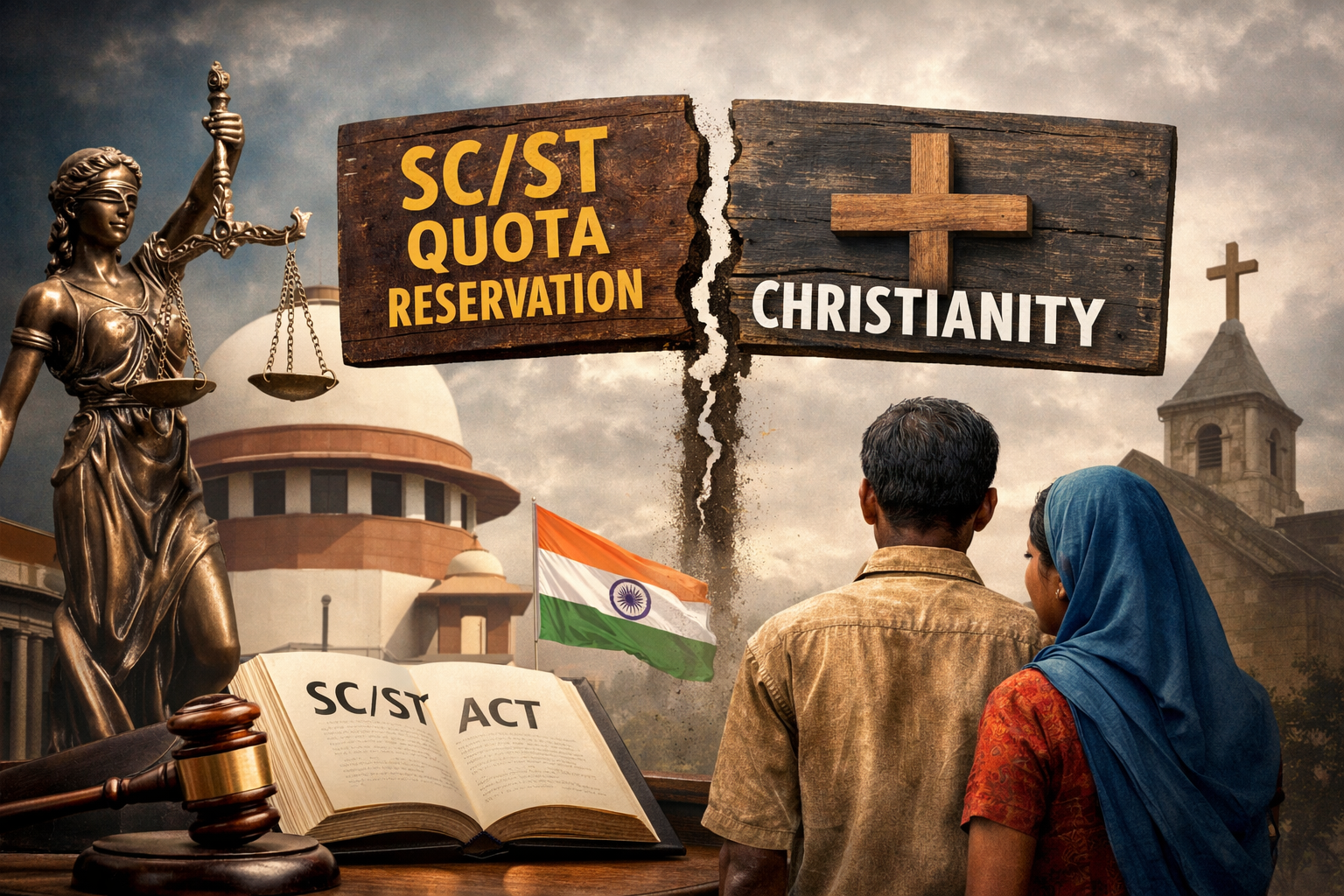
New Delhi: A recent observation linked to proceedings in the Supreme Court of India has reignited a nationwide debate on the legal status of individuals from Scheduled Caste (SC) and Scheduled Tribe (ST) communities who convert to Christianity.
During arguments, Advocate D.V.S.S. Somayajulu, appearing for the respondent, stated that the apex court has reiterated its long-standing legal position that individuals who convert from SC/ST communities to Christianity may not be entitled to claim benefits or protections under the Scheduled Castes and Scheduled Tribes (Prevention of Atrocities) Act, 1989.
He further noted that this position aligns with earlier judicial interpretations and the provisions of the Constitution (Scheduled Castes) Order, 1950, which historically limits Scheduled Caste status to specific religions. While the Order initially applied only to Hindus, it was later extended to Sikhs and Buddhists, but not to Christians or Muslims.
Legal Context and Implications
The legal framework surrounding caste and religion in India has long been complex. Courts have often held that caste-based discrimination is rooted in the traditional Hindu social structure. As a result, conversion to another religion has been interpreted in some cases as a factor that may affect eligibility for caste-based reservations and legal protections.
However, legal experts point out that the issue is not entirely settled. In several instances, courts have examined whether individuals continue to face social discrimination despite conversion, suggesting that the matter can depend on specific facts and circumstances.
Awaiting Detailed Judgment
The full judgment from the Supreme Court is yet to be released, and legal observers caution against drawing definitive conclusions until the court provides detailed reasoning. The final ruling is expected to clarify the scope and applicability of protections under the SC/ST Act for converted individuals.
Wider Impact
If affirmed in a detailed judgment, the position could have far-reaching consequences across the country, particularly affecting access to legal protections and affirmative action benefits for converted communities.
The development has already sparked discussions among legal scholars, social activists, and policymakers, highlighting the ongoing tension between constitutional provisions, religious freedom, and social justice.