The Age of Influence: How Digital Media Is Redefining Power, Perception, and Public Dialogue
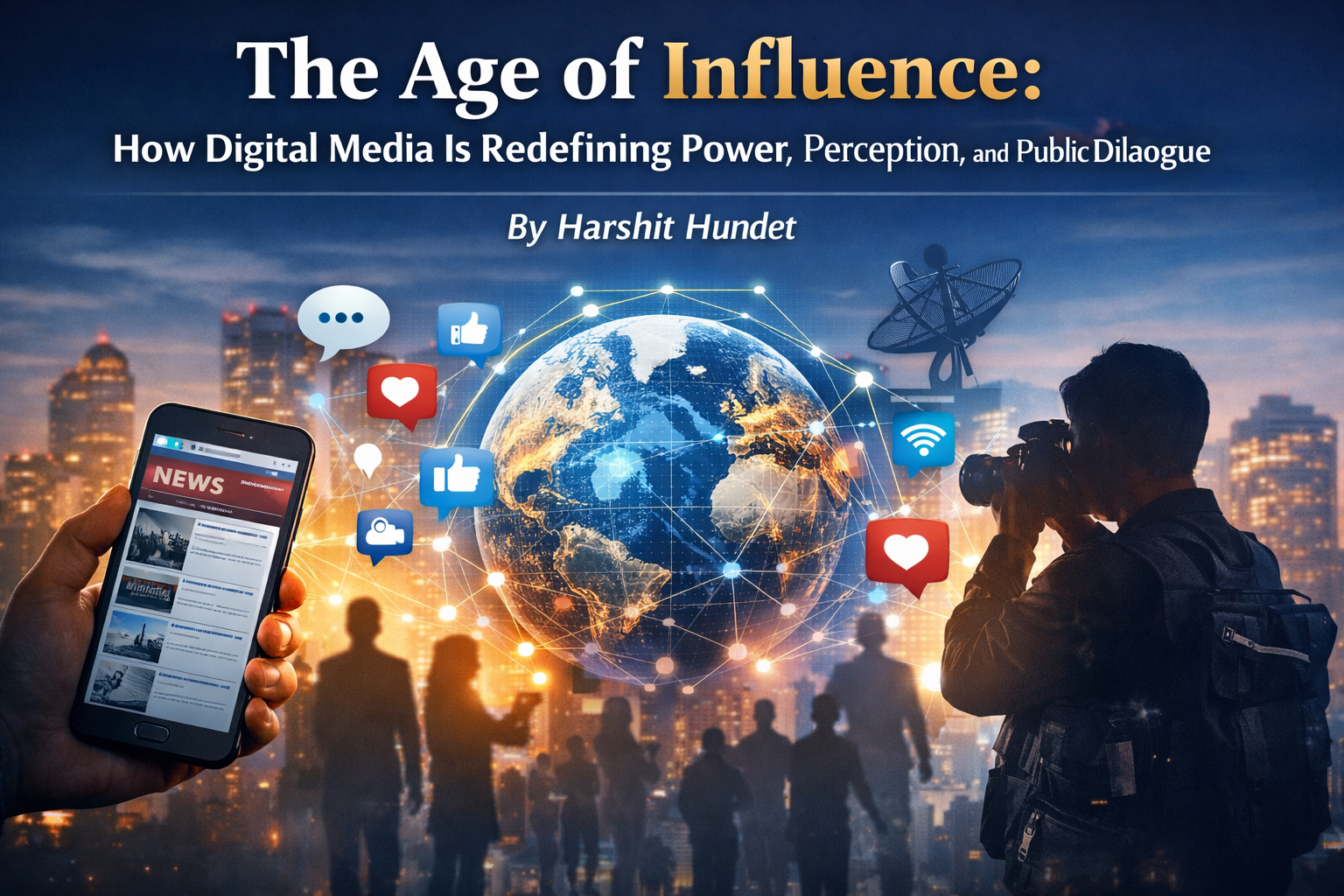
In an era where information travels faster than ever before, digital media has emerged as one of the most powerful forces shaping global discourse. From geopolitical developments and economic transformations to cultural movements and social consciousness, the digital landscape has not only amplified voices but has also redefined the very nature of influence in modern society.
Traditionally, institutions such as governments, academic bodies, and mainstream media houses held a near-monopoly over the dissemination of information. Today, however, the democratization of communication platforms has altered this paradigm. Individuals with a smartphone and internet access can now participate in shaping narratives that reach millions. This transformation has created what scholars often describe as the “age of influence,” where credibility, authenticity, and reach determine the impact of a voice rather than institutional authority alone.
Yet, this shift brings with it both extraordinary opportunities and profound challenges. On one hand, digital platforms have empowered grassroots movements, enabled citizen journalism, and accelerated the spread of awareness around issues such as climate change, social justice, and global humanitarian crises.
On the other hand, the same platforms have also become fertile ground for misinformation, algorithmic manipulation, and the rapid polarisation of public opinion.
The challenge for contemporary journalism, therefore, lies in balancing speed with responsibility. In a world where breaking news often emerges first on social media rather than in traditional newsrooms, the role of journalists is evolving from merely reporting events to contextualizing them. The responsibility is no longer limited to presenting facts; it extends to ensuring accuracy, ethical integrity, and nuanced interpretation in an increasingly complex information ecosystem.
Another significant dimension of this transformation is the changing relationship between media and audiences. Readers today are not passive consumers of information; they are active participants in conversations that shape narratives. Comment sections, social media threads, podcasts, and digital forums have created a new interactive media culture where dialogue is continuous and multidirectional.
This phenomenon has compelled journalists and media organisations to adopt a more transparent and accountable approach to reporting.
Moreover, the rise of digital storytelling has broadened the scope of journalism itself. Multimedia formats—including video journalism, immersive storytelling, and long-form investigative pieces—are redefining how stories are told and experienced. These formats are not merely stylistic innovations; they represent a deeper shift toward engaging audiences intellectually and emotionally in ways traditional reporting often struggled to achieve.
However, with greater reach comes greater responsibility. The credibility of journalism in the digital age depends heavily on maintaining rigorous editorial standards.
As misinformation spreads rapidly across digital networks, the importance of fact-checking, responsible sourcing, and ethical reporting becomes more critical than ever. In this context, journalists serve as essential custodians of truth, tasked with safeguarding the integrity of public discourse.
Looking ahead, the future of journalism will likely be defined by its ability to adapt without compromising its foundational values.
Technological advancements such as artificial intelligence, data journalism, and advanced analytics are already reshaping news production and distribution. While these innovations offer immense potential, they must be guided by human judgment, ethical frameworks, and a commitment to public interest.
Ultimately, the power of journalism lies not merely in reporting events but in shaping understanding. In a world characterized by rapid change and information overload, thoughtful and responsible journalism remains one of society’s most vital pillars. It bridges the gap between events and interpretation, facts and meaning, information and wisdom.
As the global information ecosystem continues to evolve, journalists must remain vigilant stewards of truth, ensuring that the voices shaping public dialogue are guided by integrity, critical thinking, and a commitment to the collective good.
Author:
Harshit Hundet
Indian Press Union