President Donald Trump is set to review a series of policy options on Tuesday aimed at containing rising energy prices as the Middle East conflict intensifies, including a proposal for the U.S. government to help oil tankers operating in the region secure insurance coverage, according to two sources familiar with the discussions.
Global crude benchmarks have risen sharply since Israeli and U.S. forces launched strikes on Iran over the weekend, setting off hostilities that have disrupted oil shipments across key maritime corridors. Tanker traffic through the Strait of Hormuz — the narrow waterway between Iran and Oman — has been significantly affected. Roughly one-fifth of the world’s oil supply passes through the strait, making it one of the most strategically sensitive chokepoints in global energy markets.
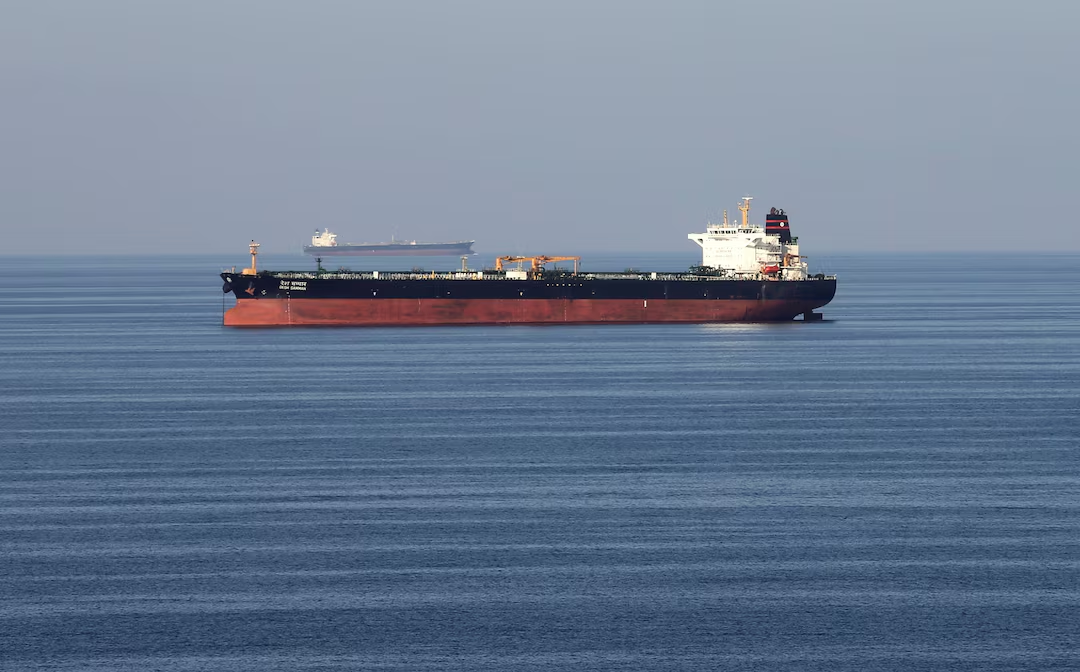
Several tankers have reportedly been damaged by strikes, while others remain stranded or delayed as security conditions deteriorate. Shipping companies have reassessed routes, and some operators have chosen to pause voyages until clearer security guarantees emerge.
Treasury Secretary Scott Bessent and Energy Secretary Chris Wright were expected to meet Trump on Tuesday afternoon to present a list of potential responses and finalise the administration’s approach, the sources said, speaking on condition of anonymity due to the sensitivity of internal deliberations.
One option under consideration involves providing federal support to ensure oil tankers can obtain war-risk insurance coverage. Since the outbreak of fighting, insurance premiums for vessels transiting the region have surged. Some insurers have scaled back exposure or withdrawn coverage altogether, citing elevated risk. Without adequate insurance, tanker operators cannot legally or commercially proceed through high-risk zones, effectively constraining supply even where physical infrastructure remains intact.
Higher insurance costs have already translated into increased freight rates, adding upward pressure to oil prices. For tankers willing to transit the Strait of Hormuz, the financial burden has risen sharply, prompting some shipping firms to explore alternative routes or delay cargoes.
U.S. government intervention in maritime insurance markets has historical precedent. During the Iran–Iraq war in the 1980s, Washington reflagged foreign tankers and provided naval escorts after private insurers retreated from the Gulf. Following the September 11, 2001 attacks, the federal government introduced temporary insurance programmes to maintain commercial shipping operations amid surging war-risk premiums.
Trump has consistently highlighted lower fuel prices as central to his economic messaging, arguing that affordable energy reduces inflationary pressure and supports household spending. Speaking to reporters on Tuesday, he acknowledged that Americans may face higher oil prices in the short term. “But as soon as this ends, those prices are going to drop, I believe, lower than even before,” he said.
Persistently elevated fuel costs could pose political risks ahead of the November midterm elections, particularly for Republican lawmakers seeking to maintain their congressional majorities. Energy prices often serve as a visible barometer of economic conditions for voters, and sharp increases at the pump tend to generate public frustration.
Secretary of State Marco Rubio said on Monday that the administration has a “program in place” to address rising energy prices and indicated that implementation would be led by Wright and Bessent. He did not disclose specific measures but suggested that phased steps would be rolled out quickly.
Another option that could be signalled as early as Tuesday involves the Strategic Petroleum Reserve (SPR). While the administration has so far shown reluctance to tap the emergency stockpile, one source said officials may indicate a willingness to release crude if market pressures intensify. The SPR has historically been used to stabilise markets during supply disruptions or geopolitical crises.
Energy analysts note that market volatility remains closely tied to developments in the Strait of Hormuz. Any prolonged disruption to tanker traffic or further escalation involving regional infrastructure could sustain price increases. Conversely, even limited restoration of secure shipping lanes could ease market tensions.
For now, the administration’s immediate focus appears to be ensuring the continuity of oil flows and stabilising tanker operations, as global markets react to one of the most serious disruptions in Gulf shipping in recent years.