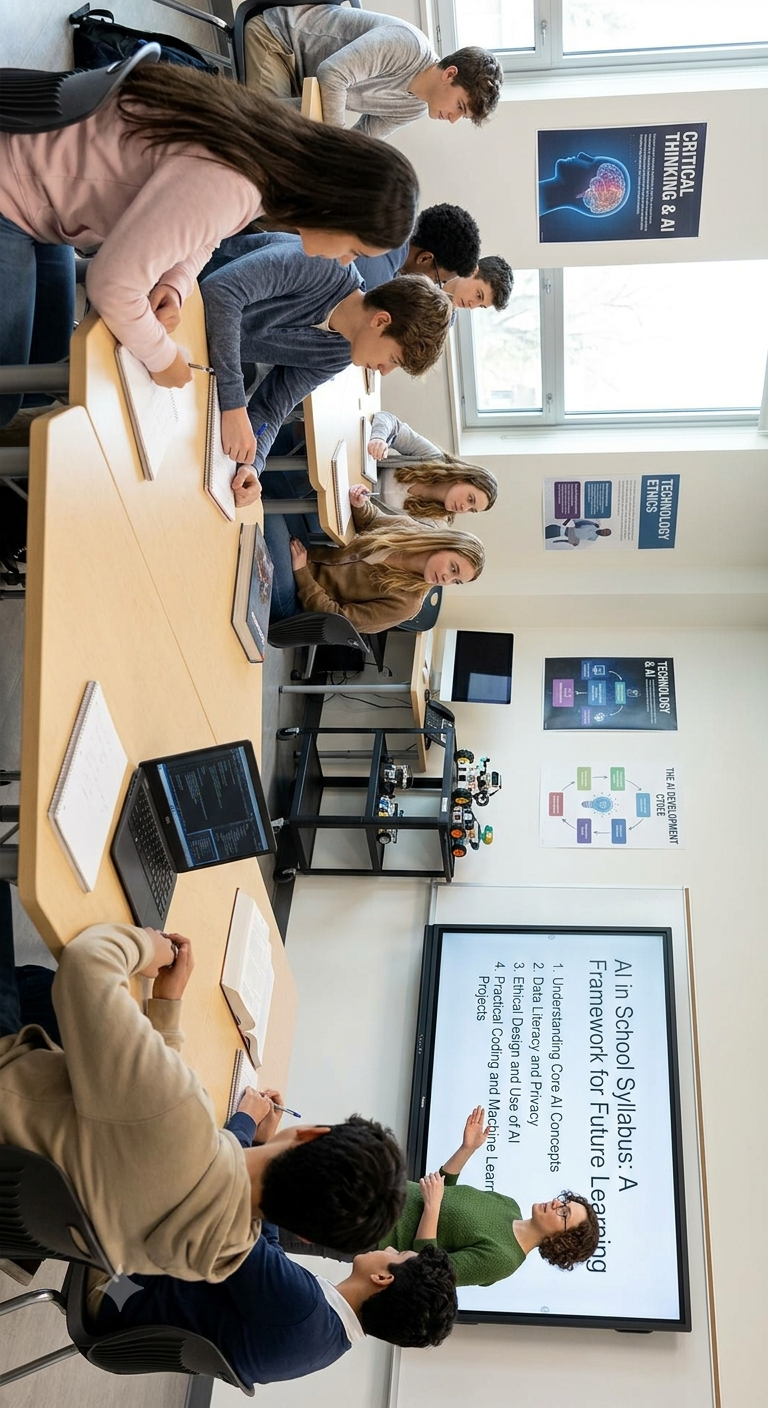
“AI” IN SCHOOL SYLLABUS
The Classroom of Tomorrow: Why AI Belongs in the School Syllabus (and Why We Must Tread Lightly)
The debate over technology in the classroom is as old as the pocket calculator. Every time a disruptive tool emerges, education faces an existential question: Do we ban it to protect traditional learning, or do we embrace it to prepare students for the future?
With Artificial Intelligence (AI), that question has become urgent. AI is no longer a futuristic concept; it is an active driver of the global economy. Integrating AI into the school syllabus is no longer just an innovative option—it is a critical necessity. However, doing so requires a careful balance to ensure it enhances, rather than erodes, foundational learning.
The Case For: Why AI Must Be Included
1. Demystifying the “Black Box”
Students are already using AI. Whether they are using ChatGPT to brainstorm essay topics, utilising AI-driven translation tools, or interacting with algorithms on social media, AI is embedded in their daily lives. Leaving it out of the syllabus doesn’t mean they won’t use it; it just means they will use it without guidance.
Including AI in the curriculum moves students from passive consumers to informed users. By teaching the basics of machine learning, neural networks, and data sourcing, schools can demystify how these tools work.
2. Developing “AI Literacy” and Critical Thinking
When students understand how an AI model is trained, they learn a vital lesson:
**AI can be wrong. **
AI literacy teaches students to spot “hallucinations” (confident but incorrect answers), recognise algorithmic bias, and question the source of digital information. In an era of deepfakes and automated misinformation, the ability to critically evaluate AI-generated content is a fundamental survival skill for the digital age.
3. Future-Proofing Careers
The job market is shifting rapidly. Future employers will not just look for candidates who know how to code or write; they will look for people who know how to collaborate with AI.
Learning **prompt engineering**[The art of structuring queries to get the best output from an AI] and understanding AI ethics will be as foundational as learning how to type or use a spreadsheet was a generation ago.
The Case Against: The Risks of Premature Integration
While the benefits are clear, rushing AI into the curriculum without guardrails poses significant risks.
1. The Erosion of Foundational Skills
The primary argument against AI in schools is the risk of cognitive laziness. If an AI can solve an algebraic equation instantly or write a history essay in five seconds, the temptation to bypass the struggle of learning is immense.
The process of struggling with a difficult concept is exactly how neural pathways are formed in the human brain. Over-reliance on AI too early in education risks creating a generation that knows how to generate answers, but doesn’t understand the underlying concepts.
2. Amplifying Educational Inequality
An AI-centric syllabus could widen the digital divide. High-end AI tools, stable high-speed internet, and updated hardware require funding. Schools in affluent areas will easily adopt comprehensive AI programs, while underfunded schools may lag. If AI becomes a core metric of modern literacy, the resource gap between students will only grow.
3. Privacy and Ethical Data Concerns
AI models thrive on data, and integrating them into schools raises massive privacy concerns. When students interact with commercial AI models, their queries, thought processes, and personal data are often tracked and used for model training. Safeguarding minors’ data privacy in an AI-driven classroom is a massive logistical and legal hurdle that education boards are not yet fully equipped to handle.
The Verdict: A Balanced Approach
Should AI be included in the school syllabus? Yes, but as a framework for understanding and a tool for creation, not a replacement for thinking.
A successful AI curriculum should follow a layered approach:
Primary Education: Focus strictly on human foundational skills—reading, writing, arithmetic, and emotional intelligence. AI should be kept in the background, used primarily by teachers to customise learning paths.
Middle School: Introduce AI literacy. Teach students *what* AI is, how algorithms work, and the importance of data privacy and scepticism toward digital content.
High School: Integrate practical AI application. Teach prompt engineering, ethical AI usage, and how to use AI as a collaborative partner for coding, writing, and research, alongside traditional testing methods that ensure individual comprehension (like in-class, pen-and-paper assessments).
AI is not going away. By thoughtfully weaving AI literacy into the educational fabric, schools can ensure that students do not become subservient to algorithms but master them to build a brighter future.
By: Rahul Rout
Date: 30/06/2026