Are Today’s Children Students, or Their Parents’ Ambitious Projects? An Opinion on Modern Parenting, Academic Pressure, and the Changing Nature of Childhood
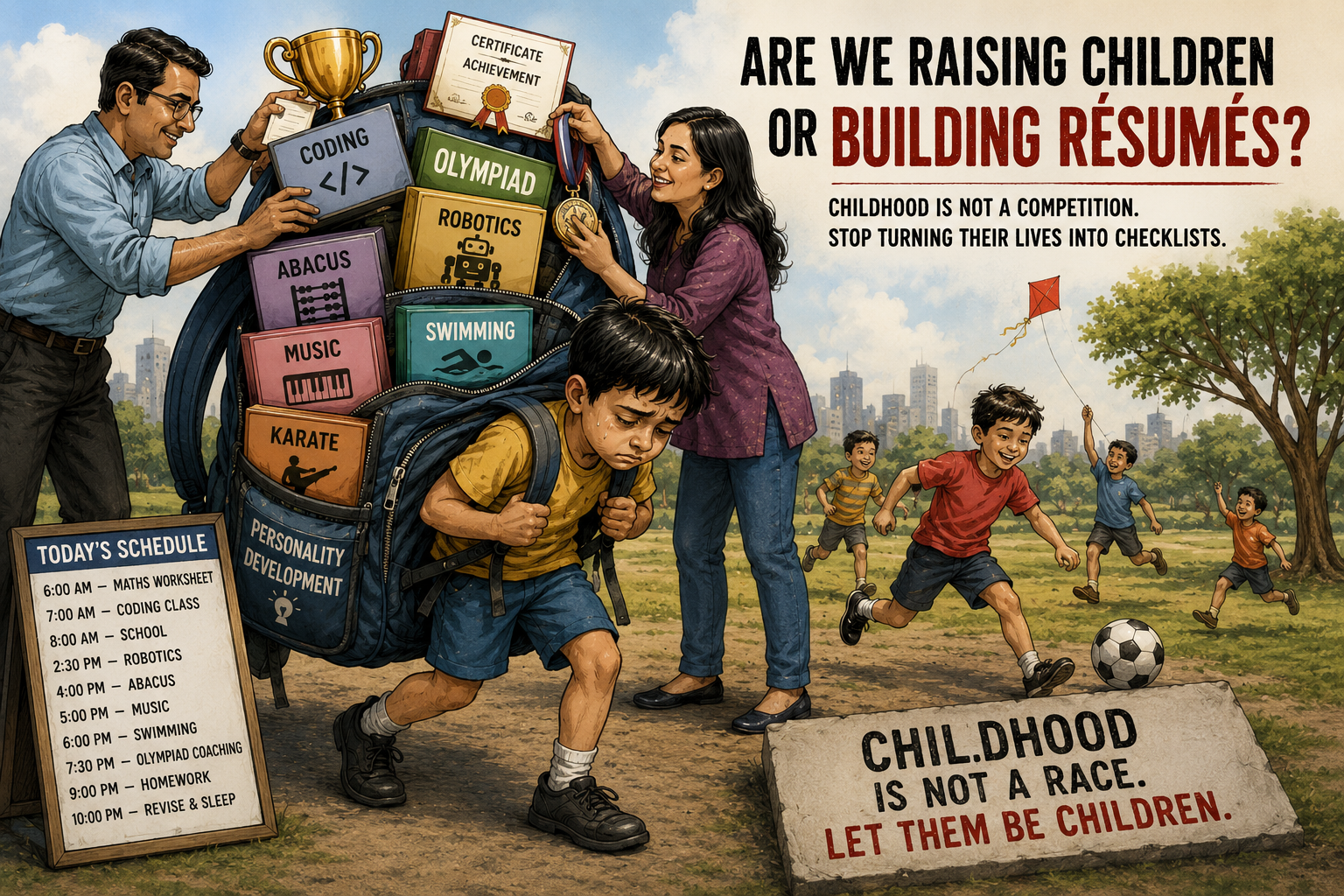
A six-year-old learning coding.
An eight-year-old attending Olympiad coaching.
A ten-year-old juggling robotics classes, abacus training, swimming lessons, music sessions, martial arts, and weekend personality-development workshops.
At first glance, this may appear to be a success story. Many modern parents view these achievements as signs that they are preparing their children for an increasingly competitive future.
However, an important question deserves reflection:
Are we raising children, or are we building résumés?
Some observers believe that childhood itself is increasingly being treated as something that must be optimized and carefully managed.
Not very long ago, childhood often involved outdoor play, imagination, exploration, making mistakes, experiencing boredom, and gradually discovering the world. Today, many children follow highly structured schedules where every activity is expected to contribute to future success.
As a result, some parents may begin to view childhood through the lens of achievement and long-term planning rather than personal growth and development.
Parents themselves face considerable pressure. In a highly competitive environment, many worry that if their child falls behind, others may gain an advantage. This concern has contributed to a culture of comparison, where academic performance and extracurricular achievements often become measures of success.
One child is learning coding.
Another is preparing for Olympiads.
A third is participating in multiple extracurricular activities before reaching middle school.
In such an environment, understanding a child’s unique interests and personality can sometimes become secondary to meeting perceived expectations.
This raises important questions:
What genuinely excites a child?
What sparks curiosity?
What brings happiness and fulfillment?
Many educators and child-development experts argue that these questions are just as important as academic achievement.
Modern education systems often place significant emphasis on measurable outcomes such as grades, rankings, examinations, and certificates. While achievement is valuable, some critics suggest that equal attention should be given to emotional resilience, creativity, critical thinking, and social development.
Children are frequently taught how to perform, compete, and succeed. Yet questions remain about whether enough attention is devoted to helping them manage failure, cope with disappointment, build meaningful relationships, and develop a healthy sense of self-worth.
These life skills may prove just as important as academic excellence.
Examples occasionally emerge that highlight potential contradictions within educational systems. For instance, reports of students being penalized for not following administrative requirements related to school materials have sparked discussions about whether compliance is sometimes prioritized over understanding and curiosity.
While discipline and structure are important, education ideally encourages students to ask questions, think independently, and explore ideas rather than simply follow instructions.
Many children spend long hours balancing schoolwork, coaching classes, assignments, and extracurricular activities. As schedules become increasingly crowded, opportunities for unstructured play, hobbies, and personal exploration may become more limited.
This trend has prompted concerns among educators, psychologists, and parents regarding stress, anxiety, and overall well-being among young people.
A common assumption in modern society is that success naturally leads to happiness. However, success and happiness are not always identical.
A child may excel academically, earn numerous certificates, and develop advanced skills. Yet long-term well-being also depends on emotional health, resilience, strong relationships, self-confidence, and a sense of purpose.
Many experts believe that a balanced approach to childhood should include both achievement and personal development.
A society’s future cannot be measured solely through test scores and rankings. It can also be reflected in the confidence of its children, the strength of their character, the freedom of their imagination, and their overall mental well-being.
Children are not investment portfolios.
They are not productivity machines.
They are individuals with unique dreams, talents, challenges, and personalities.
Perhaps parents, educators, and society as a whole can benefit from occasionally asking a simple but important question:
Are we preparing children for life, or only for the next competition?
The answer may help shape a healthier, more balanced future for the next generation.
Disclaimer: The views expressed in this article are intended to encourage discussion on parenting, education, childhood development, and societal expectations. They represent an opinion-based perspective and are not directed at any specific individual, institution, or organization.