Bharat Must Be Heard to Give Completeness to the World, Says RSS Chief Mohan Bhagwat at National Education Conference
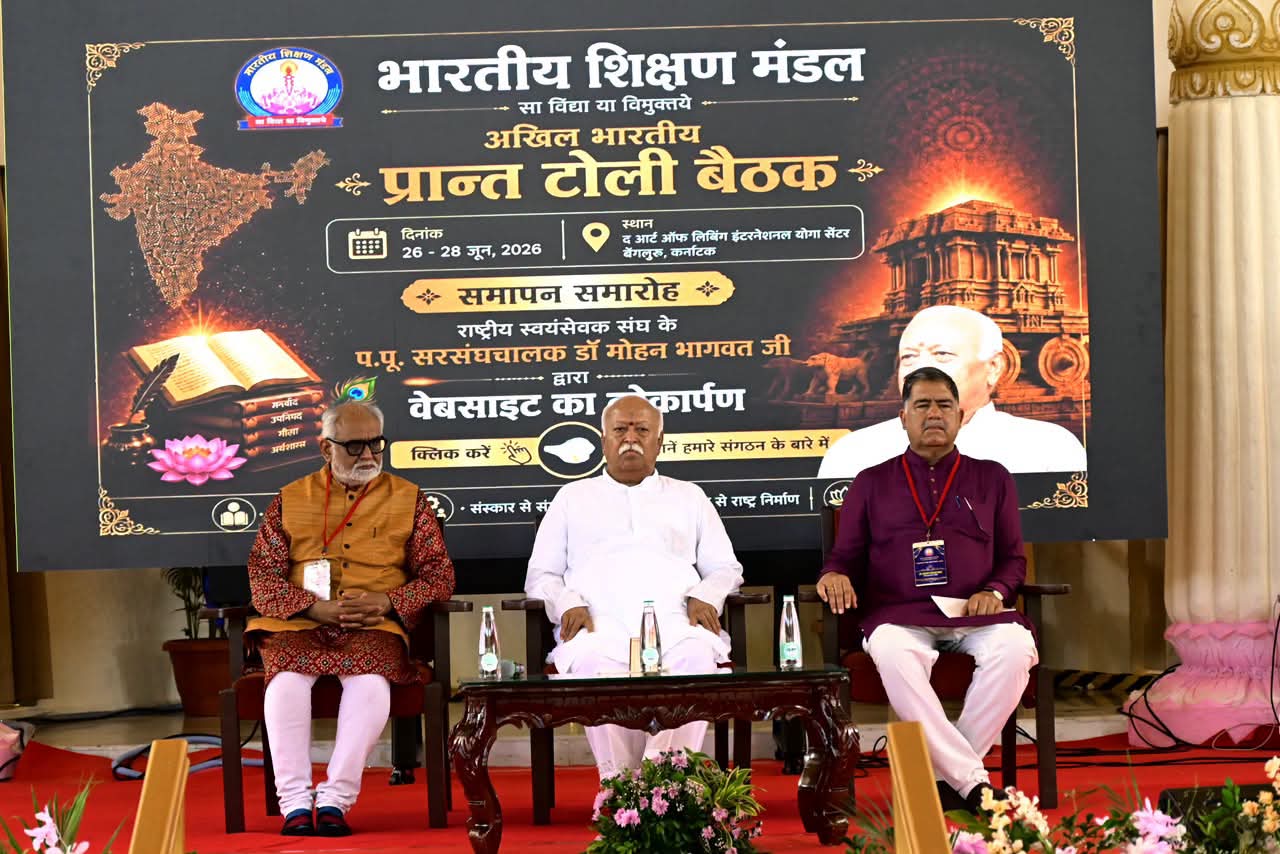
Rashtriya Swayamsevak Sangh (RSS) Sarsanghchalak Dr. Mohan Bhagwat on Sunday asserted that Bharat’s integrated and holistic worldview offers solutions to many of the contemporary challenges confronting humanity and said that the country’s civilisational wisdom must be heard globally to ensure the welfare of all beings. He was delivering the valedictory address at the concluding session of the three-day National Conference on “Operationalizing NEP 2020: Integrating Indian Knowledge Systems” at the Art of Living International Centre in Bengaluru.
Calling for a renewed global engagement with Bharat’s civilisational heritage, RSS Sarsanghchalak Dr. Mohan Bhagwat on Sunday said that the work being undertaken in the field of education by Bharatiya Shikshan Mandal (BSM) is part of a larger mission aimed at providing “completeness to the world” through an integrated and holistic worldview rooted in Bharatiya traditions.
Dr. Bhagwat was addressing the valedictory session of the three-day National Conference on “Operationalizing NEP 2020: Integrating Indian Knowledge Systems”, organised by Bharatiya Shikshan Mandal at the Art of Living International Centre, Bengaluru. The conference brought together hundreds of educationists, scholars, academicians and institutional leaders from across the country to deliberate on ways to integrate Indian Knowledge Systems within the framework of the National Education Policy (NEP) 2020.
Addressing an audience comprising nearly 380 delegates from various parts of the country, Dr. Bhagwat underlined what he described as Bharat’s historic and global responsibility in the present era. According to him, the world today is searching for answers to complex social, ecological, moral and civilisational challenges, and Bharat’s comprehensive worldview possesses the capacity to address these concerns.
He stated that while contemporary global frameworks and systems provide valuable insights, they often remain partial in their understanding and therefore cannot independently resolve the multifaceted problems confronting humanity. He argued that Bharat’s traditional vision, which integrates material, intellectual, ethical and spiritual dimensions of life, offers a more complete framework for human development and social organisation.
“To make it complete, on the basis of our complete vision, for the welfare of all beings across the world, Bharat must be heard. This is inevitable,” Dr. Bhagwat said, emphasizing that the work being carried out by Bharatiya Shikshan Mandal should be viewed as part of a broader civilisational endeavour rather than merely an educational initiative.
He further remarked that “our work is in fact to give completeness to the world,” describing the educational mission as one aimed at contributing to global welfare through the dissemination and application of Bharatiya knowledge traditions.
Elaborating on the philosophical foundations of Bharatiya thought, Dr. Bhagwat observed that the Bharatiya perspective does not reject or invalidate other systems of thought. Instead, he said, it recognises that every society and civilisation develops its own worldview based on historical experiences, cultural contexts and social realities, and that these perspectives possess their own legitimacy.
Referring to the principle of “Anekata”, or diversity, he noted that Bharatiya civilisation has historically embraced plurality and accommodated diverse streams of thought. According to him, truth is too vast and expansive to be completely comprehended through any single perspective or ideological framework.
He stressed that Bharatiya traditions advocate “Shaastrartha”—a process of scholarly dialogue and intellectual exchange—as the preferred means of engagement among differing viewpoints. Rather than promoting conflict or confrontation, such dialogue seeks to extract the essence and wisdom from various schools of thought.
Dr. Bhagwat said that this openness to multiple viewpoints while simultaneously striving for a more comprehensive understanding distinguishes the Bharatiya worldview from many contemporary approaches.
The RSS chief also highlighted the broader objectives and functioning of Bharatiya Shikshan Mandal, describing the organisation’s work as an effort to promote a holistic model of education rooted in Bharatiya values and ethos.
He said that the educational vision advocated by BSM seeks to address human development in its entirety rather than limiting education to the acquisition of livelihood skills or economic advancement alone. According to him, education should nurture all dimensions of the human personality, including intellectual, ethical, cultural, emotional and spiritual faculties.
Dr. Bhagwat cautioned against reducing educational outcomes exclusively to economic indicators or monetary considerations. He observed that contemporary systems often evaluate success primarily in financial terms, whereas Bharatiya educational traditions have historically emphasised the balanced development of individuals and society.
He reiterated that the objective of education should extend beyond employment generation and encompass character formation, social responsibility and the cultivation of values conducive to individual and collective well-being.
Speaking about the institutional character of Bharatiya Shikshan Mandal, Dr. Bhagwat emphasised that the organisation functions independently of political parties and their electoral compulsions. He said such independence is essential for sustaining long-term educational and cultural initiatives.
Recalling historical experiences from India’s freedom movement, he noted that several eminent leaders and thinkers had consciously kept educational and social work separate from direct political activity. According to him, such separation enables institutions to pursue their objectives without being constrained by short-term political considerations.
“Such work cannot be done properly alongside a political party,” he remarked, while explaining the rationale behind BSM’s independent functioning.
He added that the organisation’s autonomy, combined with its rootedness in Bharatiya values and its broader vision of global welfare, distinguishes it from many other educational institutions and organisations.
During the valedictory programme, Dr. Bhagwat also launched the newly developed website of Bharatiya Shikshan Mandal. The launch marks an important step in expanding the organisation’s digital presence and outreach.
According to the organisers, the new digital platform is expected to facilitate greater engagement with educators, researchers, scholars and citizens interested in Bharatiya education and Indian Knowledge Systems. It is also expected to serve as a repository of educational resources and information relating to BSM’s activities and initiatives.
The concluding session was attended by several senior office-bearers and functionaries of Bharatiya Shikshan Mandal, including its President Dr. Sachchidanand Joshi and General Secretary Dr. Bharatsharan Singh.
The conference witnessed participation from around 380 delegates representing educational institutions, universities, research organisations and academic bodies from different regions of the country. Participants included educators, academicians, scholars and practitioners engaged in the field of Indian Knowledge Systems and educational reforms.
Over the course of the three-day deliberations, participants exchanged ideas and shared experiences regarding the implementation of the National Education Policy 2020, with particular emphasis on integrating indigenous knowledge traditions into mainstream educational processes.
The conference sought to provide a common platform for discussing strategies aimed at strengthening educational practices rooted in Bharatiya values, traditions and civilisational knowledge.
The event had been inaugurated earlier by Karnataka Governor Thawar Chand Gehlot, who formally opened the conference and highlighted the significance of integrating Indian knowledge traditions within contemporary educational frameworks.
Organisers stated that the conference served as an important forum for collective reflection on the future direction of education in India and the role of Bharatiya knowledge systems in shaping an inclusive, value-based and holistic educational paradigm.
The deliberations also focused on strengthening institutional networks, promoting academic collaboration and creating practical frameworks for implementing the objectives outlined in the National Education Policy 2020.
As the conference concluded, participants reaffirmed their commitment to advancing educational initiatives that seek to combine modern academic requirements with the philosophical and cultural foundations of Bharatiya civilisation.
The three-day meet ended with a renewed emphasis on collaborative efforts to further the objectives of Bharatiya Shikshan Mandal and to promote educational models anchored in Indian values, knowledge traditions and a holistic understanding of human development.