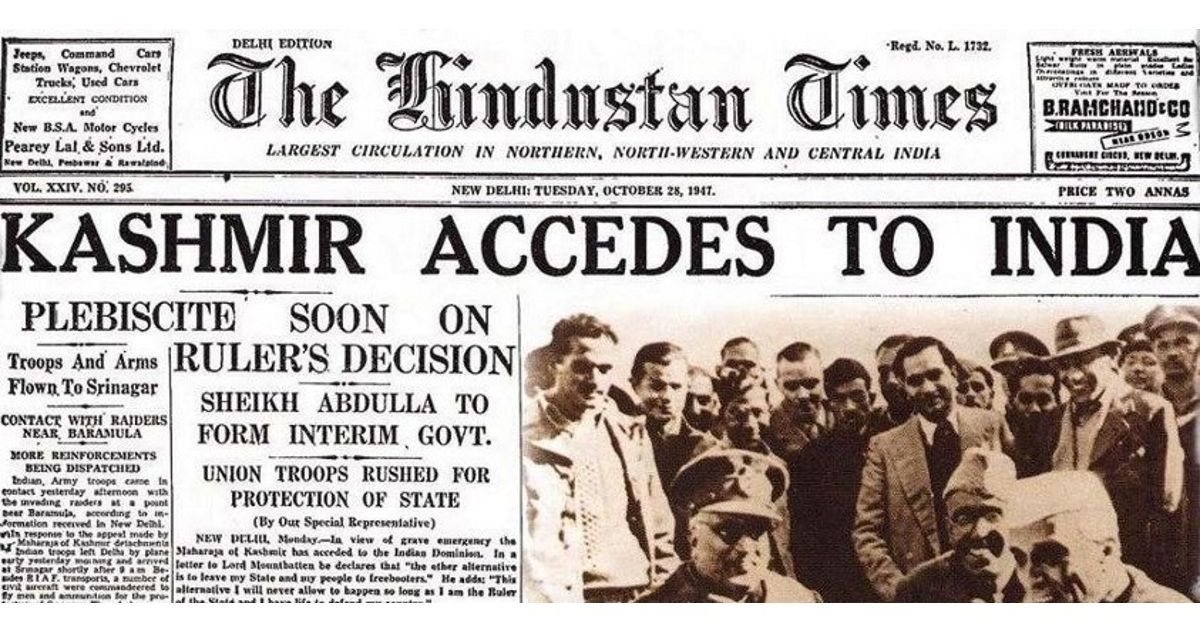
The contentious issue of Jammu and Kashmir’s accession to India continues to evoke discussions and debates, especially regarding the role played by Britain during this critical juncture in history. A new book sheds light on the alleged collaboration between British authorities and Indian leaders, as it explores the strategic motives that may have influenced the decision-making process in 1947.
Pakistan has long maintained that a conspiracy existed between Lord Mountbatten, the last Viceroy of India, and the British government to ensure that the princely state of Kashmir acceded to India rather than Pakistan. This assertion is based on the premise that Britain had vested strategic interests in the region that they wanted to protect even after they withdrew from India. In their view, India was perceived as a more reliable ally for safeguarding these interests, particularly in countering Soviet expansionism.
In his book, titled Kashmir: A Disputed Legacy, author Alastair Lamb delves into these claims, suggesting that one of the primary motivations behind Britain’s inclination towards India was the need to monitor Soviet activities in Central Asia. Lamb argues that controlling the northernmost territories of Kashmir, particularly Gilgit and Hunza, was crucial for maintaining oversight of the geopolitical landscape in the region. He posits that this monitoring could only be effectively achieved from these strategic locations.
Mountbatten’s decision to retrocede Gilgit and Hunza back to the Maharaja of Kashmir instead of transferring them to Pakistan, as dictated by the principles of the Partition outlined in the India Independence Act, adds credence to Lamb’s thesis. By opting to return these territories to the Maharaja, Mountbatten inadvertently set in motion a chain of events that would solidify Kashmir’s eventual accession to India. This move has been interpreted by some as a calculated step to keep these vital areas under Indian control, thereby furthering British strategic interests.
This narrative is not new; Pakistan first raised these allegations during the UN Security Council discussions in January 1948, attempting to counter India’s accusations about its actions in the region. The historical context and complexities surrounding the Kashmir issue remain a source of significant contention between India and Pakistan, with international observers frequently weighing in on the matter.
As the debate around Kashmir’s accession continues, it is essential to consider the various perspectives and historical nuances that have shaped this ongoing conflict. The insights provided in Lamb’s book add another layer of understanding to an already intricate saga that has implications not only for India and Pakistan but also for global geopolitics.