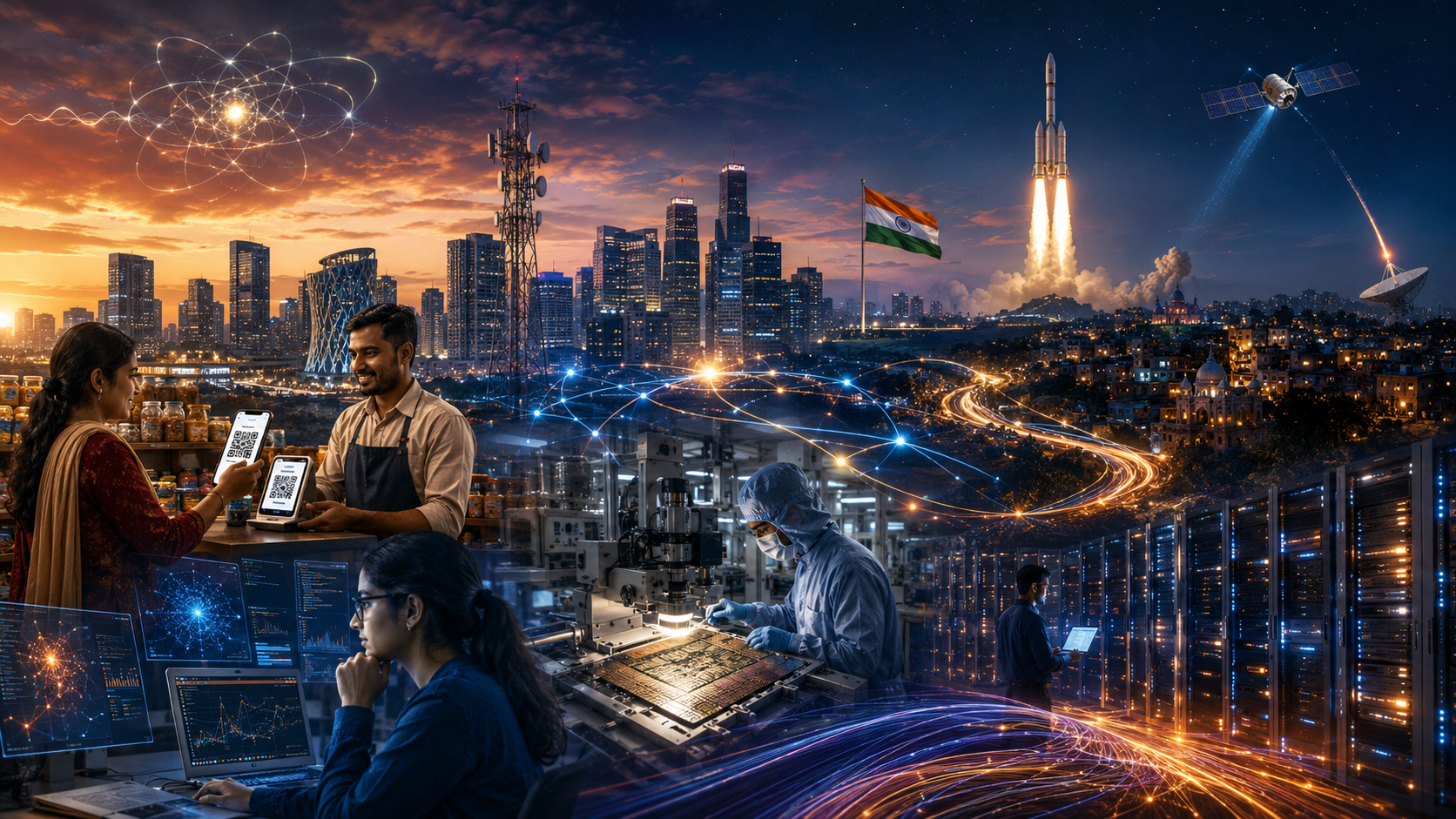
India’s technology story is no longer just about a country learning to use digital tools. It is about a country learning to build them, scale them and export them to the world. Over the last decade, India has moved from being a large consumer market for global technology companies to becoming one of the most important laboratories for digital public infrastructure, artificial intelligence, semiconductors, digital payments, space technology and rural connectivity.
The most powerful part of this shift is its scale. India’s internet user base crossed 950 million in 2025, with rural India accounting for nearly 548 million active internet users. This means the next phase of India’s digital growth is not being shaped only in Bengaluru, Hyderabad, Gurugram or Mumbai. It is also being shaped in villages, small towns, farming communities, government schools, local shops and panchayat offices.
For years, technology in India was seen through the lens of access: who has a phone, who has internet, who can make a payment online. Today, the conversation has changed. The new question is: can India create technology that solves Indian problems first and then becomes relevant for the world?
One of the clearest examples is UPI. What began as a payment interface has now become the everyday financial language of India. From vegetable vendors and autorickshaw drivers to restaurants, freelancers and small businesses, UPI has made digital money feel simple, instant and trustworthy. In March 2026 alone, UPI processed more than 22.6 billion transactions worth over ₹29.5 lakh crore, according to NPCI data.
This matters because it shows that India’s technology revolution is not limited to high-end innovation. It works when it enters daily behaviour. A person may not understand the architecture behind digital payments, but they understand the confidence of scanning a QR code and receiving money instantly. That is real technology adoption.
The same pattern is now visible in connectivity. BharatNet, one of India’s largest rural broadband programmes, has connected around 2.19 lakh gram panchayats, with over 7.25 lakh kilometres of optical fibre laid and more than 9.66 lakh FTTH connections commissioned as of April 2026. This is the infrastructure that can decide whether a village student attends an online class, whether a farmer accesses weather information, whether a health worker can upload data, and whether a rural entrepreneur can sell beyond the local mandi.
The 5G rollout has added another layer to this transformation. By February 2026, 5G services were available across all states and union territories and covered 99.9% of districts, supported by 5.23 lakh 5G base transceiver stations. This is not just about faster mobile internet. The real promise of 5G lies in telemedicine, precision agriculture, smart manufacturing, education, logistics and public safety.
But perhaps the most important shift is happening in artificial intelligence. India is not approaching AI merely as a consumer trend. Through the IndiaAI Mission, the government has onboarded more than 38,000 GPUs for a national compute facility and approved 190 projects across government bodies, startups, MSMEs, academia, researchers and students. For a country where compute access has often been expensive and concentrated, this could be a defining step.
AI will matter deeply for India because India’s problems are large, multilingual and unevenly distributed. A farmer in Maharashtra, a teacher in Bihar, a doctor in a district hospital, a small manufacturer in Tamil Nadu and a student in Assam do not need the same technology interface. India needs AI that understands language diversity, price sensitivity, low-bandwidth environments and public-service delivery. That is why the next wave of Indian AI will not be judged only by how advanced it is, but by how useful it becomes.
India has also moved seriously into AI governance. The India AI Governance Guidelines released in 2026 propose a principle-based framework for safe, trusted and inclusive AI innovation, including institutional ideas such as an AI Governance Group, a Technology & Policy Expert Committee and an AI Safety Institute. This is important because the future of technology cannot be built on innovation alone. It also needs trust.
The data privacy conversation has also become sharper. India’s Digital Personal Data Protection rules were put into force in November 2025, requiring companies to minimise personal data collection, explain the purpose of collection clearly, allow users greater control and notify people in case of data breaches. As India becomes more digital, privacy will become not just a legal issue, but a brand, governance and citizen-rights issue.
Another major update is India’s semiconductor push. For decades, India designed software for the world but depended heavily on global supply chains for chips. That equation is beginning to change. The India Semiconductor Mission 2.0, announced in the Union Budget 2026–27, focuses on semiconductor equipment, materials, full-stack Indian semiconductor IP and stronger supply chains. In May 2026, the Union Cabinet approved two more semiconductor projects in Gujarat with a cumulative investment of around ₹3,936 crore, including India’s first commercial Mini/Micro-LED display facility based on GaN technology and a semiconductor packaging facility.
This is not a small development. Semiconductors sit at the heart of smartphones, cars, defence systems, telecom networks, medical devices, AI infrastructure and consumer electronics. If India wants strategic technology independence, it cannot remain dependent only on imported chips.
India’s electronics manufacturing story has already shown what is possible. Mobile phone production increased from ₹2.14 lakh crore in FY 2019–20 to ₹5.5 lakh crore in FY 2024–25, while mobile phone exports rose to ₹2 lakh crore in FY 2024–25. Smartphones also emerged as India’s top exported commodity in calendar year 2025. This signals a wider transition: India is not only coding the digital economy; it is increasingly manufacturing its hardware backbone too.
The frontier is expanding further into space and quantum technology. Indian space-tech startup Skyroot Aerospace became the country’s first space-sector company to reach a $1 billion valuation in May 2026 after raising fresh capital, marking a strong signal for private space innovation in India. Meanwhile, under the National Quantum Mission, India demonstrated a 1,000-km quantum communication network and expanded support for quantum startups. Four thematic hubs have also been established under the mission across quantum computing, quantum communication, quantum sensing and metrology, and quantum materials and devices.
The next chapter will be even more interesting. India is already preparing for 6G, with 104 projects worth ₹271 crore approved for research and development as of February 2026. The government has also published a spectrum roadmap for 6G across short-, medium- and long-term timelines. If 5G connects people and machines faster, 6G could connect intelligence itself—through autonomous systems, immersive communication, advanced robotics and real-time industrial networks.
However, India’s technology journey will not be complete unless it remains inclusive. The same IAMAI-Kantar report that celebrates India’s 958 million active internet users also notes that around 38% of India’s population remains non-active on the internet. This is the real test. A technologically advanced India cannot be built only for the already-connected. It must include the elderly, women in rural households, small traders, migrant workers, students in government schools, micro-enterprises and first-time internet users.
The future of technology in India will therefore depend on three things: access, trust and usefulness. Access will come from connectivity, affordable devices and language-first interfaces. Trust will come from privacy, cybersecurity and responsible AI. Usefulness will come when technology solves real problems—credit for a small shopkeeper, better crop information for a farmer, faster diagnosis for a patient, better learning for a child and smoother governance for a citizen.
India has already seen the first wave of its tech revolution through UPI, digital identity, mobile internet, startups and public digital infrastructure. What it is now beginning to see is the second wave: AI, semiconductors, 6G, quantum technology, private space innovation and deep-tech manufacturing.
The biggest opportunity before India is not merely to become a digital economy. It is to become a technology civilization—one that uses innovation not only for growth, but for inclusion, resilience and national confidence.