₹22,000 Crore Debt vs ₹6.5 Crore Repayment: How Did Subhash Chandra’s Insolvency Case Reach a 99.97% Haircut?
Subhash Chandra Insolvency Case: NCLT Resolution Plan Draws Attention Over ₹22,006 Crore Claims and Low Recovery
By Ankit Kumar Mishra
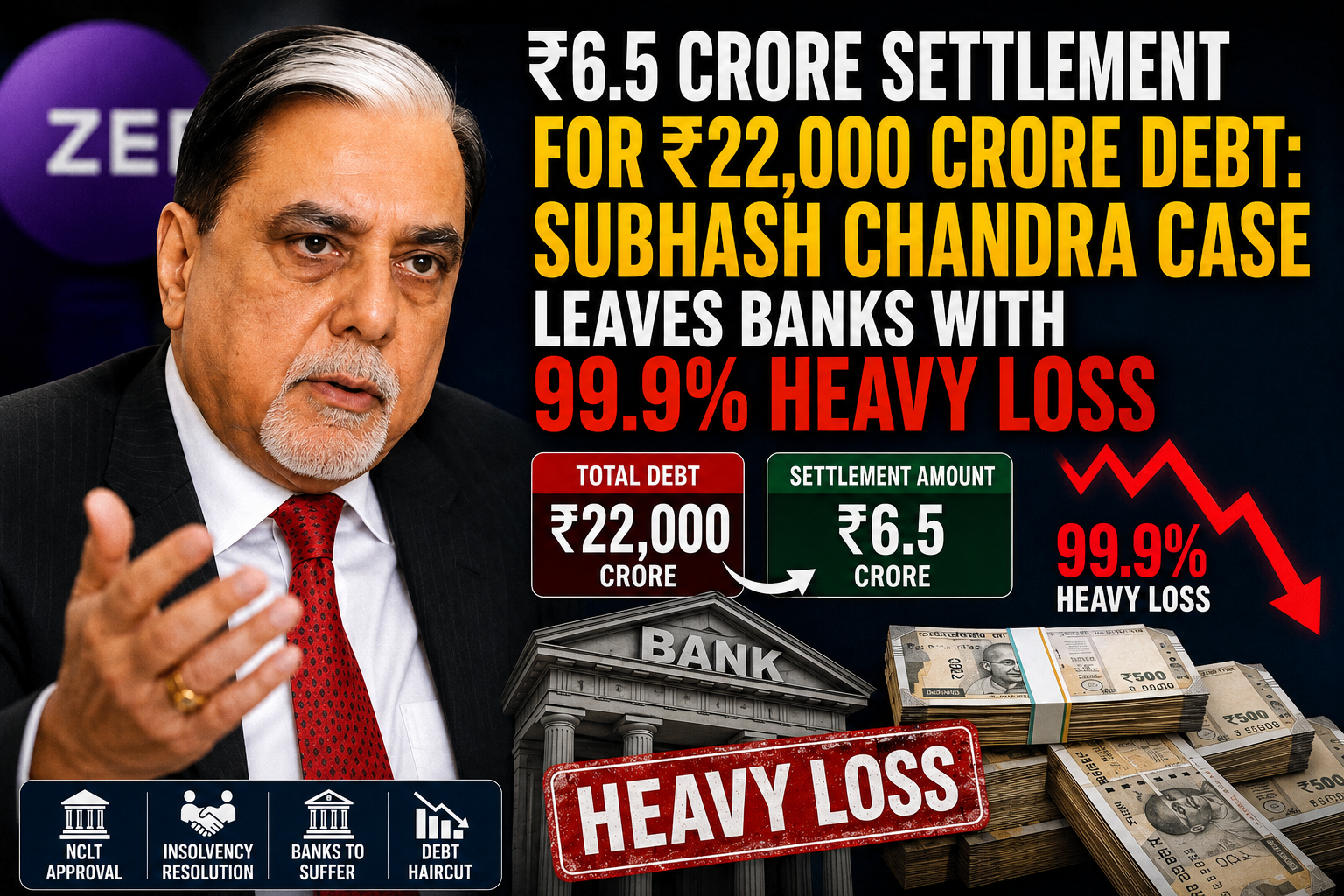
A major debate has emerged in India’s banking and insolvency sector after the National Company Law Tribunal (NCLT) approved a resolution plan involving Zee Group founder Subhash Chandra. The case involves admitted creditor claims of approximately ₹22,006.57 crore, while the approved plan provides around ₹6.5 crore for creditors in the personal insolvency proceedings. The wide difference between the two figures has raised questions about debt recovery, personal guarantees, banking losses and the effectiveness of India’s insolvency framework.
At first glance, the numbers appear striking. Against every ₹100 claimed by creditors in the personal insolvency proceedings, the recovery under the approved plan would be only a few paise. This translates into a reported recovery of roughly 0.03% and a haircut of approximately 99.97% on the admitted claims under the plan.
However, the case needs to be understood carefully. It is not simply a story of a ₹22,000-crore bank loan being waived for ₹6.5 crore. The underlying loans were taken by entities associated with the Essel Group, while Subhash Chandra’s role in the proceedings relates to personal guarantees provided for those borrowings. Therefore, the NCLT proceedings concern what can legally and financially be recovered from Chandra in his capacity as a personal guarantor.
Why Is the Recovery So Small?
The central question is whether a guarantor has sufficient recoverable assets to meet the obligations arising from the guarantee. In this case, the resolution process assessed Chandra’s financial position and the recoverable value available to creditors. The approved plan therefore does not mean that the entire original corporate debt has disappeared. Instead, it determines the amount recoverable through this particular personal insolvency process.
Reports have also highlighted concerns from lenders regarding the assessment of Chandra’s net worth, the role of the resolution professional and the manner in which his financial position was evaluated. Some bankers have questioned whether the process adequately captured all relevant assets and liabilities.
Banks and Lenders Raise Objections
The decision has not gone uncontested. Several financial institutions have expressed opposition to the NCLT-approved plan. HDFC Bank, LIC Housing Finance and other lenders have indicated that they intend to challenge the decision, citing concerns over the low recovery available to creditors. Union Bank and Canara Bank have also been reported among lenders challenging the approval.
The plan was approved with the required support of the creditors participating in the voting process. At the same time, some lenders have chosen to pursue further legal remedies. This means the matter may not be over, and further proceedings could determine whether the approved resolution plan remains unchanged or undergoes additional scrutiny.
What Does “99.97% Haircut” Actually Mean?
The term “haircut” in insolvency does not necessarily mean that a bank has literally handed over 99.97% of a loan as a gift or voluntarily waived it. It generally refers to the difference between the amount claimed or admitted and the amount that creditors are ultimately expected to recover through a resolution process.
In this case, the mathematical comparison is striking. Against admitted claims of ₹22,006.57 crore, approximately ₹6.5 crore is proposed for creditors under the personal insolvency resolution plan. That produces an apparent recovery of roughly 0.03% and a haircut of approximately 99.97% on those admitted claims.
However, the figures should not be interpreted as meaning that creditors will recover only ₹6.5 crore from all proceedings connected with the underlying loans. Recovery avenues involving the principal borrowing entities and other legal proceedings may remain separate from the personal insolvency resolution plan.
For ordinary depositors and taxpayers, such figures naturally raise concerns. Banks ultimately operate with money belonging to depositors, investors and shareholders. When large loans result in substantial losses, questions arise about credit appraisal, collateral, guarantees, risk management and accountability.
A Bigger Question for India’s Insolvency System
The Subhash Chandra case could become an important reference point in the debate over personal insolvency and corporate guarantees in India. It raises a fundamental question: What is the real value of a personal guarantee when the guarantor does not have sufficient recoverable assets?
The case also highlights the difference between the size of a financial claim and the amount that can actually be recovered through a particular legal proceeding. A creditor may have a claim worth thousands of crores, but if the legally recoverable assets available within that proceeding are limited, the final recovery can be dramatically lower.
At the same time, lenders and banking-sector observers have raised concerns that such outcomes could affect credit discipline and the incentives surrounding large corporate borrowing. If a massive admitted claim ultimately produces only a tiny recovery under a personal insolvency plan, policymakers and regulators may face pressure to examine whether existing mechanisms are sufficiently effective.
Not Just About One Businessman
The controversy surrounding Subhash Chandra’s case goes beyond one individual or one business group. It touches upon a much larger issue facing India’s financial system: how to balance entrepreneurial risk, creditor rights, banking stability and fair insolvency resolution.
For lenders, recovery is the primary objective. For an insolvent individual, the law provides a structured mechanism to resolve liabilities and obtain a fresh financial start, subject to legal requirements. The challenge is ensuring that the system protects legitimate creditor interests while also providing a lawful resolution process for individuals facing insolvency.
As lenders prepare to challenge the NCLT decision, the case is likely to remain under scrutiny.
The headline figure of ₹22,000 crore versus approximately ₹6.5 crore is undoubtedly striking. But the real story lies in understanding how personal guarantees, insolvency law, asset valuation and creditor recovery interact.
Ultimately, the Subhash Chandra case may prompt India to examine a difficult question: when a financial claim runs into thousands of crores but the recovery under a personal insolvency process is only a few crores, how should the interests of creditors, guarantors and the wider banking system be balanced?