A Pilgrim’s Journey Through Maharashtra: When Faith Meets a System
A Pilgrim’s Journey Through Maharashtra: When Faith Meets a System
My journey from 1 October to 4 October 2026
I recently travelled by car from Telangana to Maharashtra with one simple intention — to visit some of the most important temples in our country and seek the blessings of the deities.
The journey took me to Tuljapur, Grishneshwar, Bhimashankar and finally Trimbakeshwar.
I had expected a spiritual journey. What I experienced, however, was something more complicated.
At every temple, I saw thousands of devotees travelling long distances, standing in queues, tolerating inconvenience and spending their hard-earned money simply for a few moments of darshan.
And somewhere along the journey, one question kept coming back to me:
Are we actually making it easier for devotees to visit our temples, or are we slowly turning devotion into an opportunity for middlemen and unofficial collections?
I am writing this not as an expert, politician or activist. I am writing this simply as a devotee who travelled to these temples and experienced the system personally.
---
Tuljapur — Where the first doubts began
Our first destination was Tuljapur.
We went for darshan with the expectation that there would be a proper system — information counters, clear instructions, organised queues and temple staff guiding devotees.
Instead, we encountered groups of people approaching devotees and offering to take us for darshan for around ₹500 per person.
What disturbed me was not simply the amount.
If there is an officially authorised paid darshan facility, I have no objection to paying for it. In fact, I would happily pay if the money goes transparently towards temple development and better facilities for devotees.
But here, I found myself asking:
Where exactly is the official system?
The people approaching us did not appear to be directing us clearly to a proper ticket counter or explaining an official process. Even when we tried to get information from the ticket counter, getting a clear answer was difficult.
The experience left me with an uncomfortable feeling.
It appeared to me that there was a system around the temple where people were willing to collect money from devotees, while the devotee was left confused about whether the payment was actually an official temple fee or simply an unofficial collection.
I cannot say what happens to every rupee collected there, and I am not making a legal allegation against any particular person.
But the lack of clarity itself is a serious concern.
A devotee should not have to wonder whether the person asking for money is an authorised representative of the temple or simply someone taking advantage of the crowd.
---
Grishneshwar — A completely different experience
From Tuljapur, we travelled towards Grishneshwar.
We stayed nearby and went for darshan early in the morning, around 5:30 AM.
Perhaps because it was so early, we did not encounter the kind of money-demanding behaviour that we had experienced earlier.
The atmosphere was calm.
There was no major confusion.
We completed our darshan in around 15 minutes and came out.
It was a reminder that temple visits can actually be simple when the system works.
There was no feeling that someone was trying to extract money from us at every step.
That experience made the contrast with some of the other temples even more noticeable.
---
Bhimashankar — The unofficial VIP culture
After Grishneshwar, we travelled to Bhimashankar.
This was another experience that left me uncomfortable.
Private vehicles were not allowed to go close to the temple, and four-wheelers were required to be parked around two kilometres away.
Initially, I did not have a problem with this.
I understood that during heavy pilgrim traffic, restricting vehicles near the temple could be necessary for crowd management and safety.
In fact, if this is properly organised, I support such arrangements.
The problem began after we parked.
People started approaching us and offering what was described as immediate or quick darshan for approximately ₹500 per person.
The message, as conveyed to us, was quite direct:
Pay us, and you can get quick darshan. Don't pay, and you may have to stand in the queue for five hours.
That is when I started wondering:
If there is genuinely a huge demand for faster darshan, why isn't there an official Sheegra Darshan system?
Why can't the temple authorities issue an official ticket?
Suppose the temple charges ₹200, ₹300, ₹500 or whatever amount is legally decided.
Give the devotee a proper receipt.
Give them a separate queue.
Use the revenue for toilets, drinking water, crowd management, cleanliness, security, accommodation and other facilities.
Everybody benefits.
The temple gets revenue.
The devotee gets a predictable experience.
The administration gets better control.
And most importantly, the need for middlemen can be reduced.
Instead, when unofficial people offer the same service for cash, the entire system can become difficult for devotees to understand.
---
Trimbakeshwar — Where my biggest concerns began
Finally, we reached Trimbakeshwar.
This was the temple I was particularly looking forward to visiting.
The situation here was different, because there were clearly defined darshan options.
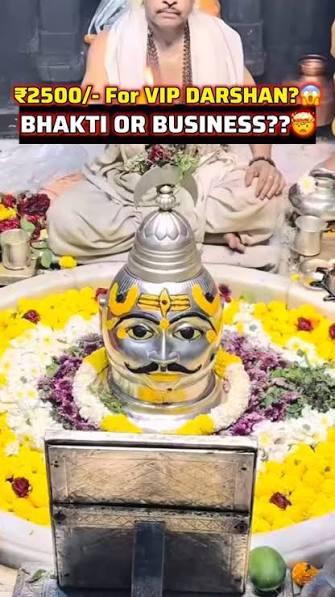
As I understood the system during my visit, there was a general/free queue, which could take approximately 7–8 hours, a ₹200 paid darshan option, and another option costing ₹2,500 per person.
I completely understand that the number of devotees increases enormously during Pitru Paksha.
But this is not an unexpected event.
Pitru Paksha happens every year.
The administration knows the dates.
The temple knows the expected crowd.
The government knows the importance of Trimbakeshwar.
The number of pilgrims can be estimated in advance.
So why should devotees have to face such long waiting periods every year?
---
The ₹200 ticket — A good idea, but an unnecessarily complicated system
The ₹200 ticket system actually has one good feature.
The devotee's photograph is taken and printed on the ticket.
That is a good security measure.
It reduces the possibility of ticket misuse and gives some accountability.
There is also supposed to be an online ticket facility.
But when we tried to use it, the system showed:
“Authentication failed.”
That one message highlighted a larger concern for me.
We are living in 2026.
Almost every person carries a smartphone.
UPI and QR-code payments are everywhere.
Digital photographs, Aadhaar authentication, QR tickets and digital payments are already part of everyday life in India.
Yet at one of our country's important pilgrimage centres, devotees can still end up standing in long queues simply to obtain a ticket.
And it is not only a problem for devotees.
Think about the staff.
Someone has to process all these people.
Police personnel have to control the queues.
Security personnel have to manage crowds.
The administration has to deal with frustration.
Why not create a simple kiosk system?
A devotee walks to the kiosk.
Photograph is taken.
Payment is made through UPI/QR/card/cash.
Ticket is generated immediately.
QR code is printed.
The devotee proceeds to the appropriate queue.
It is not complicated technology.
It is technology that India already uses everywhere.
---
But the ₹2,500 ticket raised much bigger questions
This is the part of my experience that I found most concerning.
The ₹2,500 option is expensive.
But when someone has travelled hundreds of kilometres and has limited time, standing in a queue for 7–8 hours may simply not be practical.
That can create a situation where people may feel compelled to consider the expensive option.
We eventually chose it because we had to continue our journey.
But the process itself raised several questions in my mind.
The ₹2,500 ticket was issued manually.
A person wrote the details by hand.
There was no online booking facility that I could see.
There was no QR-based digital ticketing process.
There was no photograph printed on the ticket.
There was no apparent ID verification.
For the ₹200 ticket, there was a fairly detailed process involving the devotee's photograph.
But for ₹2,500, the process appeared considerably less stringent.
We paid the amount and received what was essentially a handwritten ticket.
If there were five people, the ticket indicated something like “+4”, while the total amount collected was ₹12,500.
This immediately raises an obvious question:
Why is such a high-value transaction being handled manually?
I am not saying that this proves corruption.
I am saying that it can create an environment where transactions become difficult to track and understand for an ordinary devotee.
And that is exactly why transparency is so important.
For a ₹200 ticket, there should be accountability.
For a ₹2,500 ticket, there should be even more accountability.
Every transaction should have a digital record.
Every devotee should receive an individual ticket.
Every payment should be traceable.
Every rupee should be accounted for.
There should be a clear explanation of where the money goes.
If the ₹2,500 fee is officially authorised, then the temple administration should clearly and transparently show the process.
There is nothing wrong with charging a premium fee for a premium service — provided it is official, transparent and accountable.
---
What happened after entering the temple was even more disappointing
After purchasing the ₹2,500 ticket, we entered the temple area.
This is where another problem became visible from my perspective.
Different queues ultimately merged into the same area.
There was crowding.
There was no clear queue formation that I could see.
Security and crowd management did not appear proportionate to the number of people gathered there.
People who had paid different amounts ultimately found themselves facing significant crowding inside.
That left me wondering:
If the objective is to collect more money for faster darshan, where is the corresponding investment in crowd management?
If a devotee pays ₹2,500, the expectation should not simply be that the devotee gets inside the premises.
There should be a clearly managed route.
There should be proper security.
There should be clear signage.
There should be separate and controlled movement.
There should be dignity for the devotee.
Most importantly, there should be transparency about what exactly the devotee is paying for.
---
Temples are not tourist attractions
This is where I think we need to have a larger conversation.
Our temples are not merely tourist destinations.
They are living institutions of our civilisation.
For thousands of years, temples have been centres of faith, culture, education, music, architecture, charity and community life.
Our civilisation preserved its stories and values through temples.
The stories of the Ramayana and Mahabharata, the teachings associated with countless saints, the contributions of sages, poets and spiritual teachers — all of these are deeply connected to India's temple and pilgrimage traditions.
When a family travels hundreds or thousands of kilometres to visit a temple, they are not simply going sightseeing.
They are carrying something with them.
A father may be taking his children to show them a place he himself visited as a child.
A mother may be fulfilling a vow.
An elderly person may have waited years for the opportunity.
A family may have saved money for months for the journey.
Someone may be visiting after surviving a difficult period in life.
For that person, those few minutes of darshan can mean everything.
The administration should understand this emotional value.
The devotee is not an inconvenience.
The devotee is the reason the temple exists as a living institution.
---
We need temples that welcome devotees, not frighten them
I strongly believe that Hindu temples should become places where people feel welcomed.
A young person should want to visit a temple.
A family should feel comfortable taking their children.
An elderly person should feel that the system respects their age.
A person travelling from another state should know exactly where to go, what ticket to take and how much it costs.
There should be no need to negotiate with strangers outside the temple.
There should be no fear that refusing to pay someone will mean losing hours.
There should be no uncertainty about whether the money being collected is official.
There should be no dependence on middlemen.
The system should speak clearly to the devotee.
---
And this is where I appeal to the Maharashtra government and temple administration
I am deliberately saying this openly because I believe temple administration and pilgrim facilities deserve serious attention.
I appeal to Prime Minister Narendra Modi, the Maharashtra Chief Minister, the Maharashtra government and concerned authorities:
Please visit these temples not merely for political events or public programmes.
Visit as a devotee.
Stand in the queue.
Try to buy the ticket.
Try the online system.
Speak to ordinary pilgrims.
Ask how much money is collected through premium darshan.
Ask where every rupee goes.
Ask why high-value tickets are still being issued manually.
Ask why online systems fail.
Ask why queues merge.
Ask why devotees are made to wait for hours when better systems can be created.
And then work towards fixing these issues.
---
This is not about ₹200 or ₹2,500
For me, the issue is not the amount.
If tomorrow a temple says:
“₹500 for special darshan, and this money will be used for temple development, sanitation, accommodation, medical facilities, security and pilgrim welfare,”
I would happily pay.
If the fee is ₹1,000 or even ₹2,500 and the system is transparent, I would still understand it.
What matters is where the money goes and whether the system is transparent.
A devotee should be able to pay directly to the temple.
The transaction should be digital or properly receipted.
The ticket should carry a unique identification number.
The devotee should receive exactly the service promised.
And the temple administration should publish how much revenue the temple collected and how it is being utilised.
That is not too much to ask.
---
India has everything needed to build the world's best pilgrimage system
We have the technology.
We have UPI.
We have Aadhaar.
We have smartphones.
We have QR codes.
We have digital payments.
We have CCTV.
We have crowd analytics.
We have GPS.
We have artificial intelligence.
We have some of the world's best digital public infrastructure.
If India can digitally manage banking, railway reservations, passports, income tax, elections and millions of financial transactions, surely we can create a transparent and efficient system for temple darshan.
Imagine a future where a devotee can open an official temple app, select a date, choose free or paid darshan, make a UPI payment, upload or capture a photograph, receive a QR ticket and enter through a designated gate.
Imagine real-time crowd information.
Imagine knowing that the current waiting time is 45 minutes instead of 6 hours.
Imagine separate facilities for senior citizens, children and persons with disabilities.
Imagine clean toilets, drinking water, medical facilities and proper parking.
Imagine knowing exactly how much revenue the temple collected last month and where it was spent.
This is possible.
---
My journey ended, but the questions remain
Between 1 October and 4 October 2026, I travelled through some of Maharashtra's most sacred temples.
I went looking for blessings.
I came back with blessings — but also with questions.
Tuljapur made me question the role of unofficial intermediaries.
Bhimashankar made me question the absence of an official quick-darshan mechanism when there is clearly demand for one.
Grishneshwar showed me that a temple visit can actually be simple and peaceful.
And Trimbakeshwar made me question whether we are using modern technology and proper administration to serve devotees in the way they deserve.
I am not writing this article to attack any temple, priest, government employee or individual.
I am writing because I want our temples to be better.
I want our children to grow up visiting temples with pride.
I want pilgrims from every corner of India to feel welcome.
I want the money paid by devotees to genuinely contribute to the development of temples and pilgrim facilities.
I want technology to remove middlemen, not create new opportunities for them.
And I want every rupee collected in the name of God to be accounted for.
---
Let this be a wake-up call
Hinduism has survived thousands of years not because of governments, but because ordinary people kept their faith alive.
People travelled barefoot.
People crossed mountains.
People walked for days.
People carried their families to temples.
People preserved traditions even when circumstances were difficult.
Today, we have roads, cars, technology, digital payments and enormous administrative resources.
Our devotees should not be facing more confusion today than they did centuries ago.
We need to build temples that are efficient without losing their spirituality.
We need administration without destroying tradition.
We need technology without losing the human touch.
And above all, we need transparency.
My humble request to every Hindu reading this is simple:
Do not remain silent when something can be improved.
Question respectfully.
Demand transparency.
Ask where the money goes.
Ask for better facilities.
Ask for proper systems.
And support governments and temple administrations when they genuinely improve things — but also hold them accountable when they don't.
Our temples belong to our civilisation.
Our temples belong to our people.
And the devotee who stands in that queue, often after travelling hundreds of kilometres, deserves respect, dignity, safety and a transparent system.
I hope this journey of mine becomes more than just a travel story.
I hope it opens the eyes of devotees, temple administrators and our governments.
And I sincerely hope that the Maharashtra government and concerned authorities take these issues seriously and work towards making India's temples places that attract devotees through faith and good administration — not places where devotees are frustrated by queues, middlemen and uncertainty.
Because ultimately, a temple should bring a devotee closer to God — not closer to frustration.