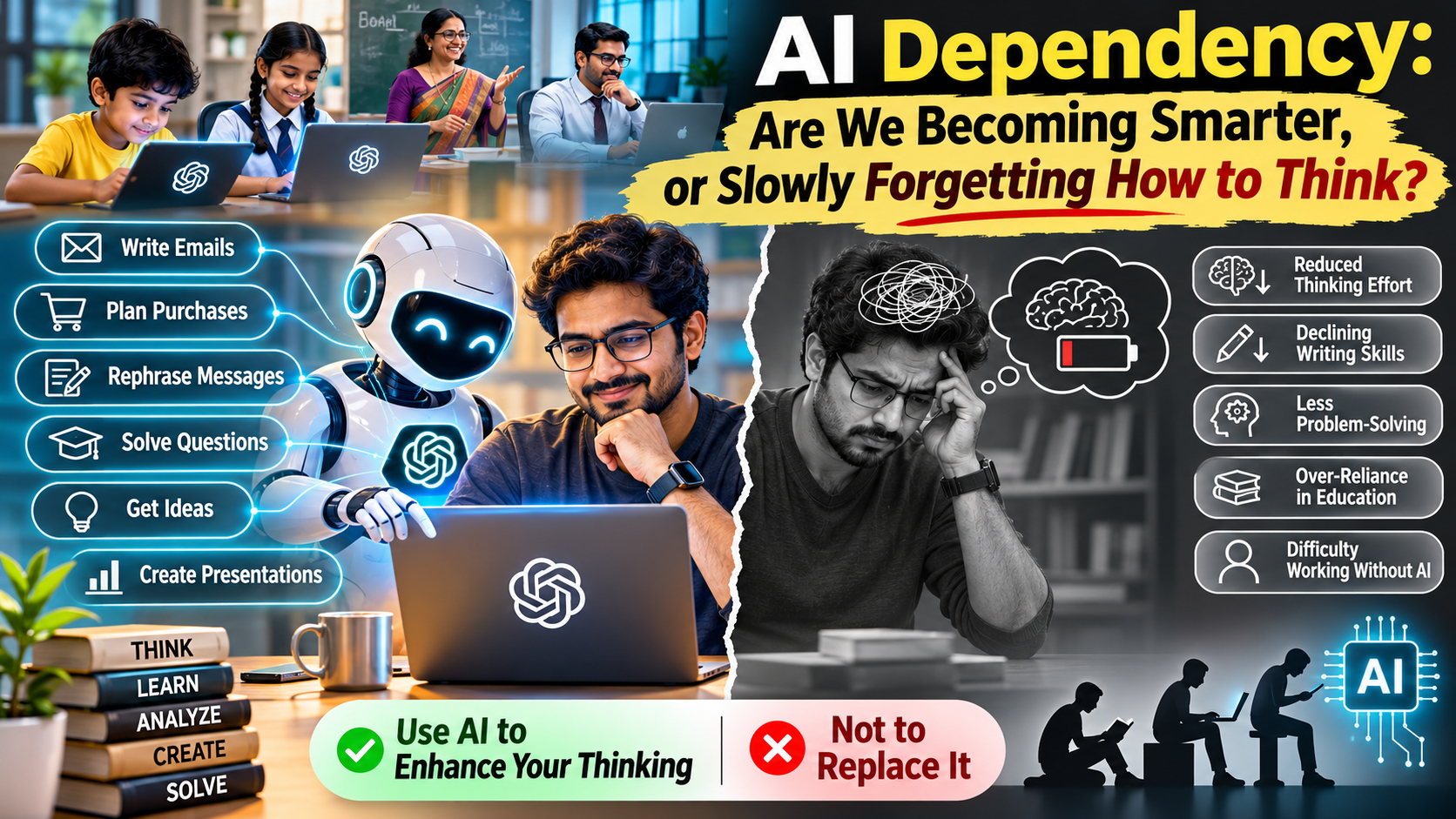
AI Dependency: Are We Becoming Smarter, or Slowly Forgetting How to Think?
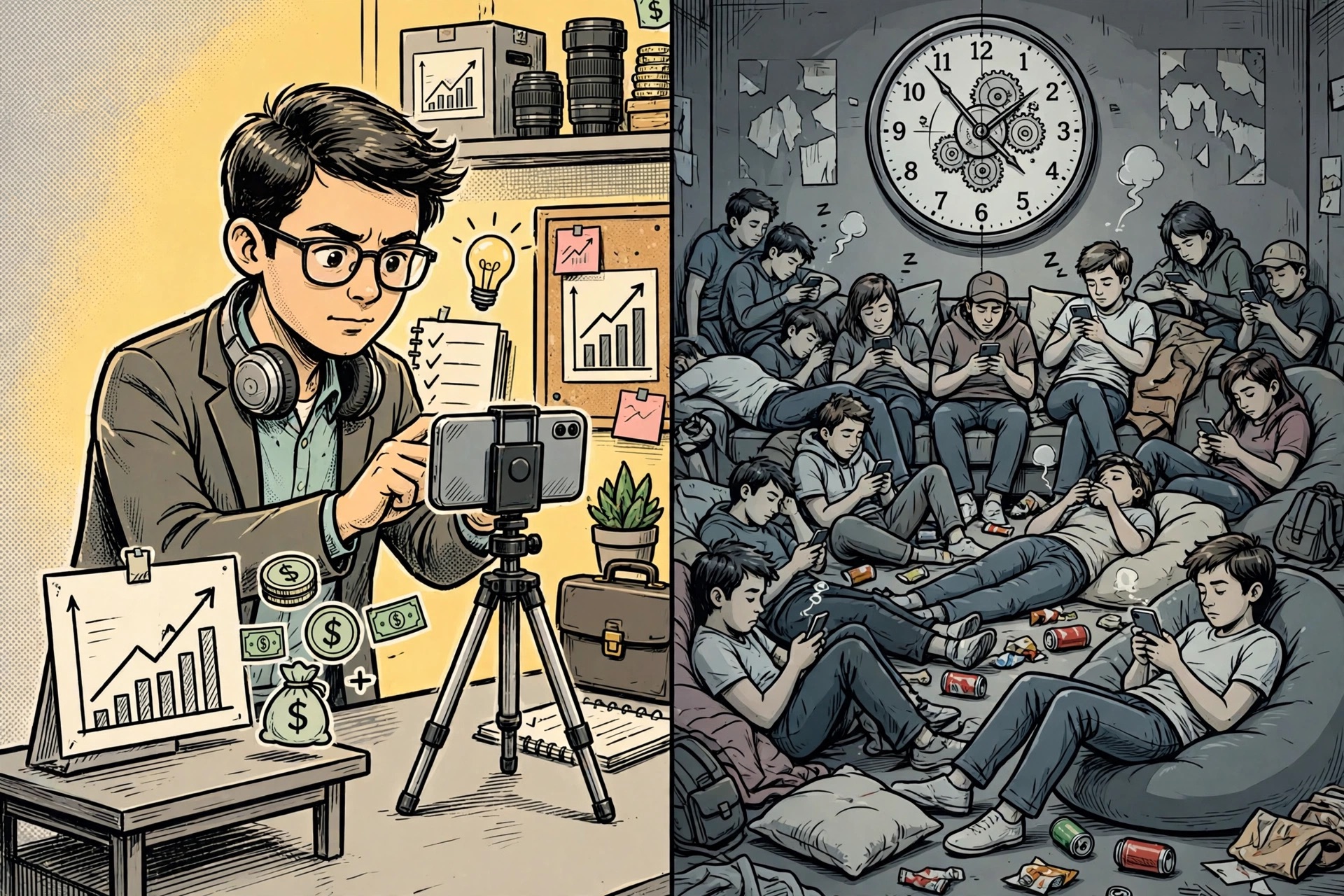
A technology that was supposed to assist our brains is slowly becoming a substitute for some of the work our minds normally do.
Something interesting, and perhaps a little worrying, is happening around us.
Today, from school-going children to senior professionals, from highly educated people to those who have just learned to operate a smartphone, almost everyone is finding ways to use Artificial Intelligence in everyday life. ChatGPT and other AI tools have quietly become part of our daily routine.
Need to write an email? Ask AI.
Want to reply to a WhatsApp message? Ask AI.
Planning to buy a mobile phone? Ask AI.
Need an explanation, a calculation, a presentation, a school assignment or even an opinion? Ask AI.
There is practically nothing we don't want to consult AI about anymore.
And I am not saying this as someone who doesn't use these tools. I use them almost every day. In fact, I have reached a stage where I sometimes feel handicapped without AI.
But recently, I started asking myself a question: Are we becoming more capable because of AI, or could we slowly be losing some of our ability to think independently?
Remember the generation before smartphones and AI?
We grew up in a completely different world.
There was no ChatGPT, no Google Maps, no smartphones and, for most people, no internet in everyday life.
If we wanted to know something, we asked someone, read a book, searched through newspapers or simply tried to figure it out ourselves.
If we wanted to write a letter, we wrote it. If we made a mistake, we corrected it. If we wanted to solve a problem, we spent time thinking about it.
We had to remember phone numbers, calculate things mentally, find directions and communicate using our own words.
We were not necessarily smarter than today's generation, but we exercised our brains differently.
Today, the moment we face a small challenge, our first instinct is often to open an AI application.
Perhaps that is convenience. But could it also reduce the opportunities we have to practise thinking and problem-solving on our own?
I am experiencing this change myself
Here is something I personally noticed.
There was a time when I could sit down and write an email, prepare a message or express my thoughts in my own words without much difficulty.
After regularly using AI for rewriting, correcting and improving my communication, I have started depending on it even for simple sentences.
Sometimes I know exactly what I want to say, but instead of writing it myself, I open ChatGPT and ask it to frame the message.
The result is usually better structured and more polished. But I have started wondering whether my own writing ability could become weaker if I do not practise it enough.
I don't think I am alone in this.
Many of us are becoming comfortable with letting AI do some of the thinking, structuring and expressing on our behalf.
We are saving time, but are we also risking the loss of some opportunities to practise these abilities ourselves?
What about our children and education?
This is where I feel the concern is much bigger.
Today's schoolchildren have access to AI tools that can solve mathematical problems, write essays, explain science, prepare assignments and answer almost any textbook question.
There is nothing wrong with using technology for learning. In fact, AI can be an excellent personal tutor.
But there is a huge difference between using AI to understand a problem and using AI to avoid thinking about it.
If a student simply copies an answer generated by AI, submits the assignment and gets marks, what has the student actually learned?
The same concern applies to teachers.
AI can help teachers prepare question papers, lesson plans and teaching material. But if teachers also start depending entirely on AI-generated content without applying their own knowledge and judgement, where does independent teaching and creativity go?
Education should not be about producing perfectly written answers. It should be about developing the ability to ask questions, analyse situations, make mistakes, find solutions and think differently.
We need to teach children how to use AI, but we must ensure that AI does not become a replacement for their thinking.
What happens if AI stops working tomorrow?
Let us imagine a situation.
Tomorrow, ChatGPT, Gemini and all other major AI tools become unavailable for a week.
No AI-assisted emails. No instant answers. No AI-generated presentations. No automatic summaries. No assistance with assignments or everyday decisions.
How many of us would comfortably return to doing these things ourselves?
How many students would be able to complete their assignments without assistance?
How many professionals would confidently prepare a report or presentation from scratch?
How many people would take their own decisions without first asking an AI tool?
I am not suggesting that the world would literally stop functioning. Humanity managed perfectly well for centuries without AI.
But such a situation could make many of us realise how much we have started outsourcing to technology.
And that should make us think.
AI is a wonderful tool, but it should remain a tool
Let me be clear. I am not against AI.
AI is one of the major technological developments of our generation. It can improve productivity, support medical research, assist education, help businesses, reduce repetitive work and make knowledge accessible to millions.
For people who struggle with language, writing or access to information, AI can be genuinely empowering.
It can help a small business owner compete with larger companies. It can help a student understand a difficult subject. It can help a professional save hours of work.
But we need to understand one fundamental difference:
Using AI to improve your thinking is progress. Using AI to avoid thinking can create dependency.
There is a difference between asking AI to review your decision and asking AI to make every decision for you.
There is a difference between asking AI to improve your writing and forgetting how to write yourself.
There is a difference between using AI as a teacher and allowing it to do all your learning.
We need to bring back independent thinking
Perhaps the solution is not to reduce AI usage completely, but to use it more intelligently.
Students should first attempt to solve problems themselves and then use AI to understand where they went wrong.
Professionals should prepare their initial thoughts before asking AI to improve their work.
Teachers should use AI as a teaching assistant, not as a substitute for their knowledge and creativity.
Parents should encourage children to read, write, calculate and solve problems independently.
All of us should occasionally challenge ourselves to complete everyday tasks without AI assistance.
Most importantly, we should learn to question AI answers rather than blindly accept everything it produces.
AI can sometimes be confidently wrong. It does not take responsibility for the decisions we make using its answers. Human judgement, experience and accountability still matter.
One final thought
I sometimes wonder whether the next generation will become exceptionally capable because they have access to AI from childhood, or whether excessive dependence on it could make some tasks more difficult without technological assistance.
I don't have a definite answer.
But I do know one thing: our ability to think, question, imagine, communicate and solve problems is what makes us human.
We spent generations developing these abilities. We should not allow convenience to make us forget them.
Technology should reduce our workload, not our willingness to think.
AI should help us become better writers, not make us forget how to write. It should help children become better learners, not turn them into copy-and-paste experts. It should help professionals make better decisions, not make decisions on their behalf.
Let AI be our assistant, not our brain. Let it be our employee, not our master.
Because the real danger is not necessarily that AI will become smarter than humans.
The real concern is that humans may stop making an effort to become smarter themselves.