"At the Mercy of Choke points: Why India Must Secure Siliguri Before Crisis Strikes"

Siliguri Corridor: From Connectivity to Strategic Resilience
By Col (Dr.) Ashwani Kumar, MiD, VSM (Retd.)
Opinion/Analysis
Recent tensions around the Strait of Hormuz and the continuing security concerns around the Bab el-Mandeb have highlighted how strategically important chokepoints can affect trade, energy supplies and wider economic stability. For India, a comparable concern exists on land in the form of the Siliguri Corridor, the narrow land link connecting the northeastern region with the rest of the country.
The experience of maritime chokepoints raises a broader strategic question for India: whether critical connectivity should be planned only for normal conditions or also for periods of disruption. The argument for greater resilience involves infrastructure redundancy, logistics preparedness, inter-agency coordination and regional connectivity.
An Internal Strategic Constraint
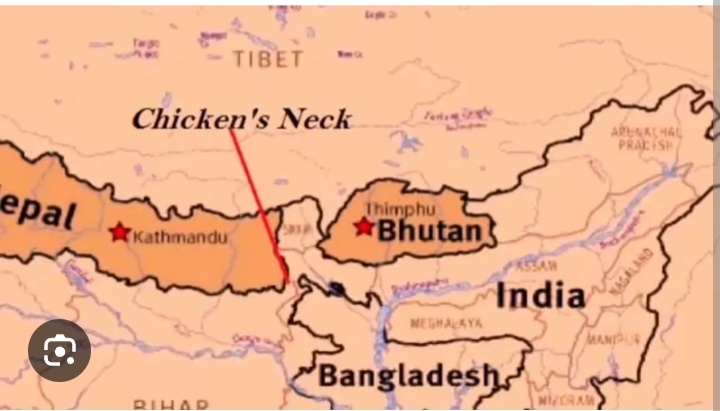
At its narrowest, the Siliguri Corridor is around 20 kilometres wide. It is bordered by Nepal, Bhutan and Bangladesh, while the Chumbi Valley in Tibet lies in the wider strategic neighbourhood. The corridor carries important road and rail links connecting mainland India with the Northeast. The Union government has previously described the Siliguri Corridor as the route through which mainland road and rail connectivity to the northeastern states passes.
This geographical configuration makes the corridor strategically important. Any major disruption caused by conflict, natural or infrastructure-related emergencies, or other security challenges could affect the movement of people, goods and essential supplies to the Northeast.
Lessons from Global Chokepoints
The Strait of Hormuz and Bab el-Mandeb illustrate the wider consequences of disruption in narrow strategic passages. Recent developments in West Asia have reduced vessel traffic through Hormuz, while security concerns have also affected shipping through the Red Sea and Bab el-Mandeb.
These developments demonstrate that concentrated dependence on a limited route can increase the economic impact of disruption. The same principle is relevant to land-based connectivity, although the nature of the risks and available responses are different.
From Connectivity to Resilience
India has expanded road, rail and other infrastructure in the Northeast in recent years. Government data also shows continued investment in connectivity projects across the region.
Connectivity and resilience, however, are not identical. Connectivity improves access during normal conditions, while resilience concerns the ability of a system to continue functioning when one route or facility is disrupted.
For the Siliguri Corridor, this suggests the need to examine alternative routes, logistical redundancy and the protection of critical infrastructure alongside continued investment in conventional connectivity.
Policy Priorities
First, alternative connectivity should be strengthened. India’s connectivity arrangements with Bangladesh provide examples of routes that can supplement existing links. The Ministry of External Affairs has noted that the Agartala–Akhaura rail link provides an alternative route to the Northeast, while several other India-Bangladesh rail links have also been operationalised.
Second, critical infrastructure should incorporate resilience. Parallel transport links, protected logistics facilities, backup communications and improved surveillance can reduce dependence on any single point of failure, subject to technical and security assessments.
Third, inter-agency coordination should remain a priority. Military, border-security and civil authorities have different responsibilities, but coordinated planning can improve the response to emergencies affecting transportation and logistics.
Fourth, logistics preparedness in the Northeast should be strengthened. Appropriate pre-positioning of essential supplies, improved mobility and adequate airlift capacity could help maintain essential services during temporary disruptions.
Fifth, developments in maritime chokepoints should be considered in India’s wider economic-security planning. Disruptions around Hormuz and Bab el-Mandeb can affect energy markets, freight costs and supply chains, making maritime security relevant to India’s broader resilience planning.
Finally, economic and digital resilience should complement physical connectivity. Diversified supply chains, strategic reserves and secure communications can reduce the consequences of disruptions affecting critical infrastructure.
An Integrated View of Security
The connection between the Siliguri Corridor, Hormuz and Bab el-Mandeb is not geographical but structural. Each involves important flows of people, goods or energy passing through routes where alternatives may be limited or more costly.
For India, this underlines the value of an integrated approach that considers infrastructure, logistics, security and regional connectivity together. The Union government has recently reviewed security and infrastructure-related issues concerning the Siliguri Corridor, indicating that the area remains part of ongoing national security planning.
The risks associated with chokepoints are not new. What has changed is the speed with which disruptions can affect interconnected economies and supply chains. The experience of maritime routes demonstrates the importance of planning for continuity before a crisis occurs.
For the Siliguri Corridor, the policy challenge is therefore to strengthen existing connectivity while developing sufficient redundancy and preparedness to manage possible disruptions. Strategic planning is most effective when it anticipates different scenarios rather than responding only after a disruption has occurred.
Author’s Note
Col (Dr.) Ashwani Kumar, MiD, VSM (Retd.), is a former Army officer who writes on national security, strategic affairs and internal security. His views in this article are presented as an opinion and analysis of strategic issues.
Disclaimer: The views expressed are those of the author and do not necessarily reflect the official policy or position of the Government of India or any affiliated organisation. Maps, images and graphics used with the article, if any, should be sourced from appropriate open-source material and clearly identified as illustrative where applicable.