BEYOND CIBIL How Bharat Can Rebuild the Lending System with Data, AI and Digital Public Infrastructure
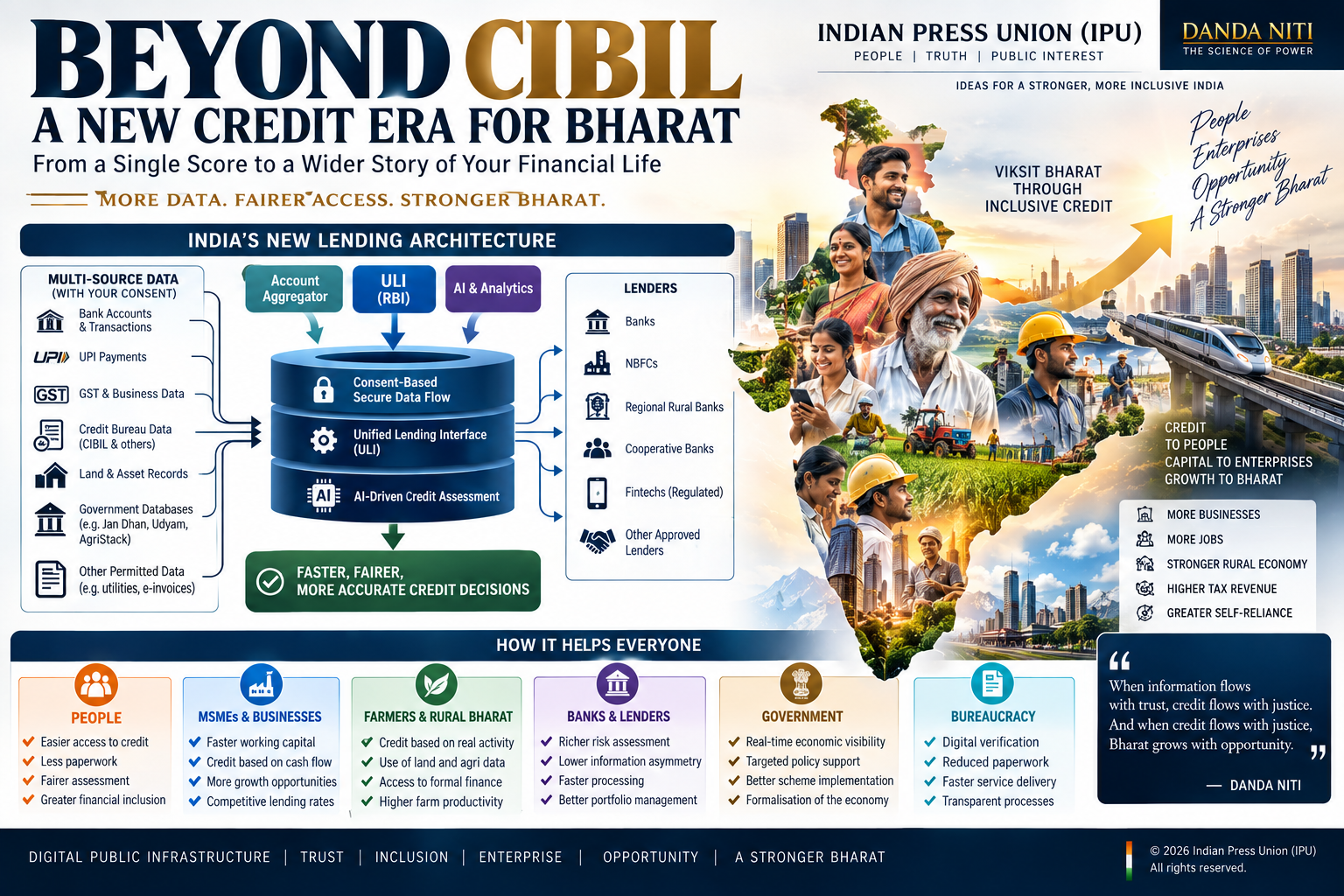
BEYOND CIBIL
How Bharat Can Rebuild the Lending System with Data, AI and Digital Public Infrastructure
By DANDA NITI | The Science of Power
For Indian Press Union (IPU)
Editorial Note: This is an original analytical article prepared for publication. It discusses the direction of India’s credit architecture based on publicly available regulatory and government material as of September 2026. It does not constitute legal, financial, banking or investment advice.
The real problem is not the absence of money. It is the absence of trusted information.
For decades, one of the central questions in Indian lending has been:
“Can this person or business repay the loan?”
But the financial system has often had a second, more difficult problem:
“How do we know?”
A salaried employee with a documented income, a long banking history and an established credit record is relatively easy to evaluate.
A farmer is different.
A small trader is different.
A first-generation entrepreneur is different.
A street-side manufacturer, a self-employed professional, a woman running a home-based enterprise, or an MSME with strong cash flows but limited formal borrowing history can be financially viable without fitting neatly into traditional credit models.
This is where Bharat’s next financial transformation could become significant.
The country is not abolishing CIBIL and the credit-bureau system is not disappearing. Rather, the architecture around credit assessment is becoming much broader.
CIBIL and other Credit Information Companies remain important. At the same time, Bharat is building an ecosystem involving Account Aggregators, Unified Lending Interface (ULI), UPI, GST-linked information, digital identity, land and asset records, alternative data, AI-based analytics and other Digital Public Infrastructure.
RBI has already moved credit reporting from monthly to fortnightly, specifically to give lenders a more current picture of borrower indebtedness and help borrowers receive faster updates after repayment. ([System Health][1])
The larger transformation is therefore not:
CIBIL → Zero CIBIL
It is:
CIBIL → One component of a much larger credit intelligence system.
And that distinction matters.
1. FROM CREDIT SCORE TO CREDIT INTELLIGENCE
The traditional lending model can be simplified as:
Borrower → Documents → Credit Bureau → Bank → Credit Decision
The emerging model can look more like:
Borrower → Consent → Verified Data → Analytics/AI → Risk Assessment → Lender → Credit
The difference is profound.
Instead of asking only:
“What was your borrowing and repayment history?”
the system can increasingly ask:
“What does the available evidence tell us about your present ability and willingness to repay?”
That evidence could include, where legally permitted and with appropriate consent and safeguards:
banking information;
cash-flow patterns;
GST information;
business transactions;
existing credit history;
verified income;
asset information;
land records;
relevant government databases;
payment behaviour;
invoice and receivable information;
sector-specific information;
and other permitted financial or non-financial datasets.
The Government has explicitly described AI-powered credit assessment as a way to move beyond conventional credit-scoring models, particularly for MSMEs, informal workers and first-time borrowers. ([Press Information Bureau][2])
That does not mean every piece of available data should be used.
It means the right data, for the right purpose, with the right consent and safeguards, can reduce the information gap between borrower and lender.
2. THE FOUR ENGINES OF THE NEW CREDIT SYSTEM
Bharat's emerging architecture can be understood through four major engines.
Engine 1: Credit history
This remains important.
CIBIL, Experian, Equifax and CRIF High Mark continue to form part of the formal credit-information ecosystem.
Credit history answers an important question:
How has this borrower behaved with credit?
It should not, however, be confused with the entirety of a borrower's financial identity.
Engine 2: Account Aggregator
The Account Aggregator framework introduces something extremely important:
consent-based financial data portability.
A customer can authorise financial information to be shared between participating institutions for a specified purpose. The framework is explicitly designed around consent rather than unrestricted access to financial information. ([Department of Financial Services][3])
As of March 31, 2026, the Department of Financial Services reported:
179 Financial Information Providers live;
989 Financial Information Users live;
more than 2.88 billion financial accounts enabled for data sharing;
284.6 million accounts linked by users.
([Department of Financial Services][3])
This is potentially transformative because documentation can increasingly become data-driven verification rather than paperwork-driven verification.
Engine 3: Unified Lending Interface
ULI is perhaps the most important piece of the emerging lending infrastructure.
RBI describes ULI as an open architecture platform connecting lenders and data-service providers through standardised APIs and a plug-and-play model. Its purpose is to reduce multiple bilateral integrations and streamline credit assessment. ([Reserve Bank of India][4])
Government information reported that, by December 12, 2025, 64 lenders — 41 banks and 23 NBFCs — were onboarded, using more than 136 data services across 12 loan journeys. The expansion includes Regional Rural Banks and District Central Cooperative Banks. ([Press Information Bureau][5])
This is important.
The challenge in Indian lending has never simply been:
“Do we have data?”
India increasingly has enormous amounts of data.
The challenge has been:
“Can the lender access the relevant data quickly, lawfully, securely and in a standardised form?”
ULI is designed to attack precisely that problem.
Engine 4: AI and analytical underwriting
Data alone does not make a lending system intelligent.
Someone has to interpret it.
This is where AI and advanced analytics can potentially change underwriting.
For example, two businesses may both have a CIBIL score of 720.
But one may have:
stable monthly collections;
predictable receivables;
consistent GST filings;
strong bank balances;
low leverage;
and regular supplier payments.
The other may have:
volatile cash flows;
declining sales;
high short-term borrowing;
delayed receivables;
and increasing financial stress.
A single score cannot adequately express the entire difference.
A richer underwriting model potentially can.
But AI should support credit judgment, not become an unaccountable black box.
That distinction will become increasingly important.
3. WHAT DOES THIS MEAN FOR THE COMMON MAN?
For an individual borrower, the biggest potential change is the movement from document-heavy lending to evidence-based lending.
Imagine a young entrepreneur who has never taken a substantial bank loan.
Under an older model:
No significant credit history → weak underwriting signal → higher uncertainty → more documentation → slower decision.
Under a mature data-driven system:
Verified financial activity + cash flow + business information + repayment behaviour + permitted alternative data → richer risk assessment.
That could help create a new category:
“New-to-credit” should not automatically mean “high-risk.”
A person may have little formal borrowing history but still have a strong economic history.
That distinction can matter enormously for:
young entrepreneurs;
first-time home or business borrowers;
self-employed professionals;
rural entrepreneurs;
small traders;
women-led businesses;
gig and platform workers;
micro enterprises.
The objective should not be to give everyone credit.
It should be to make credit decisions more accurately reflect genuine creditworthiness.
4. THE BIGGEST BENEFICIARY COULD BE THE MSME
This is where the transformation becomes economically important.
For a large corporation, financial information is relatively structured.
For a micro or small enterprise, the entrepreneur may be simultaneously:
owner;
accountant;
salesperson;
procurement manager;
operations head;
collections officer.
The business may be healthy, but its financial information may be scattered across multiple systems.
The MSME may have:
GST + UPI + bank transactions + invoices + digital payments + inventory + receivables + credit history
but the lender may not see the complete picture efficiently.
That creates an information asymmetry.
The emerging digital architecture can potentially convert fragmented information into a structured credit profile.
This matters because MSME credit is not merely a banking issue.
It is a production issue.
More working capital can mean:
more inventory → more sales → more production → more employment → more tax revenue → more investment.
RBI has reported continued growth in bank credit to MSMEs; outstanding scheduled-commercial-bank credit to MSMEs increased 14.8% year-on-year during 2024-25. ([Reserve Bank of India][6])
The next question is not simply how much credit India provides.
It is:
Can India deliver the right credit, to the right enterprise, at the right time and at a risk-adjusted price?
5. THE FARMER COULD MOVE FROM “COLLATERAL” TO “CASH-FLOW”
Agricultural lending presents an even more complicated challenge.
A farmer's economic strength may be reflected through:
landholding;
crop patterns;
irrigation;
historical production;
mandi transactions;
warehouse receipts;
crop insurance;
input purchases;
bank transactions;
weather information;
satellite-derived information;
and other legally usable datasets.
ULI already contemplates access to multiple financial and non-financial data sources, including land records and satellite-related services. ([Press Information Bureau][2])
The strategic opportunity is therefore to move progressively from:
“Show me collateral.”
toward:
“Show me verified economic capacity and repayment capacity.”
Collateral will remain relevant for many forms of lending.
But better information can potentially reduce the extent to which lack of conventional collateral becomes a proxy for lack of creditworthiness.
That distinction could be particularly important for rural Bharat.
6. WHAT HAPPENS TO BANKS?
The transformation is not anti-bank.
It can actually make banking more sophisticated.
Today, a loan officer can spend significant time collecting documents, verifying information, reconciling statements and assessing applications.
A connected digital architecture can increasingly automate parts of that process.
The bank can then concentrate more on:
risk management;
customer relationships;
portfolio management;
sector expertise;
exception handling;
monitoring;
and responsible lending.
The branch does not necessarily disappear.
Its role can evolve.
From:
“document collection centre”
to:
“financial advisory and relationship centre.”
That is a fundamentally different banking model.
7. WHAT HAPPENS TO BUREAUCRACY?
This is one of the most interesting consequences.
A significant amount of administrative friction exists because institutions repeatedly ask citizens and businesses for information that may already exist somewhere within the government or regulated financial ecosystem.
The long-term objective should be:
Ask once. Verify digitally. Use lawfully. Do not repeatedly demand the same paper.
JanSamarth already demonstrates the direction of travel by integrating multiple datasets and schemes, including Aadhaar, PAN, income information, bureau data, Udyam, GST, AgriStack and other sources for credit-linked government programmes. ([Department of Financial Services][7])
The opportunity is to take this principle much further.
Instead of:
Citizen → Form → Office → Certificate → Bank → Verification → More documents
the future could increasingly become:
Citizen → Consent → Digital verification → Decision → Audit trail
That can reduce:
processing time;
paperwork;
duplication;
manual verification;
administrative burden;
and opportunities for arbitrary delays.
But digitisation should not simply reproduce bureaucracy on a computer screen.
The process itself must be redesigned.
8. THE GOVERNMENT GAINS SOMETHING EVEN MORE VALUABLE: REAL-TIME ECONOMIC VISIBILITY
A modern credit architecture can potentially become an economic intelligence layer.
Government can better understand:
where credit is flowing;
which sectors are expanding;
which districts are underserved;
where MSMEs face financing constraints;
where agricultural credit is weak;
where businesses are becoming overleveraged;
where government schemes are underutilised;
and where interventions are actually producing results.
That could move policymaking from:
“How much money did we allocate?”
to:
“What happened after the money reached the economy?”
This is a major change in governance.
9. THE REAL BOTTLENECKS HAVE NOT DISAPPEARED
Technology does not automatically solve lending.
India still has several bottlenecks.
Bottleneck 1: Fragmented data
Data may exist but remain distributed across institutions.
Solution: standardised APIs and interoperable architecture.
Bottleneck 2: Poor data quality
Bad data can produce bad credit decisions.
Solution: data-quality standards, validation, reconciliation and borrower correction mechanisms.
Bottleneck 3: Credit history bias
A thin credit file can be mistaken for financial weakness.
Solution: use credit history alongside verified alternative indicators rather than treating one score as the entire borrower identity.
Bottleneck 4: Slow underwriting
Traditional documentation and manual verification can delay disbursement.
Solution: consent-based digital verification and automated workflows.
Bottleneck 5: Collateral dependence
Businesses without conventional collateral may struggle despite viable cash flows.
Solution: better cash-flow and risk assessment, combined with appropriate guarantee mechanisms where applicable.
Bottleneck 6: Fear of NPAs
Banks are naturally concerned about asset quality.
The answer is not to tell banks to lend recklessly.
The answer is:
better information + better risk models + better monitoring.
Bottleneck 7: Regulatory fragmentation
Different institutions may use different systems and processes.
Solution: interoperable public infrastructure and common standards while preserving the legal mandates and responsibilities of each institution.
Bottleneck 8: Privacy
More data creates greater responsibility.
India's Digital Personal Data Protection Act establishes obligations around personal-data processing and grievance mechanisms, while RBI's digital-lending framework also requires need-based data collection, explicit consent and safeguards around data use. ([MeitY][8])
Therefore:
A data-rich credit system must also become a rights-conscious credit system.
10. THE NEXT STEP: A “CREDIT STACK” FOR BHARAT
The long-term architecture could be visualised as:
IDENTITY
↓
CONSENT
↓
FINANCIAL DATA
↓
CREDIT HISTORY
↓
BUSINESS / ECONOMIC DATA
↓
ASSET & VERIFICATION DATA
↓
AI / RISK ANALYTICS
↓
LENDER
↓
CREDIT DECISION
↓
MONITORING
↓
UPDATED CREDIT HISTORY
This creates something very powerful:
A continuous credit-information loop.
Today, credit assessment is often heavily concentrated at the moment of loan application.
Tomorrow, creditworthiness could increasingly become a dynamic financial profile.
Not a permanent label.
Not a single number.
A continuously updated picture.
11. BUT THERE IS ONE LINE INDIA MUST NOT CROSS
The biggest danger in the new system is not technology.
It is unaccountable technology.
If an AI model rejects a loan, the borrower should not simply hear:
“The system rejected your application.”
There must be meaningful governance around:
what categories of data were used;
whether the data was accurate;
whether the borrower consented;
whether the decision can be challenged;
how errors are corrected;
whether discriminatory variables or inappropriate proxies are influencing the outcome;
and who is accountable for the final credit decision.
The goal must therefore be:
AI-assisted lending, not AI-unaccountable lending.
12. FROM CIBIL SCORE TO “BHARAT CREDIT IDENTITY”
The ultimate opportunity is much larger than replacing one credit score.
It is to create an ecosystem where an individual's or enterprise's verified economic behaviour becomes portable across the financial system, subject to consent, law and safeguards.
A good borrower should not have to repeatedly prove the same facts to ten different institutions.
A good MSME should not have to rebuild its financial identity every time it approaches a new lender.
A farmer should not be invisible to formal finance simply because traditional credit records do not fully capture his economic activity.
And a first-time entrepreneur should not automatically be treated as an unknown quantity.
The system should progressively move toward:
“Unknown borrower” → “Verified economic identity.”
That is a much bigger transformation than a change in credit scoring.
13. WHAT THIS COULD MEAN FOR BHARAT
If implemented responsibly, the architecture can create a virtuous cycle:
More verified data
→ better underwriting
→ faster credit
→ lower information costs
→ potentially better risk pricing
→ greater formalisation
→ stronger MSMEs
→ more investment
→ more employment
→ broader tax base
→ deeper financial markets
→ stronger economic growth.
This is why lending infrastructure is not merely a banking reform.
It is economic infrastructure.
UPI transformed how money moves.
The Account Aggregator framework is transforming how financial information can move with consent.
ULI is designed to transform how credit information can connect lenders and data providers.
The next phase is to make these systems work together intelligently.
14. THE STRATEGIC QUESTION FOR BHARAT
The question is no longer:
“Can we build another lending app?”
Bharat already has thousands of financial applications.
The bigger question is:
“Can Bharat build the operating architecture for trusted, intelligent and inclusive credit?”
That means connecting:
Identity + Consent + Data + Payments + Credit + AI + Risk Management + Government Infrastructure
into an ecosystem.
And the objective should be very clear:
Not more loans.
Better lending.
Not lending without risk.
Better measurement of risk.
Not removing banks.
Making banks more capable.
Not eliminating CIBIL.
Making credit history one part of a richer financial identity.
Not replacing human judgment.
Making human judgment more informed.
THE DANDA NITI VIEW
Power in the modern economy does not belong only to those who possess capital.
It increasingly belongs to those who can organise information, reduce uncertainty and allocate capital intelligently.
Bharat has already built extraordinary infrastructure for identity and payments.
The next frontier is credit.
If Bharat can combine its digital public infrastructure with responsible AI, consent-based data sharing, robust credit information, strong privacy protections and accountable lending, it can address one of the oldest problems in finance:
the distance between a person who needs capital and an institution willing to provide it.
The objective should be simple:
Make the deserving borrower more visible.
Make the risky borrower more accurately identifiable.
Make the good business easier to finance.
Make the lending decision faster without making it careless.
Make government intervention more targeted.
Make bureaucracy smaller through interoperability.
And above all:
Move Bharat from a system of “prove everything again” to a system of “verify once, with consent, and use responsibly.”
That is not the end of CIBIL.
It is the beginning of something much larger.
A Bharat where creditworthiness is increasingly understood as a living economic profile—not merely a number on a report.
Sources & regulatory basis
RBI — frequency of credit-information reporting increased from monthly to fortnightly, effective January 1, 2025. ([System Health][1])
Department of Financial Services — Account Aggregator framework and March 31, 2026 ecosystem statistics. ([Department of Financial Services][3])
RBI — ULI development and architecture. ([Reserve Bank of India][4])
Government of India — ULI adoption, alternative-data/AI lending and expansion toward rural/cooperative institutions. ([Press Information Bureau][5])
Department of Financial Services — JanSamarth and its multi-source credit infrastructure. ([Department of Financial Services][7])
RBI — digital-lending data-consent and borrower-protection requirements. ([System Health][9])
Government of India — Digital Personal Data Protection Act, 2023. ([MeitY][8])
© 2026 Indian Press Union / DANDA NITI editorial. All rights reserved.
Original editorial content. No part of this article may be reproduced, republished, adapted, distributed, translated, or commercially exploited, in whole or in part, without prior written permission of the rights holder, except where permitted under applicable law.
DANDA NITI | The Science of Power
Published for Indian Press Union (IPU)