
'Chest-thumping machismo': The Bayeux Tapestry reveals the bloody, bawdy truth about the Middle Ages
Bayeux Tapestry: A Medieval Story of Power, Politics and the Role of Women
The Bayeux Tapestry, an 11th-Century masterpiece depicting the Norman conquest of England, is returning from Normandy, France, to England, where it is set to be exhibited at the British Museum.
The intricate artwork is embroidered onto around 70 metres (77 yards) of flax linen and tells a dramatic story of broken promises, political ambition and conflict that culminates in the death of King Harold II at the Battle of Hastings.
Created in the 1070s, the tapestry provides a remarkable insight into medieval society and the ways in which power, military strength and political legitimacy were represented through art.
A Story Focused on Power
A large part of the tapestry's central narrative focuses on men and their roles in medieval political and military life. Soldiers, hunters, builders and labourers appear throughout the artwork, helping to create a picture of a society preparing for conflict.
The rivalry between William, Duke of Normandy, and Harold Godwinson forms the central political conflict. Their competing claims to the English throne eventually lead to the Norman invasion and the Battle of Hastings.
Dr Christopher Monk, a cultural historian of medieval England, has described the imagery as strongly reflecting the military and masculine culture of the period.
The Significance of the Artwork
Within the artistic traditions of the 11th Century, scenes that might appear unusual to modern audiences were part of the visual language of medieval embroidery and manuscript art.
According to Monk, the imagery reflects a society in which men were generally the principal actors in questions of political authority and military power. The tapestry therefore provides an important visual record of how sovereignty and legitimacy were understood at the time.
Women play a smaller role in the central narrative, largely because the story concentrates on political decisions, military campaigns and battles.
The Role of Women
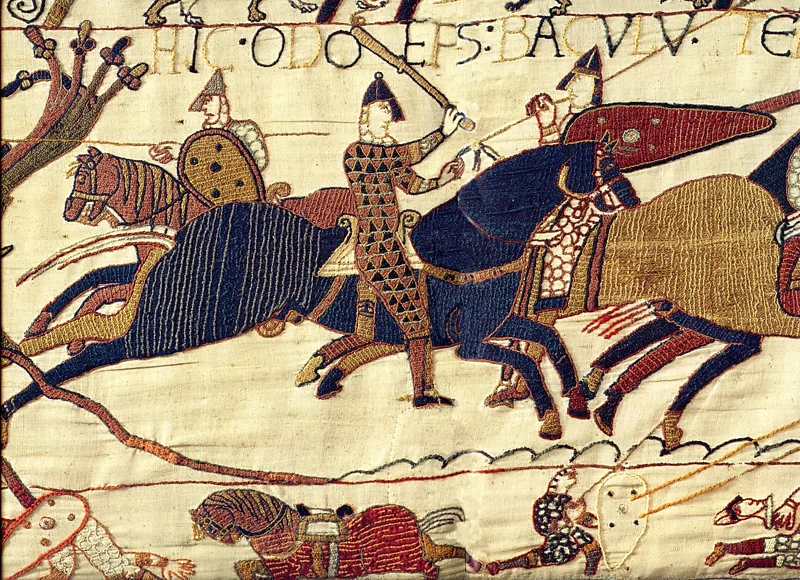
Historians believe the tapestry may have been commissioned by Bishop Odo of Bayeux, William's half-brother, who appears prominently in the artwork. Its intended audience may therefore have been closely connected to the Norman political elite.
Dr Emily Joan Ward, a lecturer in medieval history at Edinburgh University, notes that the limited presence of women may also reflect the political purpose of the work and its focus on male figures involved in the Norman campaign.
Nevertheless, the women who do appear in the central scenes can be significant. Queen Edith, for example, is shown mourning Edward the Confessor, while another scene depicts a woman and child fleeing as Norman soldiers set fire to their home.
These scenes offer a reminder that warfare affected civilians as well as those directly involved in battle.
Women in the Decorative Borders
The tapestry's upper and lower borders contain a variety of additional figures and scenes, some of which appear to offer symbolic or humorous commentary on the central narrative.
Historians have suggested that some of these scenes may relate to fables and stories that provide a contrast to the main account of the Norman conquest.
The identity and meaning of some figures remain uncertain, including a mysterious woman named Aelfgyva. Scholars have proposed several interpretations of the scene involving her, but there is no universally accepted explanation.
David Musgrove, co-author of The Story of the Bayeux Tapestry, has suggested that the scene may contain a commentary on inappropriate behaviour and power relations. Other historians have interpreted it differently, demonstrating how much remains open to debate.
Who Created the Tapestry?
Although the tapestry is closely associated with Norman political history, historians have long discussed the identities of the people who actually embroidered it.
It is possible that women played a major role in producing the artwork. Monk argues that the embroiderers may have worked from an established design while still having some freedom in how particular details were executed.
This possibility has encouraged historians to look beyond the political figures depicted in the tapestry and consider the skilled labour of the people who created it.
A Victorian Interpretation
A later replica produced in 1885 by members of the Leek Embroidery Society provides another perspective on the artwork. The replica, now displayed at Reading Museum, was created by a group of 35 women.
The Victorian version largely follows the original composition while reflecting the social and artistic sensibilities of its own period.
Importantly, the embroiderers added a border identifying themselves by name, giving greater visibility to the women who created the replica.
Historian Janina Ramirez has argued that discussions of the Bayeux Tapestry should pay greater attention to the women responsible for producing such an important work of art.
A Window Into Medieval Society
The Bayeux Tapestry remains valuable not only as a record of the Norman conquest but also as a window into medieval ideas about power, politics, warfare and society.
As the historic artwork returns to England for exhibition, it offers an opportunity to reconsider both the political story it tells and the often-overlooked people whose skills brought that story to life.